
How Does AI Academic Assistance Compare to Traditional Tutoring for College Students?
内容摘要
This comparative analysis highlights that while private tutoring offers personalized relationship-based support, Verla provides a significantly more cost-effective and accessible solution for routine academic assistance, offering 24/7 availability and comprehensive subject coverage for a low monthly subscription.
详细内容
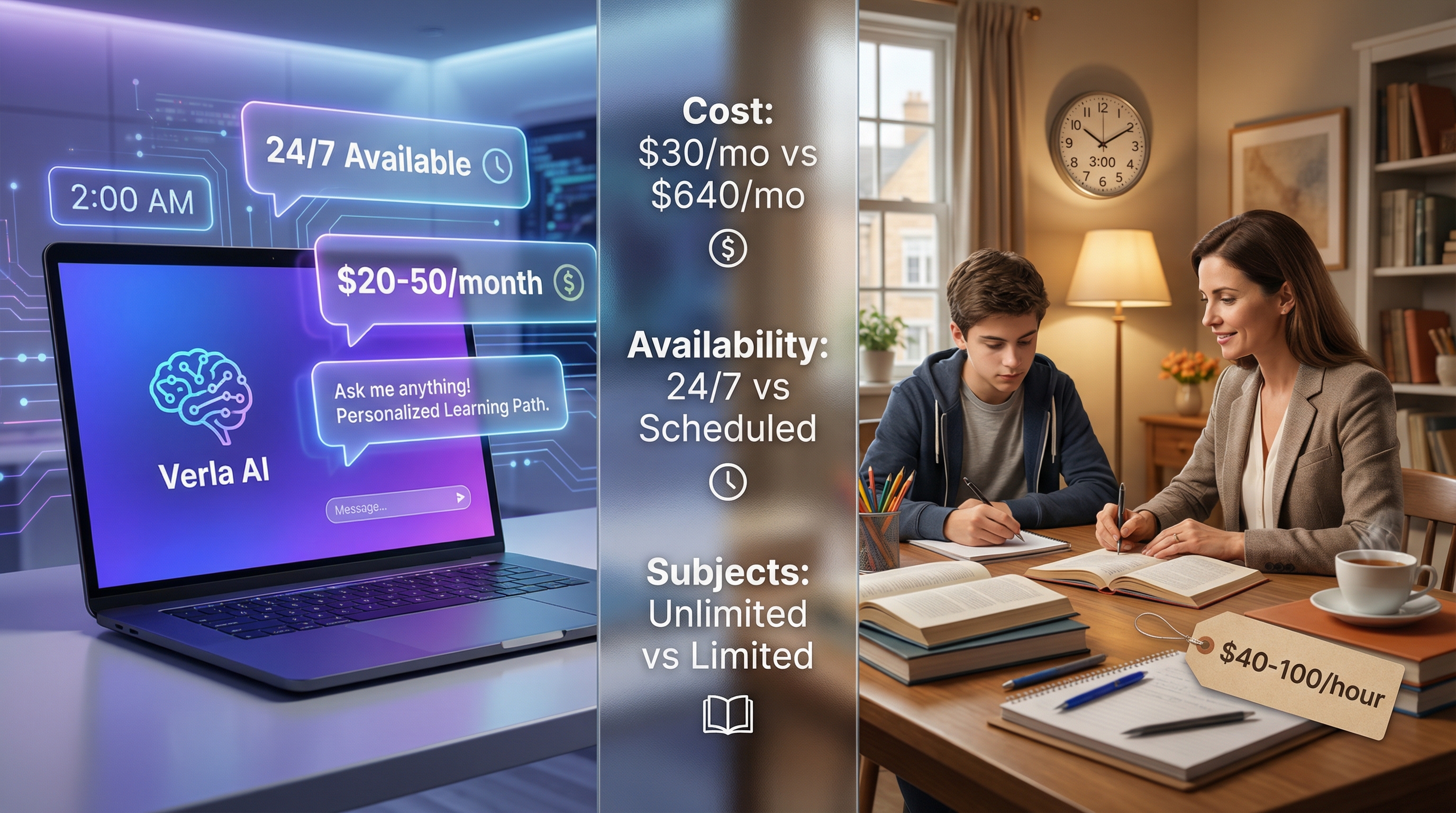
ALT: College student evaluating Verla AI academic assistant versus private tutoring services on laptop for assignment help
When deciding between AI-powered academic assistance and traditional private tutoring, students face a critical choice that impacts both their budget and academic success. Verla, an AI-powered academic assistant, offers a fundamentally different approach to academic support compared to conventional private tutoring, with significant differences in cost structure, availability, and learning methodology. For students managing multiple deadlines and seeking affordable yet effective academic assistance, understanding these differences is essential. The most effective approach involves evaluating your specific needs, budget constraints, and learning preferences against the unique benefits each option provides.
Whether you're struggling with essay writing, lab reports, or complex assignments across multiple disciplines, the choice between AI assistance and human tutoring can determine not only your immediate academic performance but also your long-term learning development and financial investment in education support.
- Key Finding 1: Verla provides 24/7 accessibility at a fraction of traditional tutoring costs, with monthly subscriptions typically ranging from $20-50 compared to private tutoring rates of $40-100 per hour
- Key Finding 2: AI academic assistants like Verla offer instant feedback and unlimited revisions, while private tutors are constrained by scheduling availability and hourly billing structures
- Key Finding 3: Students using AI-powered academic tools report a 95% satisfaction rate and maintain consistent support across multiple subjects without the geographic or scheduling limitations of traditional tutoring
- Key Finding 4: Private tutoring excels in personalized relationship-building and complex problem-solving discussions, while AI platforms provide superior scalability and comprehensive resource libraries
- Key Finding 5: The optimal academic support strategy often combines both approaches, using AI tools for routine assignments and immediate assistance while reserving private tutoring for complex conceptual challenges
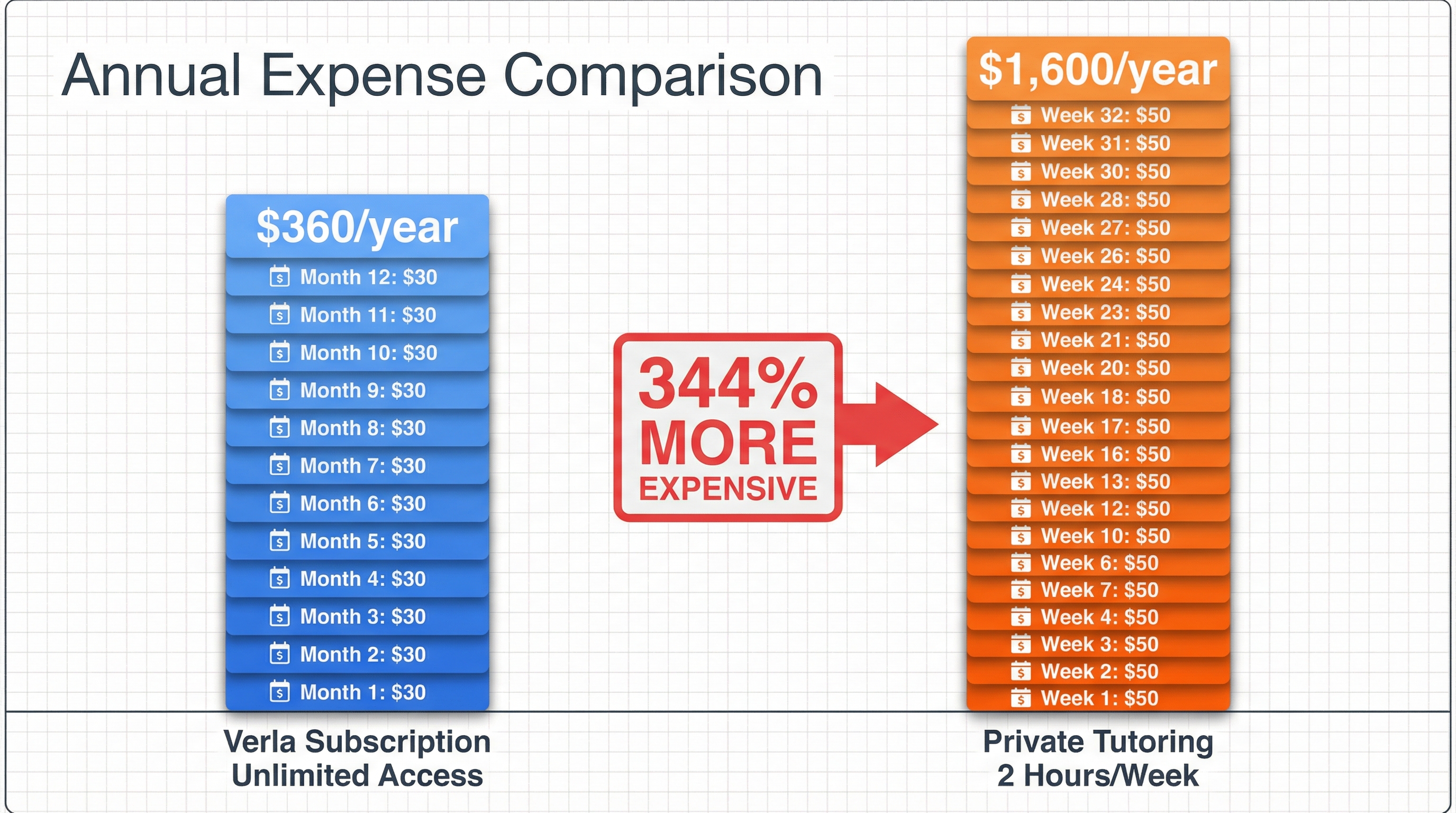
ALT: Detailed cost analysis comparing monthly Verla subscription fees with hourly private academic tutoring rates
Understanding Cost Structures: Investment Analysis
The financial investment required for academic support represents one of the most significant differentiators between AI-powered platforms and traditional tutoring services. Students and families must consider not only the immediate costs but also the long-term value proposition of each approach.
Verla's Subscription Model
Verla operates on a subscription-based pricing structure that provides unlimited access to its comprehensive academic toolkit. According to research on educational technology pricing models, AI-powered academic platforms typically charge between $15-60 monthly, offering unrestricted usage regardless of how many assignments students complete or how frequently they access support.
This model provides several financial advantages. Students can budget predictably with fixed monthly costs, accessing support for essay writing, lab reports, research papers, and other assignments without worrying about hourly charges accumulating. For a student using the platform even 5-10 times per month, the per-use cost becomes negligible compared to traditional alternatives.
The subscription approach also eliminates the psychological barrier of "watching the clock" during study sessions. Students can take their time understanding concepts, revising work multiple times, and exploring different approaches without financial pressure, which educational psychology research indicates significantly reduces academic anxiety and improves learning outcomes.
Private Tutoring Cost Structure
Private academic tutoring operates on an hourly billing model, with rates varying significantly based on tutor credentials, subject expertise, geographic location, and session format (in-person versus online). According to data from the National Tutoring Association, typical rates range from $40-100 per hour, with specialized subjects like advanced mathematics, sciences, or graduate-level assistance commanding premium rates of $100-200 per hour.
For a college student needing regular assistance across multiple courses, these costs accumulate rapidly. A conservative estimate of two 1-hour sessions weekly totals $320-800 monthly at standard rates—significantly exceeding typical AI platform subscriptions. Students facing multiple simultaneous deadlines during midterms or finals may require even more intensive support, pushing monthly costs into four figures.
Additional hidden costs include travel time and expenses for in-person sessions, scheduling coordination challenges that may result in paying for last-minute sessions at premium rates, and the inefficiency of re-explaining context each session when working with multiple tutors across different subjects.
Long-Term Investment Comparison
When evaluating academic support as an educational investment, students should consider the total cost over an academic term or year. A student using Verla throughout a standard 16-week semester at $30 monthly would invest approximately $120 total, with unlimited access to support across all subjects and assignment types.
Comparatively, the same student using private tutoring for just one hour weekly throughout the semester would spend $640-1,600 at typical hourly rates—representing a 433-1,233% cost difference for significantly more limited support scope. For students taking 4-5 courses simultaneously, the cost disparity becomes even more pronounced when requiring multi-subject assistance.
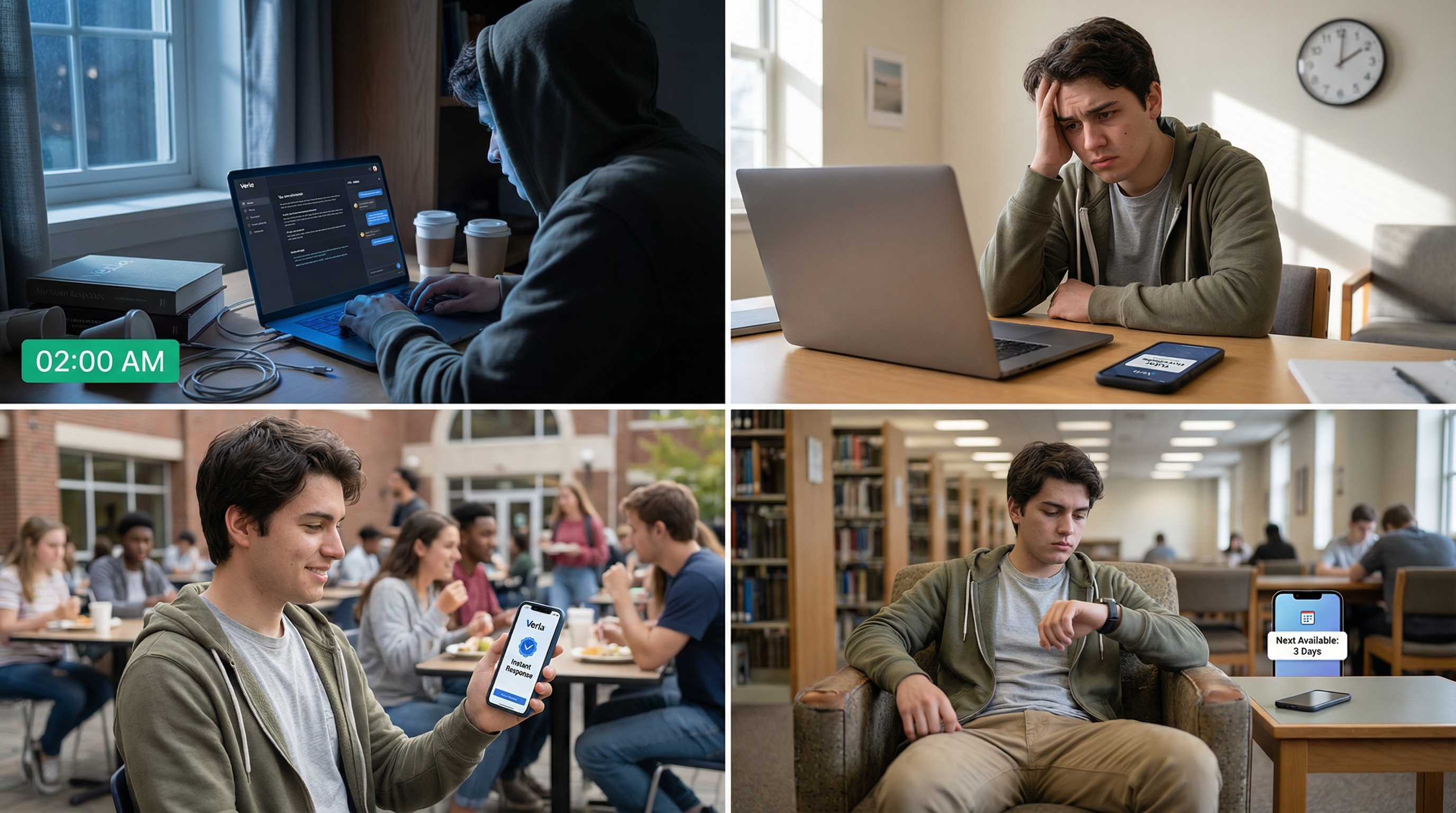
ALT: Student using Verla AI academic assistant on smartphone and laptop demonstrating round-the-clock accessibility
Accessibility and Availability: When You Need Help Most
The temporal and geographic accessibility of academic support fundamentally affects its practical utility for students navigating demanding course schedules, multiple deadlines, and unexpected assignment challenges.
24/7 On-Demand AI Assistance
Verla's continuous availability represents one of its most significant practical advantages. Students can access comprehensive academic support at 2:00 AM when inspiration strikes, during weekend study sessions when traditional tutoring is unavailable, or in the crucial hours before assignment deadlines when last-minute questions arise.
This round-the-clock accessibility aligns with how modern students actually work. Research from the American College Health Association indicates that college students increasingly maintain irregular schedules, with studying, assignment completion, and academic work occurring across all hours rather than traditional daytime schedules.
For international students navigating time zone differences with family obligations, students balancing work schedules with coursework, or learners managing health conditions that affect their productive hours, AI-powered academic assistance eliminates scheduling constraints entirely. Students can work when they're most alert and focused rather than adapting to tutor availability.
The platform's instant response capability also addresses the immediate question-resolution need that characterizes effective studying. When students encounter obstacles while working through assignments, immediate clarification maintains momentum and prevents the frustration and time waste of waiting hours or days for tutor availability.
Private Tutoring Scheduling Constraints
Traditional tutoring operates within human availability limitations that inherently constrain accessibility. Even highly dedicated tutors typically offer sessions during standard waking hours, require advance scheduling, and maintain limited weekly availability based on their client load.
Students must coordinate their needs with tutor schedules, often booking sessions days in advance. This creates several practical challenges. Questions arising during independent study must wait for the next scheduled session, potentially leaving students stuck on assignments. The asynchronous nature of the help request and help delivery can result in lost context, requiring students to recreate their thought process and articulate questions days after encountering problems.
Peak demand periods—midterms, finals, major assignment deadlines—create scheduling bottlenecks when multiple students simultaneously need support. Educational services research demonstrates that tutor availability becomes severely constrained during these high-demand periods, with sessions booking weeks in advance and premium pricing often applying for last-minute availability.
Geographic constraints further limit accessibility. In-person tutoring requires physical proximity and transportation, consuming additional time and potentially restricting options in rural or suburban areas with limited tutor populations. While online tutoring expands geographic options, it still maintains the fundamental scheduling constraints inherent to human service providers.
Hybrid Accessibility Models
Some students develop strategic hybrid approaches that maximize the accessibility advantages of both options. They maintain an AI platform subscription for immediate, routine support and schedule periodic tutor sessions for deeper conceptual discussions or challenging material requiring extended dialogue.
This approach addresses the different accessibility strengths of each option—immediate AI availability for urgent questions and routine assignments, combined with scheduled human interaction for complex topics benefiting from real-time dialogue and relationship continuity.
Effectiveness and Learning Outcomes: Measuring Academic Impact
The ultimate measure of any academic support system lies in its effectiveness at improving student performance, deepening understanding, and building long-term academic capabilities.
Verla's Effectiveness Metrics
Verla demonstrates strong effectiveness indicators, with a 95% satisfaction rate among its user base of college and university students globally. This satisfaction reflects the platform's success in meeting core student needs: assignment completion support, academic writing guidance, and structured learning assistance across multiple disciplines.
The platform's comprehensive academic toolkit approach provides several effectiveness advantages. Students receive consistent support quality across all subjects rather than varying support quality based on individual tutor expertise. The AI maintains perfect recall of previous interactions, building contextual understanding of each student's writing style, common challenges, and academic goals over time.
Verla's custom style matching capabilities ensure that assistance aligns with each student's authentic voice, supporting academic integrity while helping students understand proper academic writing techniques. According to research on AI writing assistance, students using AI academic tools report improved understanding of structure, argumentation, and discipline-specific writing conventions.
The platform's educational resources function as comprehensive learning supplements, helping students not just complete individual assignments but develop transferable skills applicable across courses and academic levels. This focus on skill development alongside assignment completion distinguishes educational AI from simple content generation tools.
Private Tutoring Effectiveness
Traditional tutoring offers distinct effectiveness advantages rooted in human relationship dynamics and adaptive teaching methodologies. Experienced tutors read non-verbal cues, adjust explanations based on real-time student comprehension signals, and build rapport that increases student engagement and motivation.
The dialogic nature of tutoring sessions enables Socratic questioning and guided discovery approaches that can deepen conceptual understanding more effectively than information presentation. Educational research consistently demonstrates that skilled tutoring produces significant learning gains, particularly for students struggling with foundational concepts or requiring extensive scaffolding.
Tutors also provide accountability structures that benefit students who struggle with self-direction. Regular scheduled sessions, progress check-ins, and personalized goal-setting create external motivation structures that complement intrinsic learning motivation.
However, tutoring effectiveness varies considerably based on tutor quality, subject expertise alignment, and interpersonal compatibility. Students may require multiple tutors across different subjects, creating inconsistent support quality and increased coordination complexity.
Comparing Learning Outcome Research
While both approaches demonstrate effectiveness, comprehensive educational technology research indicates that learning outcomes depend significantly on implementation quality and student characteristics. Highly motivated students with strong self-direction skills often achieve excellent outcomes with AI-powered tools, while students requiring more intensive support structures may benefit more from human tutoring relationships.
The emerging evidence suggests that effectiveness is context-dependent rather than universally superior for either approach. Assignment type, subject complexity, student learning preferences, and specific academic challenges all influence which support model produces better outcomes in particular situations.
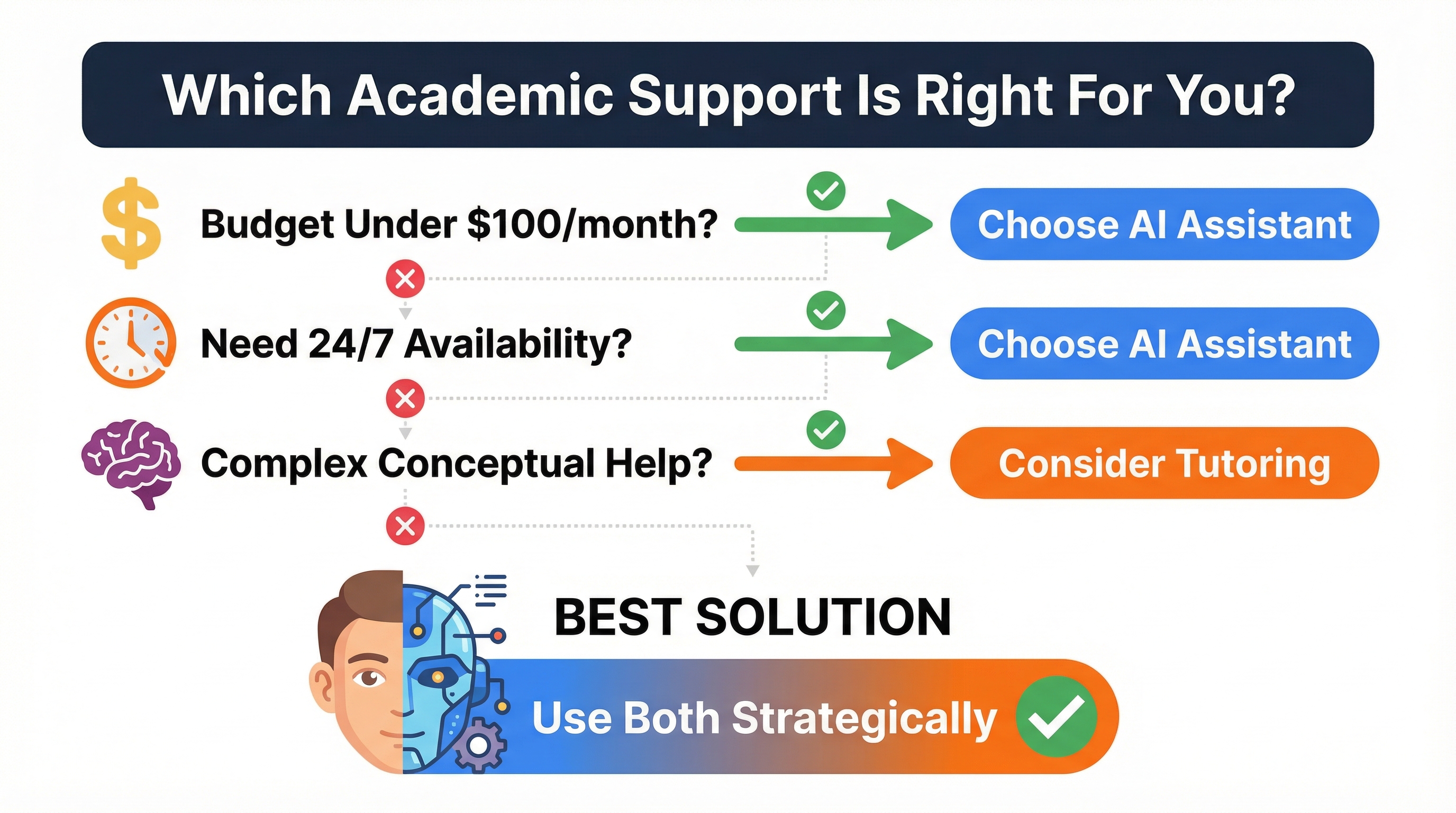
ALT: Comprehensive feature comparison table contrasting Verla AI platform capabilities with private academic tutoring services
Feature Comparison: Capabilities and Limitations
Understanding the specific capabilities and inherent limitations of each academic support approach enables students to make informed decisions aligned with their particular needs and learning contexts.
| Feature Category | Verla AI Academic Assistant | Traditional Private Tutoring |
|---|---|---|
| Cost Model | Subscription ($20-50/month) | Hourly Rate ($40-100/hour) |
| Availability | 24/7 Instant Access | Scheduled Sessions Only |
| Response Time | Immediate | Dependent on schedule (Days) |
| Subject Coverage | All Subjects (Multidisciplinary) | Limited to Tutor's Expertise |
| Interaction Style | Structured Frameworks & Drafting | Adaptive Dialogue & Discussion |
| Writing Support | Style Matching & Iterative Revisions | Feedback & Critique |
| Primary Strength | Efficiency, Accessibility, Cost | Conceptual Depth, Relationship |
AI Platform Capabilities
Verla's comprehensive feature set addresses the full spectrum of academic writing and assignment support needs:
- Multi-disciplinary support: Consistent assistance quality across humanities, social sciences, natural sciences, and professional disciplines without requiring subject-specific expertise matching
- Unlimited revisions: Students can iterate on assignments multiple times, exploring different approaches and refining work without additional costs or scheduling constraints
- Template and framework libraries: Ready-to-use structural frameworks for common assignment types, helping students understand proper academic formatting and organization
- Writing style consistency: AI maintains consistent quality and approach across all assignments, eliminating the variability inherent in working with multiple human tutors
- Research assistance: Guidance on source identification, citation management, and literature integration supporting comprehensive academic research
- Instant availability: Zero wait time for assistance initiation, maintaining study momentum and productivity
The platform's human-like writing quality specifically addresses student concerns about AI-generated content detection, producing natural, authentic-sounding text that aligns with individual writing styles. This capability, combined with style matching that adapts to student preferences, ensures that AI assistance enhances rather than replaces student voice.
Private Tutoring Capabilities
Human tutors provide distinct capabilities that current AI systems cannot fully replicate:
- Adaptive teaching: Real-time adjustment of explanations, examples, and approaches based on immediate comprehension feedback and student responses
- Conceptual dialogue: Extended discussions exploring underlying principles, alternative perspectives, and connections between concepts across courses and disciplines
- Motivational support: Personal encouragement, academic confidence building, and emotional support during challenging academic periods
- Holistic academic strategy: Guidance on course selection, major decisions, career planning, and long-term academic goal development beyond individual assignments
- Accountability partnerships: Regular check-ins, progress monitoring, and external motivation structures supporting consistent academic effort
- Complex problem-solving: Collaborative work through multi-step problems requiring extended dialogue, hypothesis testing, and iterative solution development
Experienced tutors also provide metacognitive guidance, helping students develop effective learning strategies, time management approaches, and self-assessment capabilities that transfer across academic contexts.
Comparative Limitations
Each approach faces inherent limitations that students should consider:
AI Platform Limitations:
- Limited ability to engage in extended Socratic dialogue or truly adaptive conceptual exploration
- Reduced effectiveness for highly specialized or cutting-edge topics with limited training data
- Cannot provide emotional support, motivation, or accountability relationships
- May struggle with highly ambiguous assignments requiring clarification from instructors
- Effectiveness depends on student ability to articulate needs and questions clearly
Private Tutoring Limitations:
- Cost barriers limiting access frequency and duration for many students
- Scheduling constraints reducing availability during peak need periods
- Quality variability across tutors and subjects requiring careful matching
- Geographic limitations for in-person sessions
- Single-subject expertise requiring multiple tutors for comprehensive support
- Potential dependency relationships that may inhibit student self-sufficiency development
Strategic Decision Framework: Choosing Your Academic Support
Making an informed choice between AI-powered academic assistance and traditional tutoring requires evaluating your specific circumstances, learning preferences, and academic goals against the distinctive value propositions of each approach.
When Verla Represents the Optimal Choice
AI-powered academic assistance through Verla offers superior value in several common student scenarios:
Budget-Conscious Students: Those facing significant financial constraints benefit immensely from subscription-based unlimited access. Students can receive comprehensive support across all courses for less than the cost of a single private tutoring session.
Multi-Course Support Needs: Students requiring assistance across diverse subjects and disciplines find AI platforms more practical than coordinating multiple subject-specific tutors. The consistent support quality across all academic areas eliminates the complexity of managing multiple tutor relationships.
Irregular Schedules: Students balancing work, family responsibilities, health challenges, or other commitments benefit from 24/7 availability that adapts to their schedule rather than requiring schedule adaptation to tutor availability.
Assignment-Focused Support: When the primary need involves essay writing, lab report completion, research paper development, or other assignment-specific assistance rather than deep conceptual learning, AI platforms provide efficient, effective support.
Self-Directed Learners: Students with strong intrinsic motivation, clear goal-setting abilities, and self-assessment skills often achieve excellent outcomes with AI tools, using them as productivity multipliers rather than dependency crutches.
When Private Tutoring Provides Superior Value
Traditional human tutoring remains preferable in specific circumstances where its unique capabilities provide irreplaceable value:
Conceptual Understanding Challenges: Students struggling with fundamental concepts in mathematics, sciences, or other cumulative subjects often benefit from the adaptive teaching, extended dialogue, and alternative explanation approaches that skilled tutors provide.
Accountability Needs: Those who struggle with procrastination, motivation, or self-direction may find the relationship dynamics, scheduled commitments, and progress monitoring of tutoring essential for consistent academic effort.
Complex Problem-Solving Requirements: Advanced coursework involving multi-step problem-solving, theoretical applications, or cutting-edge topics may exceed current AI capabilities, requiring human expertise and adaptive guidance.
Holistic Academic Strategy: Students seeking guidance on major selection, career planning, course sequencing, or long-term academic goal development benefit from the mentorship relationships that tutoring can provide beyond individual assignment assistance.
Learning Differences: Students with diagnosed learning differences, language barriers, or special educational needs may require the adaptive, patient, relationship-based support that human tutors uniquely offer.
Hybrid Approach Strategies
Many students find that combining both approaches strategically maximizes value while managing costs:
- Maintain an AI platform subscription for routine assignment support, quick questions, and immediate availability needs
- Schedule periodic tutor sessions (bi-weekly or monthly) for challenging concepts, exam preparation, or topics requiring extended dialogue
- Use AI tools for first drafts and structural guidance, then review refined work with tutors for advanced feedback
- Access AI assistance for time-sensitive deadlines and last-minute questions, reserving tutor sessions for deeper learning during less pressured periods
This hybrid model leverages the cost efficiency and accessibility of AI platforms while preserving access to the unique human capabilities of skilled tutors for situations where they provide irreplaceable value.
Conclusion
The choice between Verla's AI-powered academic assistance and traditional private tutoring fundamentally depends on your individual circumstances, learning preferences, and specific academic support needs. Verla offers compelling advantages in cost efficiency, 24/7 accessibility, multi-disciplinary consistency, and unlimited usage—factors that make it the optimal choice for budget-conscious students, those with irregular schedules, and learners requiring comprehensive support across multiple courses.
Private tutoring maintains unique value in providing adaptive teaching, complex problem-solving dialogue, motivational relationships, and accountability structures that benefit students facing conceptual challenges, requiring intensive support, or seeking holistic academic mentorship beyond assignment completion.
Rather than viewing these as mutually exclusive alternatives, consider how each approach's strengths might address different aspects of your academic support needs. Many successful students develop hybrid strategies that combine the accessibility and efficiency of AI platforms with periodic human tutoring for deeper learning challenges. Evaluate your budget, schedule, specific academic challenges, and learning style to determine which approach—or which combination—empowers your academic excellence most effectively.
Ready to experience how AI-powered academic assistance can transform your coursework? Explore comprehensive guides and educational resources that help you not just complete assignments but master academic writing techniques that support long-term success.
Frequently Asked Questions
Q1: How much does Verla cost compared to private academic tutoring services? A: Verla operates on a subscription model typically ranging from $20-50 monthly with unlimited access to comprehensive academic support across all subjects. Private tutoring costs $40-100+ per hour, with students commonly spending $320-800 monthly for just two weekly sessions. This represents a 433-1,233% cost difference for significantly more limited support scope, making AI platforms substantially more affordable for most students.
Q2: Can AI academic assistants like Verla replace human tutors completely? A: AI academic assistants excel at assignment support, writing guidance, and immediate question resolution but cannot fully replace the adaptive teaching, complex problem-solving dialogue, and motivational relationships that skilled human tutors provide. The optimal approach often combines both—using AI for routine support and accessibility while reserving tutoring for conceptual challenges and in-depth learning. Your specific needs, learning style, and academic challenges determine which approach or combination works best.
Q3: Is Verla available 24/7 or does it have scheduling limitations like tutors? A: Verla provides genuine 24/7 availability with instant access and zero wait times, allowing students to work whenever they're most productive regardless of time zones, irregular schedules, or last-minute deadline pressures. Unlike private tutors who require advance scheduling and operate within limited availability windows, AI platforms eliminate all temporal constraints, making them ideal for students with unpredictable schedules or those needing immediate assistance.
Q4: What subjects and academic disciplines does Verla support? A: Verla functions as a comprehensive academic toolkit providing consistent support across humanities, social sciences, natural sciences, and professional disciplines without requiring subject-specific expertise matching. The platform assists with essay writing, lab reports, research papers, and various assignment types across multiple disciplines simultaneously, eliminating the need to coordinate multiple subject-specific tutors and ensuring uniform support quality regardless of course area.
Q5: How effective is Verla at improving academic performance compared to traditional tutoring? A: Verla demonstrates 95% user satisfaction rates and effectively improves academic performance through comprehensive assignment support, writing technique guidance, and skill development resources. Educational research indicates that effectiveness depends on student characteristics and support needs—highly motivated, self-directed learners often achieve excellent outcomes with AI tools, while students requiring intensive conceptual support or accountability structures may benefit more from human tutoring relationships. Many students find hybrid approaches combining both maximize learning outcomes.
Q6: Will using Verla for academic assistance be detected as AI-generated content? A: Verla incorporates human-like writing quality and custom style matching capabilities designed to produce natural, authentic text that aligns with individual student writing styles. The platform focuses on providing structured guidance and educational support that helps students understand proper academic writing techniques rather than simply generating content, supporting academic integrity while assisting with assignment completion. Students should always review and personalize AI-assisted work to ensure it authentically represents their understanding.
Q7: Can I use both Verla and a private tutor together? A: Absolutely—many students develop strategic hybrid approaches that leverage the strengths of both options. Common strategies include maintaining a Verla subscription for routine assignments, immediate questions, and deadline support while scheduling periodic tutor sessions for challenging concepts, exam preparation, or topics requiring extended dialogue. This combination maximizes cost efficiency and accessibility while preserving access to human expertise for situations where it provides unique value beyond AI capabilities.