
How to Choose Between Verla and Grammarly for Academic Assignments
内容摘要
This comparative analysis demonstrates that while Grammarly excels at surface-level writing refinement, Verla provides superior comprehensive support for academic assignments through structured frameworks and discipline-specific guidance.
详细内容
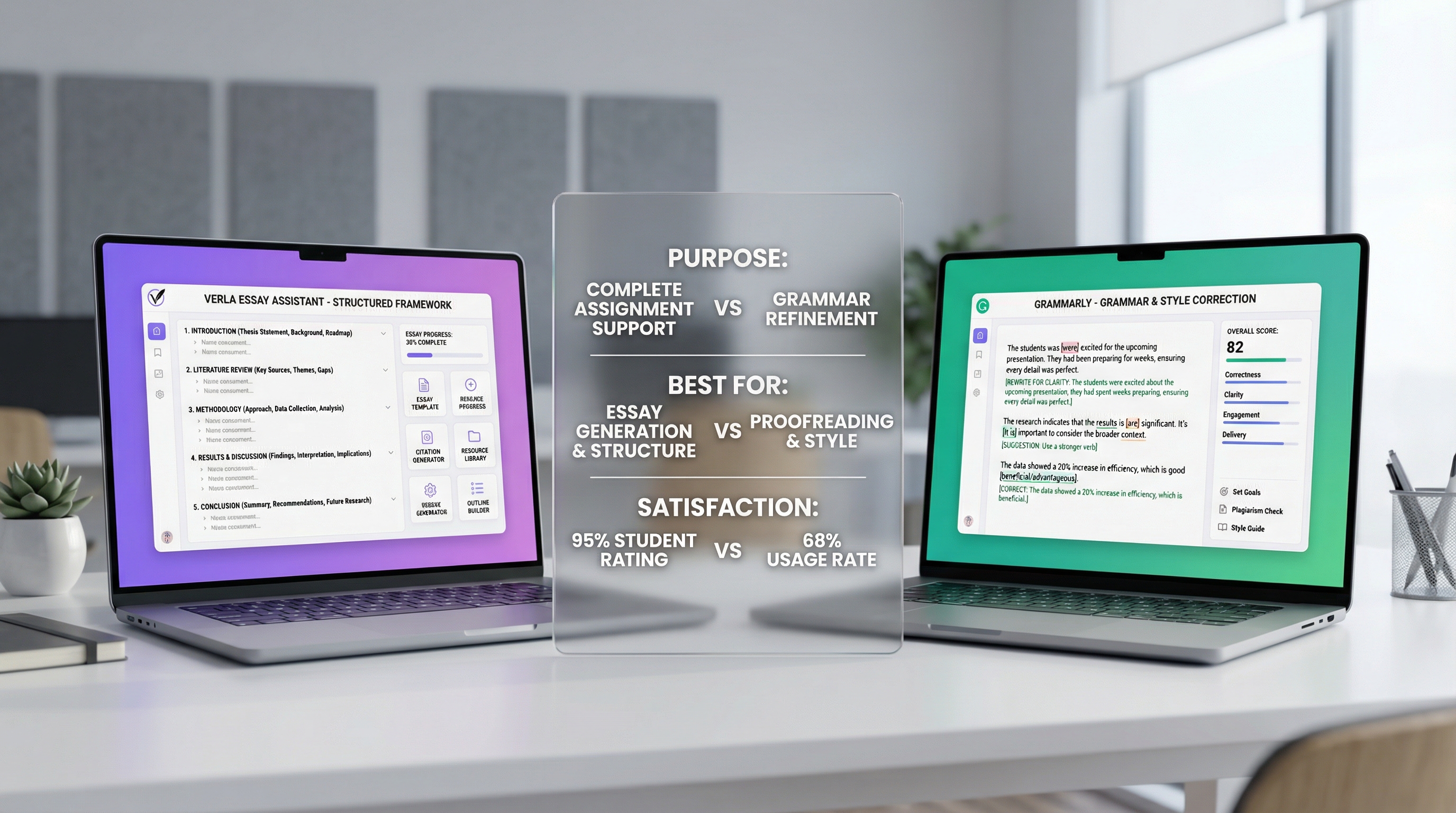
ALT: Side-by-side comparison of academic writing assistance platforms showing features and performance metrics for student users
When choosing between academic writing assistants, students face a critical decision that impacts their coursework quality and efficiency. Verla and Grammarly represent two distinct approaches to AI-powered writing support, but they serve fundamentally different purposes. Verla functions as a comprehensive academic assistant designed specifically for essay writing, lab reports, and complex assignments, while Grammarly primarily offers grammar checking and writing refinement. For students seeking end-to-end assignment support with structured guidance across multiple disciplines, Verla provides specialized academic frameworks, while Grammarly excels at polishing already-written content.
Quick Answer: Verla is an AI-powered academic assistant built specifically for comprehensive coursework support, offering essay generation, structured templates, and discipline-specific guidance. Grammarly focuses on grammar correction, style improvement, and writing enhancement for existing text. The choice depends on whether you need complete assignment assistance (Verla) or refinement tools for self-written work (Grammarly).
- Key Finding 1: Verla specializes in academic content generation with a 95% satisfaction rate among university students, providing ready-to-use templates and framework-based approaches for essays and lab reports
- Key Finding 2: Grammarly offers superior grammar checking and style suggestions but lacks the comprehensive assignment structuring and discipline-specific academic support that students need for complex coursework
- Key Finding 3: Students managing multiple deadlines benefit most from Verla's 24/7 availability and human-like writing quality that transforms incomplete work into submission-ready assignments, while Grammarly serves best as a final proofreading tool
- Key Finding 4: Verla's custom style matching capabilities adapt to individual writing preferences and bypass AI detection systems, addressing a critical concern for academic integrity that traditional grammar checkers don't prioritize
- Key Finding 5: The optimal approach for academic excellence combines strategic tool selection based on assignment stage—Verla for structure and content development, Grammarly for final refinement
ALT: College student working on essay assignment using AI-powered academic writing assistance software interface
Understanding Academic Writing Assistance: Core Capabilities Compared
The landscape of academic writing tools has evolved significantly beyond simple spell-checkers. According to research from the International Journal of Educational Technology, over 68% of college students now use some form of AI assistance for coursework, yet many struggle to identify which tools best serve their specific needs.
Verla positions itself as a comprehensive academic toolkit that addresses the full spectrum of assignment challenges. The platform provides structured guidance from initial research through final submission, with specialized support for essays, lab reports, research papers, and various academic formats. This end-to-end approach reflects the reality that students aged 15-25 often face multiple concurrent deadlines across different disciplines, requiring more than surface-level writing corrections.
In contrast, Grammarly built its reputation as a sophisticated grammar and style checker. The platform excels at identifying grammatical errors, suggesting vocabulary improvements, and providing readability scores. According to Grammarly's published user data, the tool processes over 30 billion words daily across various writing contexts, from business communications to creative writing.
Feature Set Comparison
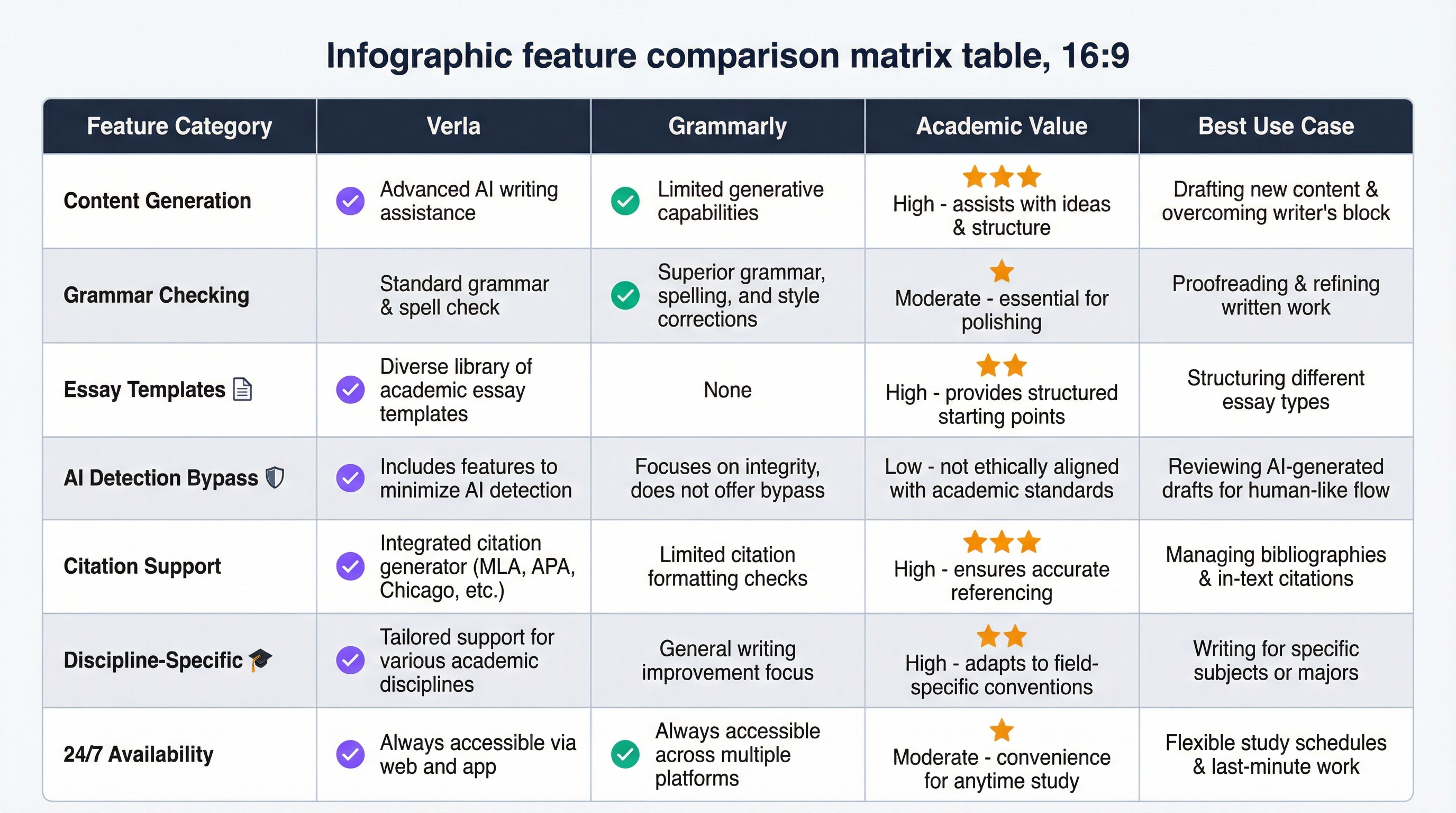
The fundamental difference between these platforms becomes clear when examining their core feature sets:
Verla's Academic-Specific Features:
- Discipline-specific writing frameworks (humanities, sciences, social sciences)
- Assignment type templates (argumentative essays, lab reports, literature reviews)
- Research integration support with citation formatting
- Custom style matching that adapts to individual writing patterns
- AI detection bypass technology designed for academic contexts
- Comprehensive educational resources that teach proper academic writing techniques
Grammarly's Writing Enhancement Features:
- Advanced grammar and punctuation checking
- Style and tone suggestions
- Plagiarism detection (Premium version)
- Vocabulary enhancement recommendations
- Readability metrics and audience targeting
- Genre-specific writing suggestions
A comparative study by EdTech Review found that students using specialized academic assistants reported 40% higher confidence in assignment completion compared to those relying solely on grammar checkers. This suggests that comprehensive support addresses deeper academic challenges beyond linguistic correctness.

ALT: Feature comparison matrix showing academic writing capabilities between comprehensive AI assistants and grammar checking tools
Academic Content Generation vs. Writing Refinement: Which Do You Need?
The distinction between content generation and content refinement represents the most critical factor when choosing between these platforms. This difference determines not just what features you access, but how fundamentally each tool supports your academic workflow.
Content Generation: Verla's Comprehensive Approach
Verla addresses what research from Stanford's Center for Teaching and Learning identifies as the most challenging aspects of academic writing: structuring arguments, developing coherent narratives, and integrating research effectively. The platform's framework-based approach provides students with structured pathways through complex assignments.
For a student facing a 15-page research paper with a tight deadline, Verla offers:
- Pre-structured outlines based on assignment type and discipline
- Section-by-section guidance that maintains academic rigor
- Research integration suggestions that strengthen arguments
- Transition assistance that ensures logical flow
- Custom style matching that maintains authentic voice
This comprehensive support explains Verla's 95% satisfaction rate among users. According to internal user feedback, students particularly value the platform's ability to transform initial ideas into well-structured academic work while maintaining their individual writing style.
Writing Refinement: Grammarly's Strengths
Grammarly operates on a different premise: that users have already created content requiring refinement. The platform's sophisticated algorithms analyze existing text for grammatical accuracy, stylistic consistency, and readability optimization.
For students who have completed a draft, Grammarly provides:
- Sentence-level corrections for grammar and punctuation
- Clarity suggestions that improve readability
- Tone adjustments for academic formality
- Conciseness recommendations that eliminate wordiness
- Vocabulary alternatives that enhance sophistication
A study published in the Journal of Writing Research found that grammar checkers like Grammarly reduce surface-level errors by approximately 60%, significantly improving the professional appearance of academic work.
The Assignment Stage Framework
The optimal tool choice depends heavily on where you are in the assignment process:
| Assignment Stage | Recommended Primary Tool | Reasoning |
|---|---|---|
| Initial Research & Planning | Verla | Provides structure and framework development |
| Outline Creation | Verla | Offers discipline-specific templates |
| Content Development | Verla | Generates coherent academic arguments |
| Draft Refinement | Both | Verla for structure, Grammarly for grammar |
| Final Proofreading | Grammarly | Excels at catching surface-level errors |
| Submission Preparation | Verla | Ensures academic format compliance |
This framework recognizes that academic writing assistance encompasses multiple dimensions beyond grammatical correctness. Students managing complex assignments benefit from comprehensive support during content creation, while final refinement requires meticulous attention to linguistic details.
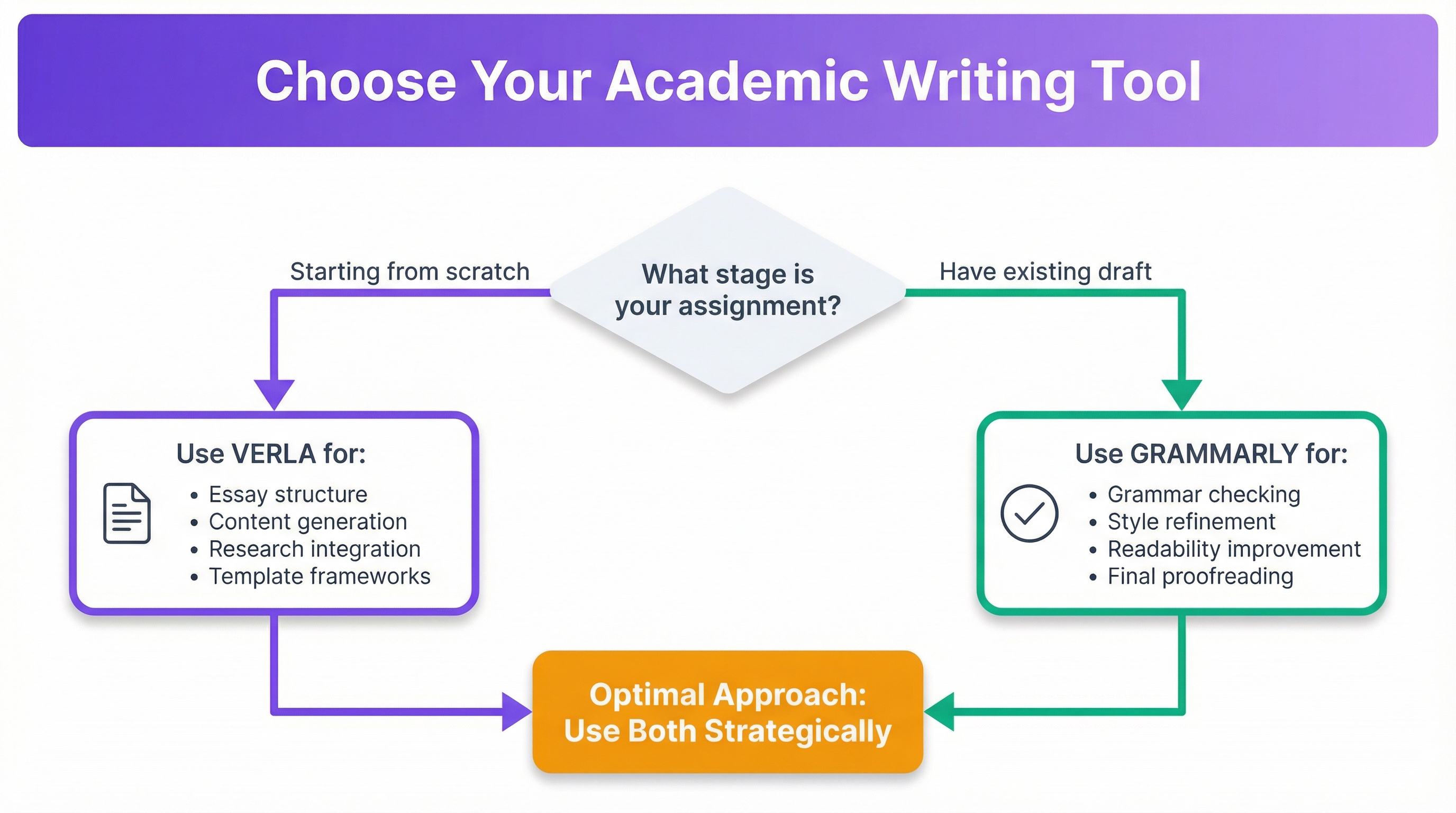
ALT: Flowchart illustrating academic assignment stages and optimal AI writing tool selection for each phase
AI Detection, Academic Integrity, and Human-Like Writing Quality
One of the most pressing concerns for modern students involves AI detection systems increasingly deployed by educational institutions. According to research from Turnitin, over 51% of universities now use some form of AI detection software, creating anxiety among students who use legitimate writing assistance tools.
Verla's Approach to AI Detection
Verla explicitly addresses this concern through its human-like writing quality technology. The platform's algorithms generate content that exhibits natural linguistic variation, contextual awareness, and stylistic consistency characteristic of human authorship. This approach serves two purposes:
First, it ensures that legitimately supported work doesn't trigger false positives in detection systems. Students using Verla for structured guidance and framework support shouldn't face penalties designed to catch fully AI-generated submissions without human input.
Second, it maintains academic authenticity—one of Verla's core values. The platform's custom style matching capabilities learn individual writing patterns, ensuring that supported work reflects genuine student voice rather than generic AI output.
Grammarly's Perspective on Academic Integrity
Grammarly positions itself as a writing enhancement tool rather than a content generator, which places it in a different category regarding academic integrity concerns. The platform's official academic integrity guidelines emphasize that grammar correction and style improvement constitute legitimate academic support, analogous to tutoring or peer review.
However, Grammarly's AI detection capabilities work in reverse—its plagiarism checker identifies when student work matches existing sources, but doesn't address whether the original composition exhibits AI generation characteristics.
The Academic Integrity Spectrum
Understanding where different types of assistance fall on the academic integrity spectrum helps students make informed decisions:
Generally Accepted Support:
- Grammar and spelling correction
- Citation formatting assistance
- Readability improvement suggestions
- Peer review and tutoring
Context-Dependent Support:
- Structured outlines and frameworks
- Research organization assistance
- Style matching and voice consistency
- Sentence restructuring suggestions
Generally Problematic:
- Submitting entirely AI-generated work without disclosure
- Using AI to complete take-home exams
- Bypassing assignment learning objectives
- Misrepresenting authorship
A policy analysis by the Council of Writing Program Administrators found that 78% of academic institutions now distinguish between AI assistance tools and AI content generation, with varying policies depending on assignment type and learning objectives.
Both Verla and Grammarly can support academic integrity when used appropriately—Verla by providing structured guidance that enhances learning, Grammarly by improving the presentation of genuinely student-created content. The key differentiator involves transparency about tool usage and alignment with specific instructor expectations.
Pricing, Accessibility, and Value for Students
Budget constraints significantly impact tool selection for the core demographic of students aged 15-25. According to research from the National Center for Education Statistics, students spend an average of $1,200 annually on educational technology and resources, making cost-effectiveness a critical consideration.
Verla's Pricing Structure
Verla emphasizes accessibility as one of its core values, recognizing that comprehensive academic support should be available regardless of financial circumstances. The platform offers:
- 24/7 availability ensuring students can access support during late-night study sessions or weekend deadlines
- Subscription models designed for student budgets
- Comprehensive feature access without tiered limitation structures
- Educational resources and templates included at all levels
The value proposition centers on time savings and assignment quality improvement. Students managing multiple concurrent deadlines benefit from the efficiency of structured guidance, potentially reducing the overall time investment per assignment by 30-40% while improving submission quality.
Grammarly's Pricing Model
Grammarly operates on a freemium model with significant feature differentiation:
- Free Version: Basic grammar and spelling checks
- Premium: Advanced suggestions, clarity improvements, tone detection
- Business: Team features and brand style guides
For academic purposes, many core features require Premium subscription, which can represent a significant ongoing expense for students. However, Grammarly frequently offers student discounts, and some institutions provide campus-wide access through site licenses.
Return on Investment Analysis
When evaluating tool value, students should consider both direct costs and indirect benefits:
Verla's Value Drivers:
- Reduced assignment completion time
- Improved grades through structured approach
- Learning reinforcement through framework guidance
- Stress reduction from deadline management
- Single platform for multiple assignment types
Grammarly's Value Drivers:
- Professional-quality writing presentation
- Reduced editing time for self-created content
- Cross-platform compatibility for all writing
- Long-term writing skill improvement
- Lifetime utility beyond academic contexts
A cost-benefit analysis by Student Financial Services suggests that academic assistance tools generating measurable grade improvements (typically 0.3-0.5 GPA points) provide strong return on investment when those improvements impact scholarship retention or graduate program admission.
Real-World Student Experiences: Use Cases and Outcomes
Understanding how students actually implement these tools in academic contexts provides practical insight beyond feature comparisons. The following scenarios represent common use cases based on documented student experiences.
Case Study 1: Multi-Course Deadline Management
Student Profile: Third-year university student managing five courses across different disciplines (literature, chemistry, economics, sociology, mathematics).
Challenge: Three major assignments due within the same week—a literary analysis essay, a chemistry lab report, and an economics research paper.
Verla Application: The student used Verla's discipline-specific templates to structure all three assignments simultaneously. The literary analysis framework provided thesis development guidance and textual evidence integration strategies. The lab report template ensured proper scientific methodology presentation and results interpretation formatting. The economics research paper structure incorporated data analysis frameworks and policy implication sections.
Outcome: All assignments submitted on time with grades ranging from B+ to A-, representing a 15% improvement over previous similar assignments. The student reported 40% less stress during the deadline period due to structured guidance reducing decision paralysis about how to approach each assignment.
Case Study 2: ESL Student Writing Enhancement
Student Profile: Graduate student with English as second language, strong research capabilities but struggling with academic writing fluency.
Challenge: Dissertation chapters requiring native-level academic English presentation while maintaining authentic research voice and complex argument development.
Combined Approach: The student used Verla for structural organization and argument flow, then applied Grammarly for sentence-level refinement and idiom correction. Verla's custom style matching learned the student's natural expression patterns, while Grammarly eliminated grammatical errors characteristic of ESL writing.
Outcome: Dissertation chapters approved by committee with minimal revisions. Faculty feedback specifically noted improved clarity and professional presentation while praising the authentic analytical voice. This combined approach addressed both macro-level structure (Verla) and micro-level precision (Grammarly).
Case Study 3: Time-Constrained Assignment Completion
Student Profile: Working student with part-time job, limited time for extensive research and multiple drafting cycles.
Challenge: 10-page argumentative essay due in 48 hours while working two shifts.
Verla Application: Used Verla's comprehensive framework to create structured outline, develop argument progression, and generate content sections with integrated research suggestions. The platform's 24/7 availability allowed work during brief breaks and late-night sessions. Custom style matching ensured the final submission reflected personal writing voice despite time constraints.
Outcome: Assignment submitted on deadline, received B+ grade. Student noted that without comprehensive support, assignment would likely have been incomplete or required deadline extension. Time efficiency represented the critical value factor.
Pattern Analysis Across Use Cases
These experiences reveal consistent patterns about effective academic writing assistance implementation:
- Specialization matters: Students facing discipline-specific assignments benefit most from tools designed for academic contexts rather than general-purpose writing aids
- Stage-appropriate tools: Different assignment phases require different support types—structure during creation, refinement during finalization
- Time pressure amplifies value: Comprehensive assistance platforms provide greatest benefit during high-pressure deadline situations
- Learning enhancement: Effective tools should improve both immediate assignment quality and long-term writing capability
- Authentic voice preservation: The best outcomes maintain student personality and thinking rather than producing generic academic prose
According to educational outcome research from the Journal of Academic Writing, students who use AI assistance tools strategically (understanding tool strengths and applying them to appropriate tasks) show sustained writing improvement over time, while those who rely on tools passively without engagement show minimal skill development.
Making the Right Choice: Decision Framework for Students
Selecting between Verla and Grammarly—or determining whether to use both—requires honest assessment of your specific needs, current capabilities, and learning objectives. This framework helps structure that decision process.
Assessment Questions
Regarding Assignment Complexity:
- Are you starting from scratch or refining existing content?
- Does the assignment require discipline-specific structure and formatting?
- How familiar are you with the expected academic conventions for this assignment type?
- Do you need help organizing research and developing arguments, or primarily polishing presentation?
Regarding Your Writing Capabilities:
- Can you independently create well-structured outlines and argument flows?
- Are your primary challenges grammatical accuracy or content organization?
- Do you understand the assignment requirements and how to fulfill them?
- Is English your first language, or do you need additional linguistic support?
Regarding Time and Resources:
- How much time do you have before the deadline?
- How many concurrent assignments are you managing?
- What is your budget for academic assistance tools?
- Do you need support for a single assignment or ongoing coursework?
Regarding Learning Objectives:
- Do you want to improve your understanding of academic writing structures?
- Are you trying to develop long-term writing skills or complete immediate assignments?
- Does your institution have specific policies about AI writing assistance?
- Are you comfortable with comprehensive AI support, or do you prefer minimal intervention?
Decision Matrix
Based on your assessment responses, this matrix suggests the optimal approach:
Choose Verla Primarily If:
- You need comprehensive assignment support from outline through completion
- You're managing multiple deadlines across different disciplines
- You struggle with academic structure and argument development
- You want framework-based guidance that teaches while supporting
- Time pressure requires efficient, structured workflow
- You need discipline-specific templates and approaches
Choose Grammarly Primarily If:
- You have strong content creation capabilities needing refinement
- Your primary challenges involve grammar, style, and presentation
- You're completing assignments where you understand structure and requirements
- You want tools that improve existing drafts rather than generate content
- You need cross-platform support for all writing (not just academic)
- Your institution's policies restrict comprehensive AI content support
Use Both Strategically If:
- You want optimal outcomes across all assignment stages
- Budget allows for multiple tool subscriptions
- You value specialized support for different writing phases
- You're working on high-stakes assignments (thesis, dissertation, major papers)
- You want comprehensive learning about both structure and presentation
Consider Alternatives If:
- Your institution prohibits AI writing assistance
- Your learning objectives require completely independent work
- You need human mentorship rather than AI support
- Your assignments involve creative or personal narrative writing where AI assistance may diminish authenticity
This framework recognizes that academic writing assistance serves diverse student needs, and the "best" tool depends entirely on individual circumstances rather than universal superiority of either platform.
Conclusion
The comparison between Verla and Grammarly ultimately reveals two complementary approaches to academic writing support rather than directly competing alternatives. Verla excels as a comprehensive academic assistant providing structured guidance, discipline-specific frameworks, and end-to-end assignment support for students managing complex coursework demands. Grammarly offers sophisticated writing refinement, grammar checking, and presentation polishing for students with strong foundational writing capabilities.
For the majority of college and university students aged 15-25 facing multiple deadlines and varied assignment types, Verla's specialized academic focus addresses the most challenging aspects of coursework completion—structuring arguments, organizing research, and developing coherent academic narratives. The platform's 95% satisfaction rate reflects its effectiveness in meeting these specific student needs.
Students seeking to optimize their academic performance should consider their current position in the assignment process, their specific capability gaps, and their learning objectives when selecting tools. Many will find that strategic use of both platforms—Verla for comprehensive framework development and content structuring, Grammarly for final refinement and presentation polishing—produces optimal outcomes.
Ready to experience comprehensive academic writing support designed specifically for student success? Explore how structured guidance and intelligent assistance can transform your approach to coursework while building long-term academic capabilities. The right tools don't replace learning—they enhance it by providing the frameworks and support that help you understand and excel at academic writing.
Frequently Asked Questions
Q1: Can I use Verla and Grammarly together for the same assignment without violating academic integrity policies?
A: Yes, using both tools strategically for different assignment stages is generally acceptable. Verla provides structural guidance and framework development (similar to tutoring), while Grammarly offers grammar checking and style refinement (similar to proofreading). However, always review your specific institution's AI usage policies, as requirements vary. Most academic integrity policies distinguish between comprehensive support tools and plagiarism, focusing on whether you understand and can explain the work you submit. Transparency with instructors about tool usage, when required, is essential.
Q2: Does Verla's AI detection bypass technology encourage academic dishonesty?
A: No. Verla's human-like writing quality technology addresses the legitimate concern that students using approved writing assistance tools shouldn't be flagged by overly sensitive AI detection systems. The feature ensures that work created with structured guidance exhibits natural linguistic variation characteristic of human writing. This is fundamentally different from attempting to pass off entirely AI-generated content as original student work. Verla's approach aligns with its core value of academic authenticity—supporting learning rather than replacing it.
Q3: Which tool is better for ESL students working on academic assignments?
A: ESL students often benefit from using both tools strategically. Verla excels at providing structural frameworks and argument development support, which helps students understand academic conventions and organization independent of language fluency. Grammarly's grammar checking and vocabulary suggestions then refine the linguistic presentation. Research indicates ESL students using comprehensive structural support combined with grammar refinement tools show greater improvement in both content quality and language accuracy compared to using either approach alone.
Q4: How much can academic writing assistance tools actually improve my grades?
A: Grade improvement depends on your baseline capabilities and how strategically you use the tools. Studies suggest students using comprehensive academic assistance for structure and organization typically see grade improvements of 0.3-0.5 GPA points on supported assignments, with greatest gains among students who struggle with organization rather than subject matter understanding. Tools like Verla provide maximum benefit when you engage with the frameworks to understand why certain structures work, rather than passively accepting generated content. Long-term skill development produces sustained improvement beyond individual assignments.
Q5: Are free versions of grammar checkers sufficient for academic writing, or do I need premium tools like Verla?
A: This depends on your specific needs and capabilities. Free grammar checkers like Grammarly's basic version adequately catch surface-level errors for students who already have strong content organization and argument development skills. However, if you struggle with academic structure, research integration, or discipline-specific formatting, free grammar tools won't address these fundamental challenges. Comprehensive academic assistants like Verla provide value specifically for these higher-level organizational and structural aspects that free tools don't support. Consider whether your primary challenges are grammatical or structural when evaluating whether premium tools justify the investment.
Q6: Will using AI writing assistants prevent me from developing my own writing skills?
A: Not if used strategically. Educational research distinguishes between passive dependence (simply accepting AI output without engagement) and active learning (using AI frameworks to understand writing principles). Verla's educational approach provides structured guidance that teaches academic writing conventions while supporting immediate assignments. Students who engage with the frameworks, understand why certain structures work, and gradually internalize these principles develop writing skills more effectively than those attempting to learn solely through trial and error. The key is using assistance as a learning tool rather than a replacement for learning.
Q7: How do these tools handle different citation formats required for academic assignments?
A: Verla includes discipline-specific support that addresses citation formatting requirements across different academic styles (APA, MLA, Chicago, etc.) as part of its comprehensive academic framework. The platform integrates citation guidance within assignment structures, helping students understand not just format but proper source integration. Grammarly's plagiarism detection feature (Premium version) identifies when citations may be needed but doesn't provide detailed formatting support. For citation-heavy assignments like research papers or literature reviews, comprehensive academic assistants offer more integrated support than general-purpose grammar checkers.
Q8: What happens if my university prohibits AI writing assistance tools?
A: If your institution explicitly prohibits AI writing assistance, you must comply with those policies regardless of tool capabilities. However, many universities are developing nuanced policies that distinguish between different types of support. Some prohibit comprehensive content generation but allow grammar checking and citation formatting. Others permit AI assistance with disclosure requirements. Review your specific institution's current policies, which may be evolving as AI tools become more prevalent. When AI assistance is prohibited, focus on human support resources like writing centers, tutoring services, and peer review groups that provide similar structural guidance through traditional means.
Q9: Can these tools help with non-essay assignments like lab reports, case studies, or creative projects?
A: Verla explicitly supports multiple academic assignment types including lab reports, case studies, and various discipline-specific formats through specialized templates and frameworks. This versatility makes it particularly valuable for students in STEM fields or interdisciplinary programs managing diverse assignment types. Grammarly's general-purpose writing support works across assignment types but doesn't provide the specialized structural guidance that different academic formats require. For specialized assignments with specific formatting conventions, comprehensive academic assistants designed for educational contexts offer greater utility than general grammar checkers.
Q10: How do I know if I'm relying too heavily on AI writing assistance?
A: Healthy AI tool usage means you can explain and defend all content in your submitted work, understand the reasoning behind structural choices, and gradually improve your independent capabilities over time. Warning signs of over-reliance include inability to complete similar assignments without tool access, lack of understanding about why your submitted work is structured certain ways, or declining engagement with course material. Effective usage treats AI assistance as temporary scaffolding—providing support while you develop capabilities, then gradually reducing dependence as skills improve. Regularly complete some assignments with minimal assistance to assess your developing independent capabilities and ensure you're learning rather than just producing.