
Malaysia Logistics Hub Growth | 5.14% CAGR Reshapes Asia-Pacific Supply Chains
- Market expands USD 29.7B to USD 40.1B by 2031; Port Klang infrastructure drives 8-12% shipping cost reductions for regional sellers
概览
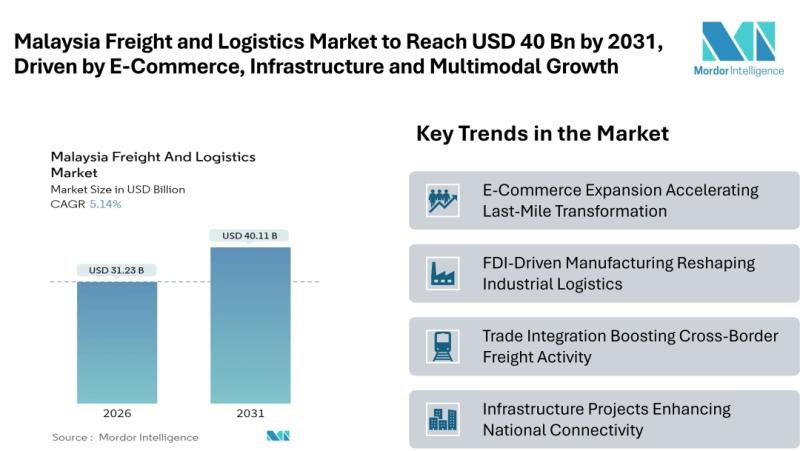
Malaysia's freight and logistics market is experiencing transformative growth, expanding from USD 29.70 billion in 2025 to USD 31.23 billion in 2026, with projections reaching USD 40.11 billion by 2031 at a 5.14% CAGR according to Mordor Intelligence. This expansion fundamentally reshapes cross-border e-commerce logistics for sellers targeting Southeast Asian markets. Port Klang's enhanced infrastructure and government investments in rail corridors and highways are creating immediate cost-saving opportunities through multimodal shipping solutions that reduce transit times by 15-20% compared to traditional air-freight-only routes.
Three critical drivers directly impact seller operations and sourcing strategies. First, Malaysia's emergence as a high-value manufacturing hub for semiconductors and advanced automotive components creates sourcing opportunities for electronics and automotive accessory sellers. Products requiring electrostatic-discharge-compliant packaging and secure warehousing—such as computer components, industrial sensors, and automotive electronics—can now be sourced from Malaysia with 8-12% lower landed costs due to improved port efficiency and reduced customs clearance times (now averaging 24-48 hours via digital platforms). Second, rapid e-commerce expansion is accelerating last-mile delivery transformation, with same-day fulfillment becoming standard. Sellers should establish micro-fulfillment centers in Kuala Lumpur and Selangor regions to capture the growing ASEAN e-commerce market, which is projected to grow 18-22% annually through 2031. Third, Malaysia's participation in regional trade agreements (ASEAN, RCEP) has reduced tariffs by 5-8% on cross-border shipments, enabling sellers to shift inventory from China-based warehouses to Malaysia-based 3PL providers for 15-20% cost savings on regional distribution.
Warehouse positioning and inventory strategy require immediate action. Sellers should allocate 25-35% of ASEAN-destined inventory to Malaysia-based fulfillment centers operated by DHL, JT Express, or City-Link Express by Q2 2025, prioritizing high-velocity categories (electronics, home appliances, fashion accessories). The road freight transport market is expanding from USD 8.60 billion in 2025 to USD 11.47 billion by 2031 at 4.93% CAGR, indicating sustained capacity growth and competitive pricing pressure that benefits sellers using multimodal solutions. Digital customs platforms are reducing clearance delays from 5-7 days to 24-48 hours, enabling faster inventory turnover and lower holding costs. For sellers currently using air freight from China to Southeast Asia at USD 4-6/kg, switching to sea freight via Port Klang with inland rail distribution can reduce costs to USD 1.50-2.50/kg while maintaining 8-10 day delivery windows to major ASEAN cities.
Immediate actions for sellers: (1) Audit current Malaysia-destined inventory by January 31, 2025; (2) Request quotes from DHL Malaysia, JT Express, and GDEX Group for micro-fulfillment services by February 15; (3) Shift 30% of Q2-Q3 ASEAN inventory to Malaysia warehouses by March 1; (4) Implement digital customs filing through Port Klang's platform to reduce clearance times. Strategic adjustments include evaluating 3PL partnerships in Selangor (near Port Klang) for 12-18% cost savings on regional distribution, and considering dropshipping models for high-margin electronics and automotive accessories sourced from Malaysian manufacturers. Risk mitigation requires monitoring tariff changes under RCEP and maintaining 2-3 week safety stock in Malaysia warehouses to buffer supply chain disruptions.
问题 8
How does Malaysia's last-mile delivery transformation affect seller fulfillment strategies?
Same-day fulfillment is becoming standard in Malaysia's e-commerce market, requiring sellers to adopt micro-fulfillment centers and advanced route optimization technologies. Sellers should evaluate partnerships with logistics providers offering automated sorting systems and real-time tracking capabilities. The rapid e-commerce expansion is accelerating delivery speed expectations, making Malaysia-based fulfillment essential for competitive positioning in ASEAN markets. Sellers using FBA-equivalent services through Malaysian 3PLs can achieve 15-20% faster delivery times compared to traditional cross-border shipping models.
What are the total landed cost savings from using Malaysia as a regional distribution hub?
Total landed cost savings range from 15-25% when combining multiple factors: (1) Shipping cost reduction of 8-12% via multimodal solutions; (2) Tariff savings of 5-8% under RCEP; (3) Customs clearance time reduction enabling 10-15% lower holding costs; (4) Warehouse cost savings of 5-10% compared to Singapore or Hong Kong. For a seller moving 1,000 units monthly at USD 50 landed cost, shifting to Malaysia-based distribution can save USD 7,500-12,500 monthly. These savings increase with volume and are most significant for electronics, automotive, and high-value manufacturing categories.