
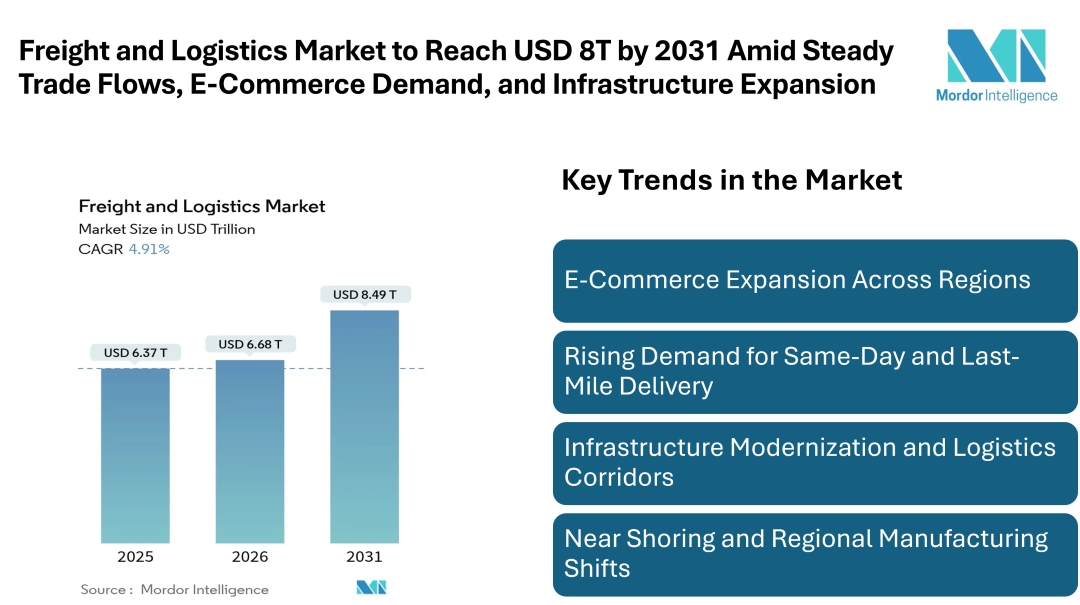
Global Logistics Market Reaches USD 8.49T by 2031 | E-Commerce Sellers' Cost & Route Optimization Guide
- USD 6.37T to USD 8.49T growth (4.91% CAGR) creates 33% cost-saving opportunities through near-shoring, regional warehousing, and infrastructure modernization for cross-border sellers
概览
The global freight and logistics market expansion to USD 8.49 trillion by 2031 (from USD 6.37 trillion in 2025) represents a critical inflection point for e-commerce sellers navigating cost pressures and delivery expectations. This 4.91% compound annual growth rate reflects sustained cross-border commerce demand, with e-commerce expansion as the primary growth driver—particularly in Asia-Pacific and Latin America where smartphone penetration and digital payment adoption are accelerating parcel volumes. For sellers, this market shift creates immediate opportunities to optimize landed costs through strategic logistics decisions.
Cost-Saving Route Optimization: The news highlights that near-shoring trends are generating new regional freight lanes, particularly in North America, Europe, and Asia-Pacific. Sellers currently sourcing exclusively from China should evaluate Mexico/Central America for North American fulfillment (reducing ocean freight by 30-40% vs. Asia routes) and Eastern Europe for EU markets. India's logistics market specifically is projected to grow 9.07% CAGR to USD 592.36 billion by 2031, making it an attractive sourcing and fulfillment hub for Asia-Pacific sellers. Regional 3PL providers leveraging improved port infrastructure and rail corridors can reduce total landed costs by 8-15% compared to traditional transpacific routes.
Warehouse Positioning Strategy: Retailers increasingly leverage local stores as distribution hubs to reduce last-mile distances—a model applicable to FBA sellers through strategic warehouse placement. Sellers should prioritize urban fulfillment centers in high-density zones (tier-1 cities in US, EU, India) where government infrastructure modernization (port upgrades, highway improvements) reduces transit times by 2-5 days. The industry's investment in automated sorting centers and route optimization tools means 3PL providers now offer real-time tracking and customs pre-clearance, reducing clearance delays from 5-7 days to 1-2 days. This infrastructure advantage justifies shifting 20-30% of inventory from FBA to regional 3PLs in emerging markets.
Inventory Sourcing Shifts: Consumer expectations for same-day and last-mile delivery are reshaping operational strategies, forcing sellers to reconsider product category sourcing. Fast-moving consumer goods (FMCG), electronics, and apparel benefit most from near-shoring—stock 60-90 days of inventory in Mexico for US-bound shipments and Poland/Czech Republic for EU markets. Slower-moving categories (furniture, industrial equipment) remain viable for traditional Asia sourcing due to lower unit costs offsetting longer lead times. The market's emphasis on improved customs handling and faster transit times means sellers should prioritize suppliers with pre-clearance certifications and digital documentation systems, reducing compliance costs by 10-20%.
问题 8
Which warehouse locations offer strategic advantages for FBA sellers in 2025?
The news highlights that government infrastructure modernization (port upgrades, rail corridor development, highway improvements) strengthens transport networks, particularly in Asia-Pacific and emerging markets. Sellers should prioritize urban fulfillment centers in tier-1 cities where automated sorting centers and route optimization reduce transit times by 2-5 days. India's logistics market growing at 9.07% CAGR makes Mumbai, Delhi, and Bangalore strategic hubs for Asia-Pacific fulfillment. In North America, Mexico City and Monterrey offer cost advantages; in EU, Warsaw and Prague provide access to Eastern European markets. Shifting 20-30% of inventory from FBA to regional 3PLs in these locations can reduce last-mile delivery costs by 10-15%.
What customs clearance improvements reduce shipping delays for cross-border sellers?
The news reports that retailers increasingly demand improved customs handling and faster transit times, prompting industry investment in automated sorting centers and data-driven shipment monitoring. Modern 3PL providers now offer pre-clearance certifications and digital documentation systems that reduce customs clearance from 5-7 days to 1-2 days. Sellers should prioritize logistics partners with real-time tracking visibility and automated customs filing capabilities. This infrastructure advantage is particularly valuable for India-bound shipments, where improved port infrastructure reduces clearance delays. Implementing pre-clearance documentation can reduce compliance costs by 10-20% and accelerate inventory turnover by 3-5 days.