
Global Healthcare Waste Solutions Emerge as Critical Market Opportunity
- Sustainable waste management transforms from challenge to strategic business ecosystem
概览
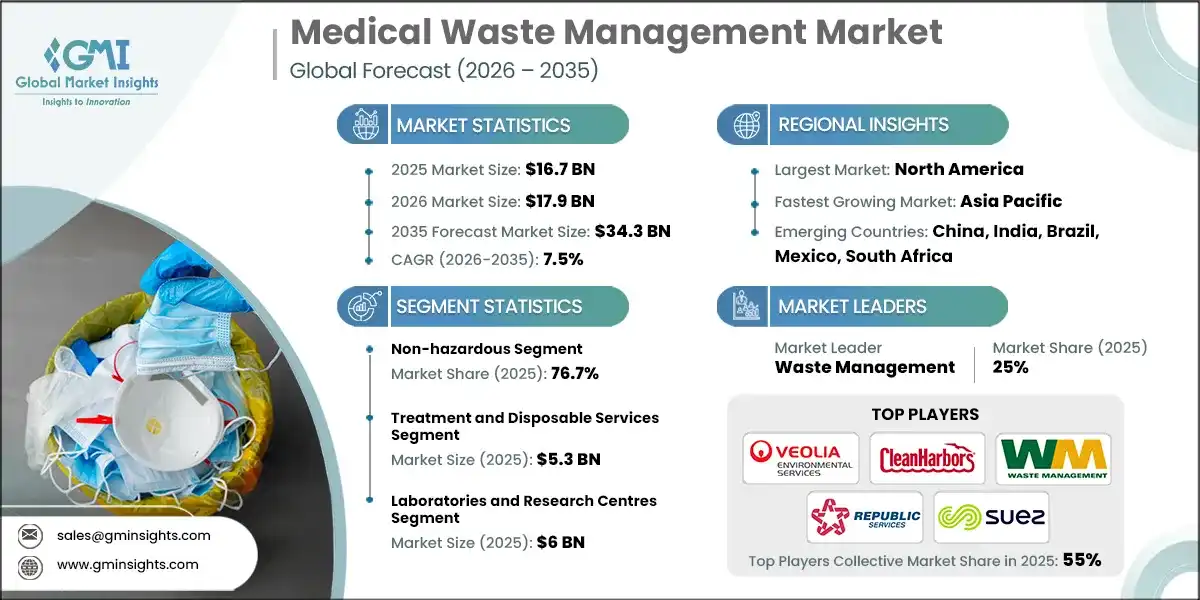
The medical waste management market is experiencing a transformative evolution, signaling a critical intersection of healthcare, environmental sustainability, and technological innovation. By 2035, this sector is projected to reach a substantial USD 34.3 billion, representing a robust 7.5% compound annual growth rate that reflects deepening global awareness of waste disposal challenges.
Emerging Market Dynamics reveal a complex landscape where healthcare infrastructure and environmental consciousness are driving unprecedented change. The World Health Organization's data highlights a stark disparity in waste generation—high-income countries produce up to 0.5 kg of hazardous waste per hospital bed daily, compared to 0.2 kg in low-income regions. This variance underscores not just a waste management challenge, but a broader global health and sustainability imperative.
Technological Innovation and Regulatory Frameworks are becoming pivotal market accelerators. Regulatory mechanisms like the U.S. Resource Conservation and Recovery Act (RCRA) are creating fertile ground for advanced waste management technologies. Companies like Veolia Environmental Service, Clean Harbors, and Waste Management are pioneering solutions including autoclaving, chemical disinfection, and waste-to-energy technologies that transform waste from an environmental liability into a potential resource.
The market's growth trajectory is fundamentally driven by increasing awareness of health hazards associated with improper medical waste disposal. Sustainability has evolved from a peripheral consideration to a core strategic priority. For healthcare providers, waste management is no longer just an operational necessity but a critical component of environmental responsibility and public health protection.
Looking forward, the medical waste management market represents a sophisticated ecosystem where technological innovation, regulatory compliance, and environmental stewardship converge. Stakeholders must view this not as a cost center, but as a strategic opportunity for creating sustainable, efficient healthcare infrastructure.
问题 3
What technologies are transforming medical waste management?
Advanced technologies like autoclaving, chemical disinfection, and waste-to-energy solutions are revolutionizing the sector. These innovations help convert medical waste from an environmental liability into a potential resource, supported by regulatory frameworks like the U.S. Resource Conservation and Recovery Act (RCRA).
How do waste generation patterns differ globally?
High-income countries generate up to 0.5 kg of hazardous medical waste per hospital bed daily, compared to 0.2 kg in low-income countries. This disparity highlights significant variations in healthcare infrastructure, waste management capabilities, and environmental standards across different regions.