
Dark Store Revolution 2025-2031 | $131B Market Reshapes Last-Mile Logistics for Sellers
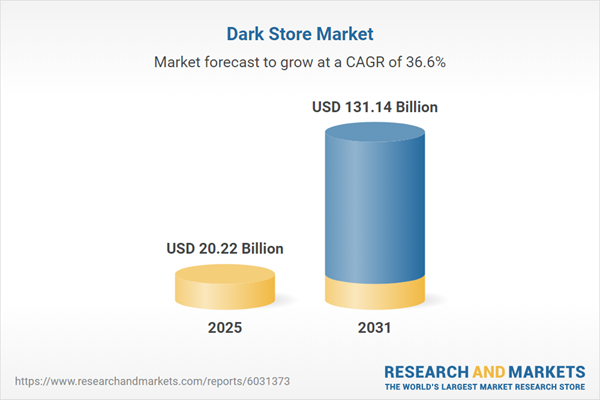
- Dark store market explodes 36.56% CAGR from $20.22B (2025) to $131.14B (2031); sellers must adapt inventory, sourcing, and fulfillment strategies to compete with ultra-fast 30-minute delivery networks
概览
The global dark store market is undergoing a seismic transformation that directly impacts how cross-border sellers must structure their fulfillment operations. Projected to surge from $20.22 billion in 2025 to $131.14 billion by 2031 at a 36.56% CAGR, dark stores—specialized online-only fulfillment centers optimized for rapid order processing—are fundamentally reshaping urban logistics and consumer expectations around delivery speed. This expansion creates both immediate threats and strategic opportunities for e-commerce sellers across multiple categories.
The Competitive Pressure on Traditional Fulfillment Models: Major players like Zomato are aggressively expanding dark store networks with plans to establish 2,000 locations by 2026, while the U.S. Department of Commerce reported a 6.6% increase in e-commerce sales in Q2 2024, underscoring the critical need for localized distribution hubs. For sellers, this means consumer expectations for same-day and 30-minute delivery are no longer niche—they're becoming baseline competitive requirements. Sellers relying on traditional FBA networks or 3PL providers with regional consolidation points face margin compression as customers increasingly expect ultra-fast fulfillment. The Council of Supply Chain Management Professionals noted U.S. business logistics costs reached $2.6 trillion in 2024, highlighting that fulfillment infrastructure costs are intensifying across the industry.
Technology-Driven Inventory Optimization as Competitive Necessity: The 2024 MHI Annual Industry Report revealed that 55% of supply chain leaders plan to increase investments in supply chain technology, with AI-powered inventory management and logistics automation becoming standard. Dark stores leverage these technologies to optimize space utilization and manage high-volume orders with minimal errors—capabilities that traditional sellers must now replicate. This signals a critical shift: sellers who don't invest in inventory visibility, demand forecasting, and automated warehouse management systems will lose competitive positioning. The technology investment requirement creates barriers for small sellers but opportunities for those who can implement AI-driven inventory systems.
Category Expansion Beyond Grocery Creates New Sourcing Opportunities: A notable trend is dark stores expanding beyond grocery into electronics, fashion, and beauty products—categories with higher order values and better margins. This diversification indicates that fast fulfillment is no longer limited to perishables but is becoming the expected delivery model across premium categories. Sellers in electronics, fashion, and beauty should prioritize sourcing from suppliers with shorter lead times and positioning inventory in urban micro-fulfillment centers rather than regional warehouses. The high urban real estate costs dark stores face ($2.6T total logistics spend) create opportunities for sellers to partner with emerging 3PL providers building dark store-adjacent fulfillment networks at lower cost points.
问题 8
How will dark store expansion affect cross-border sellers' landed costs and pricing?
Dark stores are compressing last-mile delivery costs for domestic competitors while cross-border sellers face structural disadvantages: longer shipping times (10-21 days vs. 30 minutes) and higher landed costs. Cross-border sellers must differentiate through product selection (niche categories, international brands) rather than competing on delivery speed. Calculate new landed cost models: if dark stores reduce last-mile costs from $3-5 per order to $0.50-1.00, cross-border sellers need to reduce their total landed cost (product + shipping + tariffs + storage) by 15-20% to remain competitive. This means sourcing from lower-cost regions (Vietnam, India) and consolidating shipments to reduce per-unit shipping costs from $2-3 to $1-1.50. Consider FBA as a hedge—Amazon's infrastructure investments may enable faster delivery to compete with dark stores.
Should sellers invest in their own dark store fulfillment or partner with 3PLs?
For sellers with <$5M annual revenue, partnering with emerging 3PL providers building dark store-adjacent networks is more cost-effective than building proprietary fulfillment. High urban real estate costs make dark store economics challenging for individual sellers—the market is consolidating around major players like Zomato. Instead, sellers should identify 3PLs with 2-3 urban micro-fulfillment locations and negotiate exclusive category partnerships. For sellers with $5M+ revenue, consider co-investing in shared micro-fulfillment facilities with 2-3 complementary sellers (non-competing categories) to distribute $500K-1M facility setup costs. The 36.56% CAGR growth indicates this infrastructure will become essential—early movers securing partnerships with emerging 3PLs will gain 6-12 month competitive advantages.