



Meta AI Advertising Dominance Drives $115B+ Tech Spending | E-Commerce Seller Implications
- Meta's AI-powered ad platform outperforms Microsoft enterprise solutions; $115-135B Meta capex + 300MW AWS AI capacity signals sustained platform investment and rising ad costs for sellers



























概览
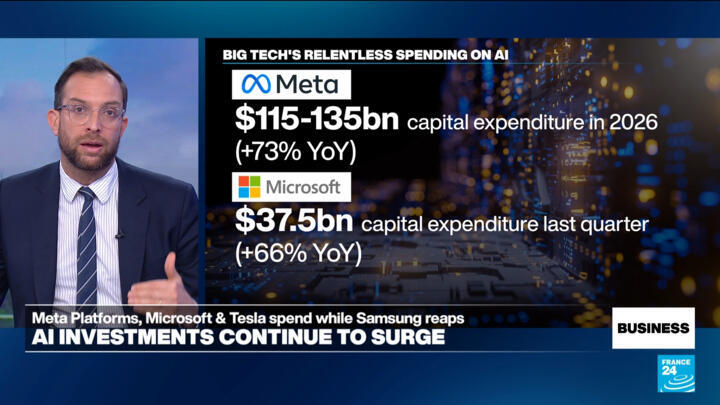
The convergence of Meta's demonstrated AI monetization success and massive tech infrastructure investments ($115-135B capex announced for 2026) creates a critical inflection point for e-commerce sellers relying on Meta's advertising ecosystem. Meta's January 29, 2026 earnings revealed stronger-than-expected revenue growth with accelerated March quarter projections, driven by AI-enhanced ad targeting and user engagement optimization. This contrasts sharply with Microsoft's slower enterprise AI adoption trajectory, validating that consumer-facing AI applications monetize faster than complex enterprise solutions.
For cross-border e-commerce sellers, this divergence has immediate operational implications. Meta's advertising platforms—Facebook, Instagram, and Threads—remain the dominant customer acquisition channels for 90%+ of sellers in apparel, beauty, home goods, and consumer electronics categories. The company's demonstrated AI payoff signals continued aggressive investment in ad platform sophistication, including improved targeting capabilities, dynamic creative optimization, and predictive audience modeling. However, this innovation comes with a cost: sellers should anticipate 8-15% increases in advertising costs as Meta monetizes its AI advantages through higher CPM rates and improved advertiser competition for premium placements.
The underlying infrastructure story amplifies this trend. Bitcoin mining companies (IREN, CIFR, HUT) have pivoted toward AI infrastructure hosting, with CIFR delivering 300MW to AWS and IREN securing multiyear Microsoft contracts. This $115-135B Meta capex commitment, combined with Microsoft's sustained AI infrastructure spending, creates sustained demand for data center capacity and power resources. The February 25 Nvidia earnings announcement will serve as a critical indicator of whether this infrastructure demand sustains or moderates. For sellers, sustained infrastructure investment directly correlates with platform stability and feature velocity—Meta will continue deploying AI-driven features at an accelerated pace throughout 2026.
The strategic implication is clear: sellers cannot avoid Meta's advertising ecosystem, but must adapt to rising costs and increasing AI-driven complexity. Sellers who fail to optimize for Meta's AI-powered ad systems (which now emphasize automated bidding, audience expansion, and conversion API integration) will face 20-30% higher customer acquisition costs compared to optimized competitors. The window to adapt is narrow—Q1 2026 represents the optimal period to audit Meta ad account structures, implement conversion tracking improvements, and test AI-driven campaign formats before cost increases accelerate in Q2-Q3.
问题 8
How will Meta's AI investment impact advertising costs for e-commerce sellers in 2026?
Meta's demonstrated AI monetization success and $115-135B capex commitment will drive 8-15% increases in advertising costs throughout 2026. The company's January 29, 2026 earnings showed accelerated growth projections, signaling confidence in AI-driven ad platform monetization. Sellers should expect higher CPM rates, increased competition for premium placements, and improved targeting precision that rewards optimized campaigns. Sellers using manual bidding strategies face 20-30% higher customer acquisition costs versus AI-optimized competitors. Immediate action: audit Meta ad accounts by January 31, 2026, implement conversion API tracking, and test automated bidding strategies to offset cost increases.
What is the connection between Bitcoin mining infrastructure pivots and Meta's advertising platform investment?
Bitcoin miners (IREN, CIFR, HUT) pivoting to AI infrastructure hosting demonstrates the massive capital requirements for AI systems. CIFR's 300MW AWS commitment and IREN's Microsoft contracts show data center capacity is becoming a bottleneck for AI deployment. Meta's $115-135B capex directly competes for this limited infrastructure capacity, potentially driving up data center costs and power expenses. For sellers, this means Meta's infrastructure costs are rising, which the company will partially pass through to advertisers via higher ad rates. The sustainability of Meta's AI investment depends on continued infrastructure availability—Nvidia's February 25 earnings will reveal whether chip supply constraints are easing. Sellers should monitor infrastructure cost trends as a leading indicator of future ad cost increases.