
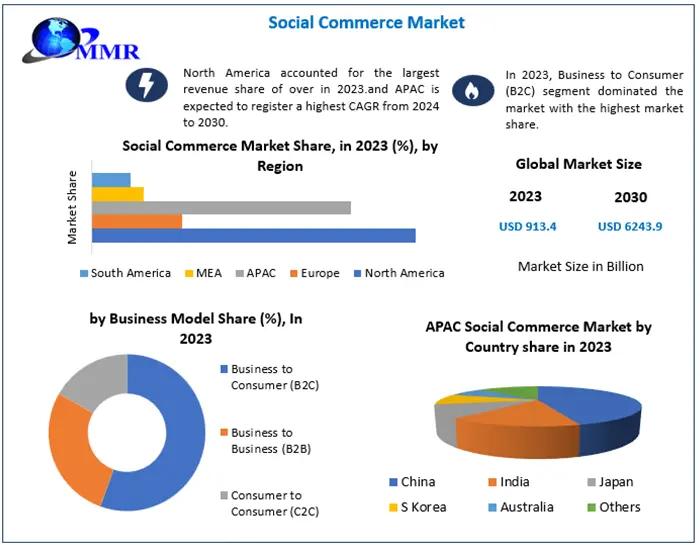

The global social commerce market is experiencing unprecedented growth, expanding from USD 913.4 billion in 2023 to a projected USD 6,243.9 billion by 2030—a 31.60% compound annual growth rate that fundamentally reshapes where and how sellers reach customers. This isn't incremental growth; it represents a complete reorientation of e-commerce infrastructure toward social-first, video-first selling models that achieve conversion rates up to 10 times higher than traditional e-commerce platforms.
Video commerce and live streaming dominate this transformation, driving a remarkable 30% conversion rate through real-time interaction and urgency mechanisms. The B2C segment commands over 55% of market share, with major platforms—Meta (Facebook/Instagram), TikTok (Douyin), Amazon, eBay, Alibaba, and Pinterest—aggressively integrating shoppable features. Recent strategic moves include eBay's Seller Hub social sharing capabilities and Pinterest's landmark Amazon partnership for third-party ads, signaling that traditional e-commerce platforms are pivoting toward social integration rather than competing against it.
Regional dynamics create distinct seller opportunities. North America currently leads in revenue with innovative "Style Editor" storefronts, while Asia-Pacific is forecast for fastest growth—with social commerce expected to constitute nearly one-third of China's total e-commerce by 2025. This geographic divergence means sellers targeting North America should focus on visual merchandising and influencer partnerships, while Asia-Pacific sellers must prioritize video content production and live streaming capabilities to capture the 31% growth trajectory.
Sustainability and authenticity have emerged as competitive differentiators, not optional features. Consumers increasingly favor brands demonstrating transparent, ethical practices on social platforms. User-generated content (UGC) and influencer endorsements drive the entire customer journey from discovery to transaction. For sellers to compete effectively in this USD 6.2 trillion landscape, they must adopt AI-first, mobile-optimized, community-driven strategies prioritizing authentic engagement and shoppable video content. The operational imperative is clear: sellers who don't develop video content capabilities and real-time engagement strategies will lose market share to competitors who do.
Sellers must implement four immediate operational changes: (1) Allocate 20-30% of marketing budget to video content creation and live streaming within 30 days, (2) Establish social media accounts on TikTok Shop, Instagram Shopping, and Amazon Live with product catalogs linked within 60 days, (3) Hire or contract video creators to produce 2-3 shoppable videos weekly and conduct 2 live streams monthly within 90 days, and (4) Implement AI-powered analytics to track video performance, conversion rates, and audience engagement. The investment is significant—USD 3,000-8,000 monthly for content creation—but the 30% conversion rate advantage justifies the spend. Sellers delaying these changes risk losing market share to competitors already capturing the 31.6% annual growth. The timeline is critical: sellers who establish social commerce presence in Q1 2025 will build audience momentum and algorithmic advantage before competition intensifies.
Fashion, beauty, home décor, and lifestyle accessories demonstrate the highest social commerce conversion rates (25-35%) due to visual storytelling advantages. Fashion benefits from influencer partnerships and style inspiration content; beauty thrives on tutorial-based live streams showing product application; home décor leverages before-and-after transformations; lifestyle accessories (bags, jewelry, tech gadgets) drive impulse purchases through limited-time live offers. Electronics and appliances show lower conversion rates (8-12%) because consumers require detailed specifications and reviews. Sellers in high-conversion categories should prioritize social commerce investment immediately, while electronics sellers should focus on educational content and expert reviews to build trust. The B2C segment commanding 55% of social commerce market share indicates that brand-to-consumer direct selling (versus marketplace reselling) generates higher margins and conversion rates, making private label and branded products ideal for social commerce strategies.
The social commerce market is growing at 31.6% annually due to four primary drivers: (1) video commerce and live streaming achieving 30% conversion rates versus 3-5% for traditional e-commerce, (2) seamless integration of shopping directly into social platforms eliminating friction, (3) user-generated content and influencer endorsements creating authentic discovery pathways, and (4) sustainability transparency becoming a competitive differentiator. The market expansion from USD 913.4 billion (2023) to USD 6.2 trillion (2030) reflects consumer preference for immersive, real-time shopping experiences over static product listings. Sellers must prioritize video content creation and live streaming capabilities to capture this growth.
TikTok Shop, Instagram Shopping, and Amazon Live represent the highest-opportunity platforms for different seller segments. TikTok dominates video commerce with native live streaming and shoppable content, making it ideal for fashion, beauty, and lifestyle sellers targeting Gen Z. Instagram and Facebook leverage Meta's 3+ billion users with 'Style Editor' storefronts and influencer integration, best for established brands. Amazon Live and eBay's Seller Hub social features serve sellers already operating on these platforms seeking to add video channels. Pinterest's Amazon partnership creates unique opportunities for home, DIY, and fashion categories. The optimal strategy involves multi-platform presence with platform-specific content: short-form video for TikTok, lifestyle imagery for Instagram, and product demonstrations for Amazon Live.
Asia-Pacific is forecast for the fastest growth because social commerce is expected to constitute nearly one-third of China's total e-commerce by 2025, with similar trajectories across Southeast Asia. This region has three structural advantages: (1) mobile-first consumer behavior with 80%+ smartphone penetration, (2) established live streaming commerce culture where consumers expect real-time seller interaction, and (3) platform dominance by Alibaba, TikTok (Douyin), and WeChat that have integrated shopping for 5+ years. Sellers targeting Asia-Pacific must develop Mandarin-language video content, partner with local influencers, and optimize for mobile-first experiences. The region's growth rate (estimated 35-40% annually) significantly exceeds North America (15-20%), making it critical for sellers seeking maximum market expansion.
Sellers must adopt three core video commerce strategies: (1) Create short-form shoppable video content (15-60 seconds) optimized for TikTok, Instagram Reels, and YouTube Shorts with direct product links, (2) Implement live streaming 2-3 times weekly with real-time Q&A, product demonstrations, and limited-time offers to drive the 30% conversion rate, and (3) Develop authentic user-generated content partnerships with micro-influencers (10K-100K followers) who drive higher engagement than macro-influencers. The operational requirement is significant: sellers need in-house video production capability or budget USD 2,000-5,000 monthly for freelance creators. Platforms like TikTok Shop and Amazon Live provide native tools for shoppable video, but success requires consistent content calendars and real-time engagement during live sessions.
Sustainability has emerged as a pivotal growth catalyst, with consumers increasingly favoring brands demonstrating transparent, ethical practices on social platforms. This means sellers must visibly communicate supply chain transparency, ethical sourcing, and environmental practices directly within product listings and video content. Brands that highlight sustainable practices in live streams and UGC campaigns achieve higher engagement and customer loyalty. For sellers, this requires: (1) Documenting and displaying certifications (Fair Trade, B Corp, carbon-neutral shipping), (2) Creating behind-the-scenes content showing ethical manufacturing, and (3) Responding to sustainability questions in real-time during live streams. Sellers ignoring sustainability signals risk losing Gen Z and millennial customers who represent 55%+ of social commerce buyers and actively research brand ethics before purchasing.
Social commerce achieves conversion rates up to 10 times higher than traditional e-commerce—approximately 30% for live streaming versus 2-3% for Amazon or Shopify. This dramatic difference stems from three factors: (1) Real-time interaction and urgency mechanisms in live streams create FOMO (fear of missing out), (2) Social proof through comments, shares, and influencer endorsements reduce purchase hesitation, and (3) Seamless checkout integrated directly into social apps eliminates friction. For sellers, this means a USD 1,000 advertising spend on TikTok Shop live streams could generate USD 10,000-15,000 in revenue, versus USD 2,000-3,000 on traditional Amazon PPC. The conversion advantage makes social commerce essential for sellers seeking to maximize return on ad spend, particularly in fashion, beauty, and lifestyle categories where visual storytelling drives purchasing decisions.
Sellers must implement four immediate operational changes: (1) Allocate 20-30% of marketing budget to video content creation and live streaming within 30 days, (2) Establish social media accounts on TikTok Shop, Instagram Shopping, and Amazon Live with product catalogs linked within 60 days, (3) Hire or contract video creators to produce 2-3 shoppable videos weekly and conduct 2 live streams monthly within 90 days, and (4) Implement AI-powered analytics to track video performance, conversion rates, and audience engagement. The investment is significant—USD 3,000-8,000 monthly for content creation—but the 30% conversion rate advantage justifies the spend. Sellers delaying these changes risk losing market share to competitors already capturing the 31.6% annual growth. The timeline is critical: sellers who establish social commerce presence in Q1 2025 will build audience momentum and algorithmic advantage before competition intensifies.
Fashion, beauty, home décor, and lifestyle accessories demonstrate the highest social commerce conversion rates (25-35%) due to visual storytelling advantages. Fashion benefits from influencer partnerships and style inspiration content; beauty thrives on tutorial-based live streams showing product application; home décor leverages before-and-after transformations; lifestyle accessories (bags, jewelry, tech gadgets) drive impulse purchases through limited-time live offers. Electronics and appliances show lower conversion rates (8-12%) because consumers require detailed specifications and reviews. Sellers in high-conversion categories should prioritize social commerce investment immediately, while electronics sellers should focus on educational content and expert reviews to build trust. The B2C segment commanding 55% of social commerce market share indicates that brand-to-consumer direct selling (versus marketplace reselling) generates higher margins and conversion rates, making private label and branded products ideal for social commerce strategies.
The social commerce market is growing at 31.6% annually due to four primary drivers: (1) video commerce and live streaming achieving 30% conversion rates versus 3-5% for traditional e-commerce, (2) seamless integration of shopping directly into social platforms eliminating friction, (3) user-generated content and influencer endorsements creating authentic discovery pathways, and (4) sustainability transparency becoming a competitive differentiator. The market expansion from USD 913.4 billion (2023) to USD 6.2 trillion (2030) reflects consumer preference for immersive, real-time shopping experiences over static product listings. Sellers must prioritize video content creation and live streaming capabilities to capture this growth.
TikTok Shop, Instagram Shopping, and Amazon Live represent the highest-opportunity platforms for different seller segments. TikTok dominates video commerce with native live streaming and shoppable content, making it ideal for fashion, beauty, and lifestyle sellers targeting Gen Z. Instagram and Facebook leverage Meta's 3+ billion users with 'Style Editor' storefronts and influencer integration, best for established brands. Amazon Live and eBay's Seller Hub social features serve sellers already operating on these platforms seeking to add video channels. Pinterest's Amazon partnership creates unique opportunities for home, DIY, and fashion categories. The optimal strategy involves multi-platform presence with platform-specific content: short-form video for TikTok, lifestyle imagery for Instagram, and product demonstrations for Amazon Live.
Asia-Pacific is forecast for the fastest growth because social commerce is expected to constitute nearly one-third of China's total e-commerce by 2025, with similar trajectories across Southeast Asia. This region has three structural advantages: (1) mobile-first consumer behavior with 80%+ smartphone penetration, (2) established live streaming commerce culture where consumers expect real-time seller interaction, and (3) platform dominance by Alibaba, TikTok (Douyin), and WeChat that have integrated shopping for 5+ years. Sellers targeting Asia-Pacific must develop Mandarin-language video content, partner with local influencers, and optimize for mobile-first experiences. The region's growth rate (estimated 35-40% annually) significantly exceeds North America (15-20%), making it critical for sellers seeking maximum market expansion.
Sellers must adopt three core video commerce strategies: (1) Create short-form shoppable video content (15-60 seconds) optimized for TikTok, Instagram Reels, and YouTube Shorts with direct product links, (2) Implement live streaming 2-3 times weekly with real-time Q&A, product demonstrations, and limited-time offers to drive the 30% conversion rate, and (3) Develop authentic user-generated content partnerships with micro-influencers (10K-100K followers) who drive higher engagement than macro-influencers. The operational requirement is significant: sellers need in-house video production capability or budget USD 2,000-5,000 monthly for freelance creators. Platforms like TikTok Shop and Amazon Live provide native tools for shoppable video, but success requires consistent content calendars and real-time engagement during live sessions.
Sustainability has emerged as a pivotal growth catalyst, with consumers increasingly favoring brands demonstrating transparent, ethical practices on social platforms. This means sellers must visibly communicate supply chain transparency, ethical sourcing, and environmental practices directly within product listings and video content. Brands that highlight sustainable practices in live streams and UGC campaigns achieve higher engagement and customer loyalty. For sellers, this requires: (1) Documenting and displaying certifications (Fair Trade, B Corp, carbon-neutral shipping), (2) Creating behind-the-scenes content showing ethical manufacturing, and (3) Responding to sustainability questions in real-time during live streams. Sellers ignoring sustainability signals risk losing Gen Z and millennial customers who represent 55%+ of social commerce buyers and actively research brand ethics before purchasing.
Social commerce achieves conversion rates up to 10 times higher than traditional e-commerce—approximately 30% for live streaming versus 2-3% for Amazon or Shopify. This dramatic difference stems from three factors: (1) Real-time interaction and urgency mechanisms in live streams create FOMO (fear of missing out), (2) Social proof through comments, shares, and influencer endorsements reduce purchase hesitation, and (3) Seamless checkout integrated directly into social apps eliminates friction. For sellers, this means a USD 1,000 advertising spend on TikTok Shop live streams could generate USD 10,000-15,000 in revenue, versus USD 2,000-3,000 on traditional Amazon PPC. The conversion advantage makes social commerce essential for sellers seeking to maximize return on ad spend, particularly in fashion, beauty, and lifestyle categories where visual storytelling drives purchasing decisions.
Sellers must implement four immediate operational changes: (1) Allocate 20-30% of marketing budget to video content creation and live streaming within 30 days, (2) Establish social media accounts on TikTok Shop, Instagram Shopping, and Amazon Live with product catalogs linked within 60 days, (3) Hire or contract video creators to produce 2-3 shoppable videos weekly and conduct 2 live streams monthly within 90 days, and (4) Implement AI-powered analytics to track video performance, conversion rates, and audience engagement. The investment is significant—USD 3,000-8,000 monthly for content creation—but the 30% conversion rate advantage justifies the spend. Sellers delaying these changes risk losing market share to competitors already capturing the 31.6% annual growth. The timeline is critical: sellers who establish social commerce presence in Q1 2025 will build audience momentum and algorithmic advantage before competition intensifies.
Fashion, beauty, home décor, and lifestyle accessories demonstrate the highest social commerce conversion rates (25-35%) due to visual storytelling advantages. Fashion benefits from influencer partnerships and style inspiration content; beauty thrives on tutorial-based live streams showing product application; home décor leverages before-and-after transformations; lifestyle accessories (bags, jewelry, tech gadgets) drive impulse purchases through limited-time live offers. Electronics and appliances show lower conversion rates (8-12%) because consumers require detailed specifications and reviews. Sellers in high-conversion categories should prioritize social commerce investment immediately, while electronics sellers should focus on educational content and expert reviews to build trust. The B2C segment commanding 55% of social commerce market share indicates that brand-to-consumer direct selling (versus marketplace reselling) generates higher margins and conversion rates, making private label and branded products ideal for social commerce strategies.