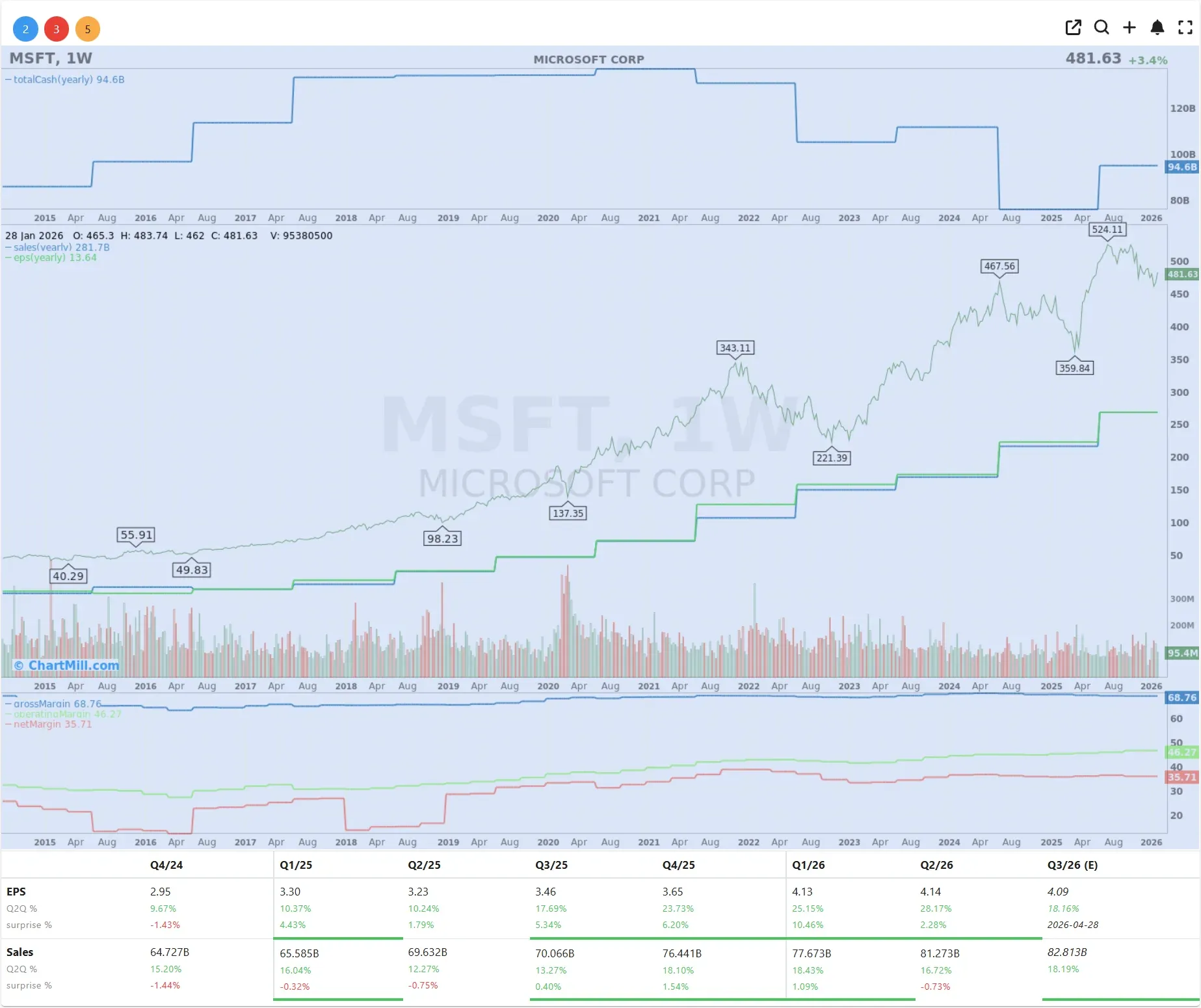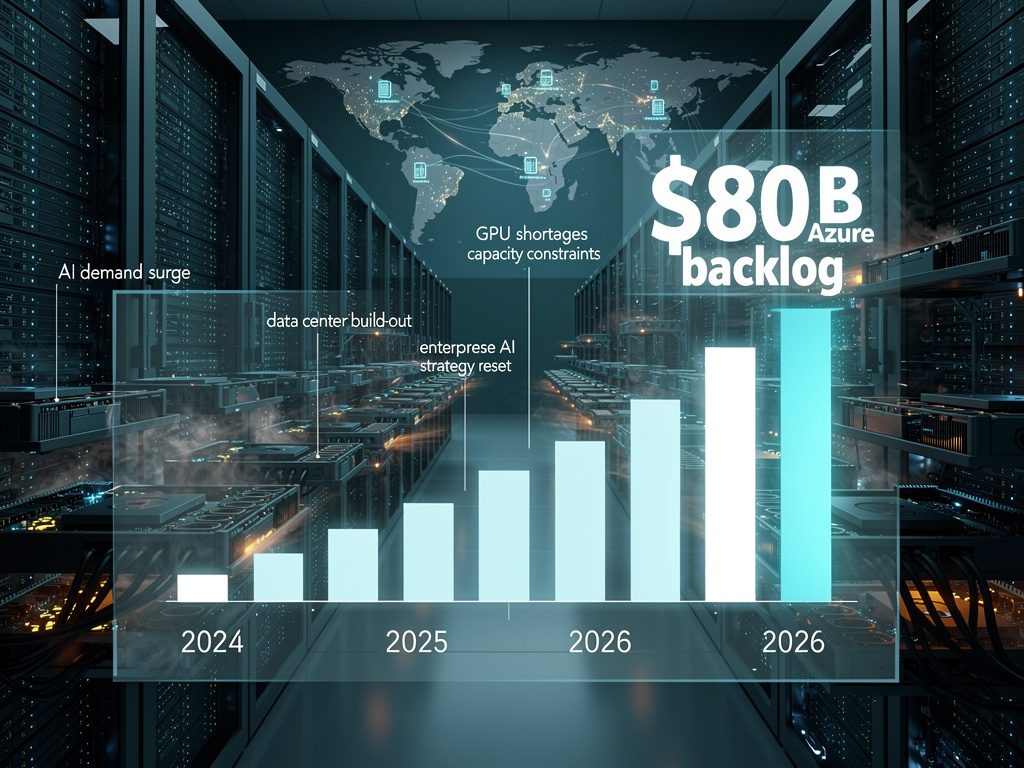



Microsoft's January 28, 2026 earnings reveal a critical infrastructure crisis that directly impacts e-commerce sellers worldwide. The company's stock plummeted 6.1% despite beating earnings expectations and achieving 38% Azure cloud-computing growth, signaling investor concerns about massive capital expenditure ($37.5B capex, up 66% year-over-year) failing to translate into proportional revenue growth. The core issue: severe GPU capacity constraints from limited Nvidia chip supply are forcing Microsoft to allocate computing resources between third-party cloud customers and internal product development teams, creating a supply-demand imbalance that threatens service availability and pricing stability for sellers using Azure infrastructure.

For cross-border e-commerce sellers, this represents an immediate operational risk. Approximately 100,000+ sellers globally rely on Azure cloud services, Microsoft 365, and AI-powered analytics tools for inventory management, order processing, and customer intelligence. Microsoft's guidance of 37-38% Azure growth in Q1 2026 (below analyst expectations of 37%) indicates the company is characterizing growth as "allocated capacity rather than maximum potential growth"—meaning sellers may face service throttling, higher latency, or pricing increases as Microsoft prioritizes internal AI development over customer expansion. The GPU allocation dilemma is particularly acute: CFO Amy Hood explicitly stated that prioritizing third-party cloud capacity would compromise internal GPU availability for Microsoft's own product development teams, forcing a zero-sum choice between seller infrastructure and corporate innovation.
The competitive cloud landscape amplifies seller risk. While Amazon's stock remained relatively flat and Alphabet gained 1.5%, suggesting investors view Google Cloud as better positioned for performance, Microsoft's capex trajectory and capacity constraints create a divergence in cloud provider strategies. Google Cloud and AWS may gain market share as sellers seek more reliable, scalable infrastructure. The broader hyperscaler trend shows that capital intensity alone doesn't guarantee proportional revenue growth—particularly when capacity constraints and competitive dynamics limit pricing flexibility. For sellers, this means Azure's competitive positioning weakens, potentially forcing migration to alternative cloud providers (AWS, Google Cloud) at significant switching costs and operational disruption. The earnings call revealed Microsoft's strategic dilemma: balancing immediate cloud capacity expansion against long-term product innovation, a tension that directly translates to seller infrastructure uncertainty through 2026-2027.
**Immediate AI optimization:** Use Azure Cost Management + AI analytics to identify underutilized resources (typically 20-30% of cloud spend); implement auto-scaling policies to match compute to actual demand patterns. **Predictive cost management:** Deploy Azure Cost Anomaly Detection to flag unusual spending spikes before they impact budgets; use machine learning models to forecast monthly costs and identify optimization opportunities. **Workload optimization:** Migrate batch processing to spot instances (70% cost savings) and reserved instances (40% savings) for predictable workloads; consolidate microservices to reduce API calls and data transfer costs. **AI-powered alternatives:** Replace expensive Azure Cognitive Services with open-source alternatives (OpenAI API, Hugging Face models) for NLP/vision tasks; use AWS SageMaker or Google Vertex AI for model training at 30-50% lower costs. **Seller-specific tactics:** Implement dynamic pricing AI using cheaper cloud providers (AWS Lambda, Google Cloud Functions) instead of Azure; use edge computing (local processing) for real-time inventory updates to reduce cloud API calls by 40-60%. Expected savings: 25-40% reduction in cloud spend by Q2 2026 through AI-driven optimization.
Microsoft's Q1 2026 guidance (37-38% growth, characterized as 'allocated capacity') suggests capacity constraints will persist through Q2-Q3 2026. Pricing increases typically follow capacity constraints by 60-90 days, meaning sellers should expect Azure price announcements by April-May 2026 (effective June-July 2026). Service availability impacts (throttling, latency increases, API quota reductions) may occur sooner (March-April 2026) as Microsoft prioritizes internal AI development. The earnings call revealed management's commitment to 'long-term R&D and product innovation despite investor pressure for faster cloud expansion,' indicating capacity constraints are intentional strategic choices, not temporary supply issues. Sellers should plan for 8-15% cost increases by Q3 2026 and implement cost optimization measures immediately. Monitor Microsoft's quarterly earnings (April, July, October 2026) for capacity and pricing updates.
Microsoft faces unique GPU supply constraints due to Nvidia dependency and internal AI development prioritization, while AWS and Google Cloud maintain more balanced capacity allocation. AWS stock remained relatively flat (neutral investor sentiment), suggesting stable but not exceptional cloud growth. Google Cloud stock gained 1.5%, indicating investor confidence in better capacity positioning and cloud service expansion. AWS operates 31 global regions with diversified GPU access (Nvidia, custom chips), while Google Cloud leverages TPU (Tensor Processing Units) for AI workloads, reducing Nvidia dependency. Microsoft's constraint is structural: CFO Hood explicitly stated internal GPU needs conflict with customer expansion. For sellers, this means AWS and Google Cloud offer more reliable AI service availability and pricing stability through 2026-2027. Sellers with AI-dependent operations should prioritize AWS or Google Cloud migration to avoid Microsoft's capacity bottlenecks.
**Immediate (February 2026):** Audit current Azure usage and costs using Azure Cost Management; document all AI service dependencies (Cognitive Services, Machine Learning, OpenAI integration). **30-day actions:** Request Azure capacity commitments or reserved instances to lock in current pricing before potential increases; evaluate AWS and Google Cloud pricing for equivalent services. **60-day actions:** Develop cloud migration contingency plan if Azure spend exceeds $5,000/month; test workload portability to alternative cloud providers. **90-day actions:** Implement cost optimization (spot instances, auto-scaling, service consolidation) to reduce Azure spend by 20-30% and improve negotiating position with Microsoft. Monitor Microsoft's Q3 2026 earnings (April 2026) for capacity constraint updates and competitive positioning shifts. Set calendar alerts for Azure price change announcements (typically 30-60 days notice).
Microsoft's $37.5B capex prioritizes internal AI product development over customer AI service expansion, creating a resource allocation conflict. The company is investing heavily in OpenAI partnership, Copilot integration, and internal AI capabilities while constraining third-party Azure AI service capacity. This means sellers relying on **Microsoft 365 Copilot** (AI-assisted content creation for product listings), **Azure AI Document Intelligence** (invoice/receipt processing), and **Azure Cognitive Search** (product discovery optimization) may experience delayed feature releases, higher pricing, or reduced API quotas through 2026. Sellers should document current AI tool dependencies and evaluate alternative providers: **OpenAI API** (ChatGPT for content), **Google Vertex AI** (machine learning), **AWS SageMaker** (model training). Budget 15-20% cost increases for Microsoft AI services by Q3 2026.
GPU-intensive services face the highest risk due to Nvidia chip supply constraints. Specifically: **Azure Machine Learning** (AI model training, demand forecasting), **Azure Cognitive Services** (computer vision for product images, NLP for customer reviews), **Azure Synapse Analytics** (large-scale data processing), and **Azure OpenAI Services** (generative AI for product descriptions, customer support). These services directly support seller operations like dynamic pricing optimization, inventory forecasting, and customer intelligence. Non-GPU services like **Azure App Service** (web hosting), **Azure SQL Database** (transactional data), and **Azure Storage** (file/blob storage) face lower risk. Sellers should audit usage by service type in Azure Cost Management by February 2026 and consider shifting GPU workloads to on-demand or spot instances to reduce costs by 40-70%.
The earnings data suggests strategic migration consideration, though not immediate urgency. Microsoft's guidance of 37-38% Azure growth (below analyst expectations) indicates capacity constraints will persist through 2026. AWS remained relatively flat in stock performance while Google Cloud gained 1.5%, suggesting investors view Google as better positioned for cloud performance and capacity expansion. Sellers with 500+ monthly transactions or AI-dependent operations (dynamic pricing, inventory forecasting) should conduct cloud cost audits comparing Azure, AWS (EC2, S3), and Google Cloud (Compute Engine, BigQuery) by March 2026. Migration costs typically range $15,000-50,000 for mid-size sellers, but avoiding future price shocks and service throttling may justify the investment. Prioritize migration if your current Azure spend exceeds $5,000/month.
Microsoft's severe GPU allocation limitations directly threaten Azure pricing stability. The company's $37.5B capex surge (66% year-over-year) combined with constrained GPU supply from Nvidia creates a supply-demand imbalance. CFO Amy Hood explicitly stated that prioritizing third-party cloud capacity would compromise internal GPU availability, forcing Microsoft to choose between seller infrastructure expansion and internal AI development. Sellers should expect potential price increases of 8-15% on compute-intensive services (AI analytics, machine learning models, real-time data processing) by Q2-Q3 2026 as Microsoft monetizes scarce GPU capacity. Monitor Azure pricing dashboards monthly and evaluate AWS or Google Cloud alternatives with 30-60 day migration windows to avoid lock-in.
**Immediate AI optimization:** Use Azure Cost Management + AI analytics to identify underutilized resources (typically 20-30% of cloud spend); implement auto-scaling policies to match compute to actual demand patterns. **Predictive cost management:** Deploy Azure Cost Anomaly Detection to flag unusual spending spikes before they impact budgets; use machine learning models to forecast monthly costs and identify optimization opportunities. **Workload optimization:** Migrate batch processing to spot instances (70% cost savings) and reserved instances (40% savings) for predictable workloads; consolidate microservices to reduce API calls and data transfer costs. **AI-powered alternatives:** Replace expensive Azure Cognitive Services with open-source alternatives (OpenAI API, Hugging Face models) for NLP/vision tasks; use AWS SageMaker or Google Vertex AI for model training at 30-50% lower costs. **Seller-specific tactics:** Implement dynamic pricing AI using cheaper cloud providers (AWS Lambda, Google Cloud Functions) instead of Azure; use edge computing (local processing) for real-time inventory updates to reduce cloud API calls by 40-60%. Expected savings: 25-40% reduction in cloud spend by Q2 2026 through AI-driven optimization.
Microsoft's Q1 2026 guidance (37-38% growth, characterized as 'allocated capacity') suggests capacity constraints will persist through Q2-Q3 2026. Pricing increases typically follow capacity constraints by 60-90 days, meaning sellers should expect Azure price announcements by April-May 2026 (effective June-July 2026). Service availability impacts (throttling, latency increases, API quota reductions) may occur sooner (March-April 2026) as Microsoft prioritizes internal AI development. The earnings call revealed management's commitment to 'long-term R&D and product innovation despite investor pressure for faster cloud expansion,' indicating capacity constraints are intentional strategic choices, not temporary supply issues. Sellers should plan for 8-15% cost increases by Q3 2026 and implement cost optimization measures immediately. Monitor Microsoft's quarterly earnings (April, July, October 2026) for capacity and pricing updates.
Microsoft faces unique GPU supply constraints due to Nvidia dependency and internal AI development prioritization, while AWS and Google Cloud maintain more balanced capacity allocation. AWS stock remained relatively flat (neutral investor sentiment), suggesting stable but not exceptional cloud growth. Google Cloud stock gained 1.5%, indicating investor confidence in better capacity positioning and cloud service expansion. AWS operates 31 global regions with diversified GPU access (Nvidia, custom chips), while Google Cloud leverages TPU (Tensor Processing Units) for AI workloads, reducing Nvidia dependency. Microsoft's constraint is structural: CFO Hood explicitly stated internal GPU needs conflict with customer expansion. For sellers, this means AWS and Google Cloud offer more reliable AI service availability and pricing stability through 2026-2027. Sellers with AI-dependent operations should prioritize AWS or Google Cloud migration to avoid Microsoft's capacity bottlenecks.
**Immediate (February 2026):** Audit current Azure usage and costs using Azure Cost Management; document all AI service dependencies (Cognitive Services, Machine Learning, OpenAI integration). **30-day actions:** Request Azure capacity commitments or reserved instances to lock in current pricing before potential increases; evaluate AWS and Google Cloud pricing for equivalent services. **60-day actions:** Develop cloud migration contingency plan if Azure spend exceeds $5,000/month; test workload portability to alternative cloud providers. **90-day actions:** Implement cost optimization (spot instances, auto-scaling, service consolidation) to reduce Azure spend by 20-30% and improve negotiating position with Microsoft. Monitor Microsoft's Q3 2026 earnings (April 2026) for capacity constraint updates and competitive positioning shifts. Set calendar alerts for Azure price change announcements (typically 30-60 days notice).
Microsoft's $37.5B capex prioritizes internal AI product development over customer AI service expansion, creating a resource allocation conflict. The company is investing heavily in OpenAI partnership, Copilot integration, and internal AI capabilities while constraining third-party Azure AI service capacity. This means sellers relying on **Microsoft 365 Copilot** (AI-assisted content creation for product listings), **Azure AI Document Intelligence** (invoice/receipt processing), and **Azure Cognitive Search** (product discovery optimization) may experience delayed feature releases, higher pricing, or reduced API quotas through 2026. Sellers should document current AI tool dependencies and evaluate alternative providers: **OpenAI API** (ChatGPT for content), **Google Vertex AI** (machine learning), **AWS SageMaker** (model training). Budget 15-20% cost increases for Microsoft AI services by Q3 2026.
GPU-intensive services face the highest risk due to Nvidia chip supply constraints. Specifically: **Azure Machine Learning** (AI model training, demand forecasting), **Azure Cognitive Services** (computer vision for product images, NLP for customer reviews), **Azure Synapse Analytics** (large-scale data processing), and **Azure OpenAI Services** (generative AI for product descriptions, customer support). These services directly support seller operations like dynamic pricing optimization, inventory forecasting, and customer intelligence. Non-GPU services like **Azure App Service** (web hosting), **Azure SQL Database** (transactional data), and **Azure Storage** (file/blob storage) face lower risk. Sellers should audit usage by service type in Azure Cost Management by February 2026 and consider shifting GPU workloads to on-demand or spot instances to reduce costs by 40-70%.
The earnings data suggests strategic migration consideration, though not immediate urgency. Microsoft's guidance of 37-38% Azure growth (below analyst expectations) indicates capacity constraints will persist through 2026. AWS remained relatively flat in stock performance while Google Cloud gained 1.5%, suggesting investors view Google as better positioned for cloud performance and capacity expansion. Sellers with 500+ monthly transactions or AI-dependent operations (dynamic pricing, inventory forecasting) should conduct cloud cost audits comparing Azure, AWS (EC2, S3), and Google Cloud (Compute Engine, BigQuery) by March 2026. Migration costs typically range $15,000-50,000 for mid-size sellers, but avoiding future price shocks and service throttling may justify the investment. Prioritize migration if your current Azure spend exceeds $5,000/month.
Microsoft's severe GPU allocation limitations directly threaten Azure pricing stability. The company's $37.5B capex surge (66% year-over-year) combined with constrained GPU supply from Nvidia creates a supply-demand imbalance. CFO Amy Hood explicitly stated that prioritizing third-party cloud capacity would compromise internal GPU availability, forcing Microsoft to choose between seller infrastructure expansion and internal AI development. Sellers should expect potential price increases of 8-15% on compute-intensive services (AI analytics, machine learning models, real-time data processing) by Q2-Q3 2026 as Microsoft monetizes scarce GPU capacity. Monitor Azure pricing dashboards monthly and evaluate AWS or Google Cloud alternatives with 30-60 day migration windows to avoid lock-in.
**Immediate AI optimization:** Use Azure Cost Management + AI analytics to identify underutilized resources (typically 20-30% of cloud spend); implement auto-scaling policies to match compute to actual demand patterns. **Predictive cost management:** Deploy Azure Cost Anomaly Detection to flag unusual spending spikes before they impact budgets; use machine learning models to forecast monthly costs and identify optimization opportunities. **Workload optimization:** Migrate batch processing to spot instances (70% cost savings) and reserved instances (40% savings) for predictable workloads; consolidate microservices to reduce API calls and data transfer costs. **AI-powered alternatives:** Replace expensive Azure Cognitive Services with open-source alternatives (OpenAI API, Hugging Face models) for NLP/vision tasks; use AWS SageMaker or Google Vertex AI for model training at 30-50% lower costs. **Seller-specific tactics:** Implement dynamic pricing AI using cheaper cloud providers (AWS Lambda, Google Cloud Functions) instead of Azure; use edge computing (local processing) for real-time inventory updates to reduce cloud API calls by 40-60%. Expected savings: 25-40% reduction in cloud spend by Q2 2026 through AI-driven optimization.
Microsoft's Q1 2026 guidance (37-38% growth, characterized as 'allocated capacity') suggests capacity constraints will persist through Q2-Q3 2026. Pricing increases typically follow capacity constraints by 60-90 days, meaning sellers should expect Azure price announcements by April-May 2026 (effective June-July 2026). Service availability impacts (throttling, latency increases, API quota reductions) may occur sooner (March-April 2026) as Microsoft prioritizes internal AI development. The earnings call revealed management's commitment to 'long-term R&D and product innovation despite investor pressure for faster cloud expansion,' indicating capacity constraints are intentional strategic choices, not temporary supply issues. Sellers should plan for 8-15% cost increases by Q3 2026 and implement cost optimization measures immediately. Monitor Microsoft's quarterly earnings (April, July, October 2026) for capacity and pricing updates.