




Microsoft's $357B Stock Collapse Signals AI Infrastructure Cost Crisis for E-Commerce Sellers
- 10% single-day plunge triggers tech sector selloff; cloud service costs and platform fees face upward pressure for sellers relying on Azure, AWS, and marketplace infrastructure












概览
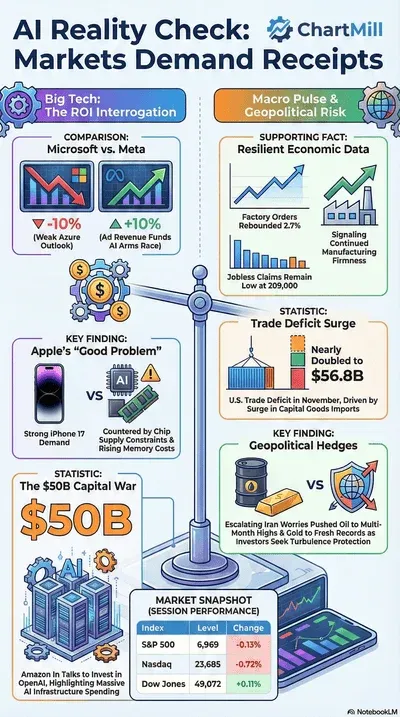
Microsoft's historic $357 billion market capitalization loss on January 29-30, 2026—the second-largest single-day decline for any U.S. company—represents a critical inflection point for e-commerce sellers dependent on cloud infrastructure and technology platforms. The software giant's 10% stock plunge, its worst performance since March 2020, stemmed from disappointing earnings guidance revealing that Azure cloud services growth decelerated to 39% year-over-year, missing the 39.4% consensus forecast. CFO Amy Hood disclosed that Microsoft deliberately reallocated data center capacity from external customer services to internal AI initiatives, prioritizing proprietary offerings like Copilot over external cloud customer capacity. This strategic pivot signals that major cloud providers are constraining external capacity to maximize margins on first-party AI services—a dynamic with direct implications for e-commerce sellers.
The broader technology sector selloff cascaded across multiple platforms and service providers. The Nasdaq Composite fell as much as 2.6% intraday before closing down 0.7%, while the S&P 500 declined 0.1% and the Russell 2000 fell 1.55%. ServiceNow, Workday, and Salesforce experienced significant losses alongside Microsoft, while Meta Platforms bucked the trend with an 8% gain despite announcing substantial AI spending—suggesting market skepticism specifically about Microsoft's cloud infrastructure monetization strategy. The VIX volatility index rose 3.32-7.52 points to 17.44-18.15, indicating elevated market uncertainty. Simultaneously, precious metals reached record highs (gold at $5,094.40), reflecting investor flight to safe-haven assets amid economic uncertainty and the Federal Reserve's decision to hold interest rates steady after three consecutive cuts in late 2025.
For cross-border e-commerce sellers, this market correction carries immediate and long-term operational implications. Technology platform providers supporting e-commerce operations face investor pressure to optimize spending and demonstrate profitability from AI investments, potentially leading to: (1) Higher cloud service fees: Sellers using Azure, AWS, or Google Cloud for inventory management, analytics, and fulfillment optimization may face 5-15% price increases as providers prioritize margin expansion over customer acquisition; (2) Reduced infrastructure investment: Venture capital availability for e-commerce tech startups has contracted, slowing innovation in logistics optimization, payment processing, and marketplace tools that sellers depend upon; (3) Platform budget constraints: Amazon and Microsoft, which operate significant e-commerce and cloud platforms, may reduce investment in seller-facing features, fulfillment network expansion, and competitive pricing; (4) Tighter seller financing: Reduced technology sector valuations and credit availability could increase borrowing costs for sellers seeking working capital or inventory financing. Barclays analyst Raimo Lenschow noted that Azure growth will likely plateau due to law of large numbers and internal capacity allocation, while Bernstein's Mark Moerdler emphasized management's deliberate prioritization of sustainable long-term value over short-term stock performance—accepting near-term capacity constraints to build AI competitive advantages. Wells Fargo maintained an overweight rating, arguing Microsoft's early AI leadership justifies premium valuation, but premarket trading showed stock essentially flat at +0.55%, indicating investor uncertainty about cloud growth trajectories.
问题 8
Should sellers shift away from Microsoft cloud services given the market uncertainty?
While Microsoft's stock declined 10% and faces capacity constraints, immediate migration away from Azure may not be optimal. Wells Fargo maintained an overweight rating, arguing Microsoft's early AI leadership justifies premium valuation. However, sellers should: (1) conduct a cost-benefit analysis comparing Azure, AWS, and Google Cloud pricing for their specific workloads, (2) avoid long-term commitments to Azure at current pricing until market stabilizes, (3) diversify cloud infrastructure across multiple providers to reduce single-vendor risk, and (4) negotiate volume discounts with Microsoft before potential price increases. The premarket trading showed Microsoft stock essentially flat at +0.55%, indicating investor uncertainty about cloud growth trajectories. Sellers with existing Azure investments should maintain current deployments while evaluating alternatives for new projects.
How will reduced venture capital availability impact e-commerce logistics and payment processing innovation?
The technology sector selloff—with the Nasdaq down 0.7% and Russell 2000 down 1.55%—reduces venture capital availability for tech startups, directly impacting innovation in e-commerce infrastructure. Sellers typically benefit from emerging tools in: (1) logistics optimization (route planning, carrier selection), (2) payment processing (lower fees, faster settlement), (3) inventory forecasting (AI-driven demand prediction), and (4) marketplace automation. Reduced VC funding means fewer startups can develop competitive alternatives to established providers, potentially extending seller dependence on higher-cost incumbents. Sellers should: (1) evaluate current logistics and payment providers for lock-in risks, (2) consider investing in internal automation capabilities, and (3) monitor for consolidation in the tech services sector that could reduce competitive pressure on pricing.