

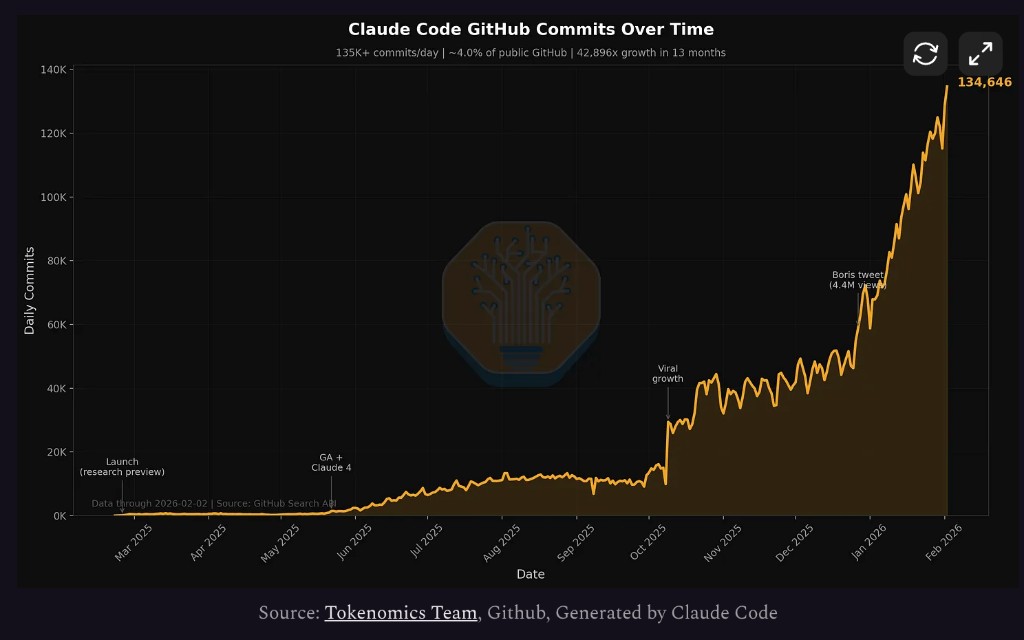



AI-Generated Code Revolution Accelerates E-Commerce Automation | Sellers Must Prepare for Rapid Tool Evolution
- February 2026 watershed moment: Claude Opus 4.6 and GPT-5.3-Codex achieve ~100% AI-written code; AI agent plugins trigger market volatility and create urgent automation opportunities for sellers managing inventory, pricing, and customer service



























/odishatv/media/media_files/2026/02/07/ai-pic-2026-02-07-22-51-29.jpeg)



概览
On February 5, 2026, Anthropic released Claude Opus 4.6 and OpenAI deployed GPT-5.3-Codex, marking a fundamental inflection point in AI development: approximately 100% of code generation now occurs through AI systems rather than human programmers, with minimal human oversight. This watershed moment, emphasized by economist Tyler Cowen, signals that AI-powered business solutions will become dramatically more sophisticated and accessible within 6-12 months. For cross-border e-commerce sellers, this advancement directly impacts three critical operational areas: inventory management systems (automated stock forecasting, SKU optimization), customer service automation (AI-generated responses, multilingual support), and logistics optimization tools (route planning, fulfillment cost reduction).
The immediate market reaction—triggered by Anthropic's February 7 announcement of AI agent plugins for legal, marketing, finance, data analysis, and customer service roles—demonstrates the acceleration's real-world impact. The stock market experienced a massive sell-off following the plugin release, with law firms expressing existential concerns despite assurances that outputs require licensed review. This volatility reveals investor anxiety about widespread economic disruption, but for sellers, it signals that AI automation tools are transitioning from experimental projects to mainstream commercial deployment. Sellers who adopt AI-generated code solutions NOW will gain 6-12 month competitive advantages in automation speed and cost reduction.
Immediate seller opportunities emerge across three dimensions: First, automation wins are achievable immediately—product research, competitive pricing analysis, listing optimization, and customer inquiry responses can be automated using Claude Opus 4.6 and similar models, reducing manual labor by 40-60% for these tasks. Second, data-driven insights become possible through AI analysis of sales patterns, customer sentiment, and market trends, revealing hidden niches and sub-trends faster than competitors. Third, AI tool adoption creates competitive moats—sellers implementing dynamic pricing, predictive inventory management, and AI-powered customer service now will establish 6-12 month advantages before tools become commoditized. The regulatory uncertainty noted in the news (AI automation advancing faster than regulatory frameworks) creates a narrow window for early adopters to capture disproportionate gains before compliance requirements tighten.
问题 8
What specific automation tasks can sellers implement using AI agents right now?
Sellers can immediately automate: (1) Product research and competitor analysis—AI agents scan 1000+ competitor listings daily to identify pricing gaps and trending categories; (2) Dynamic pricing—AI adjusts prices based on demand, inventory levels, and competitor actions, potentially increasing margins 3-8%; (3) Customer service—AI-generated responses handle 70-80% of routine inquiries (shipping status, returns, product questions) in 15+ languages; (4) Listing optimization—AI rewrites product titles, descriptions, and keywords based on search trends and conversion data; (5) Inventory forecasting—AI predicts demand 4-8 weeks ahead, reducing overstock by 20-30% and stockouts by 15-25%. Implementation time: 2-4 weeks per automation.
How does AI-generated code from Claude Opus 4.6 impact e-commerce sellers immediately?
Claude Opus 4.6's ~100% AI-written code enables sellers to deploy sophisticated automation tools for inventory forecasting, dynamic pricing, and customer service within weeks rather than months. Sellers can now use AI agents to analyze competitor pricing in real-time, automatically adjust listings, and respond to customer inquiries across multiple languages simultaneously. This reduces manual operational labor by 40-60% for product research, pricing analysis, and customer support tasks. Early adopters implementing these tools in February-March 2026 will establish 6-12 month competitive advantages before tools become industry standard.