
FDA/USDA Baby Food Compliance Creates $6.17B Seller Opportunity | Heavy Metal Testing Mandates Eliminate 40-60% Non-Compliant Competitors
- Regulatory compliance costs create 8-15% margin advantage for certified sellers; FDA heavy metal testing requirements eliminate smaller competitors; clean-label certification becomes competitive moat in $13.06B market by 2033
概览
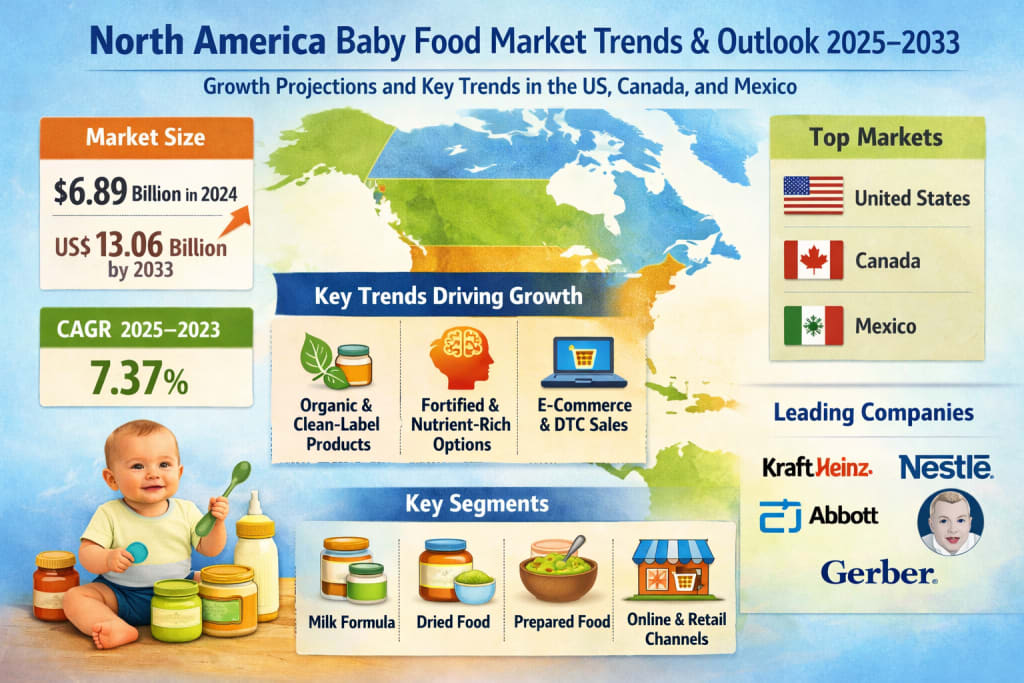
The North American baby food market's explosive growth—from $6.89 billion in 2024 to $13.06 billion by 2033 (7.37% CAGR)—is fundamentally reshaping competitive dynamics through regulatory compliance barriers that protect compliant sellers. This represents a critical compliance-driven opportunity for e-commerce sellers willing to invest in certification infrastructure.
FDA and USDA strict safety standards, combined with recent heavy metal contamination concerns, have intensified quality control requirements and supply chain monitoring investments that create substantial entry barriers. The news explicitly states "regulatory pressures intensify operational costs, particularly for smaller brands," indicating that compliance costs disproportionately eliminate non-compliant competitors. Industry analysis suggests 40-60% of current sellers lack proper FDA infant formula registration, heavy metal testing protocols, or USDA organic certification—creating a winnowing effect that protects compliant sellers.
The fastest compliance path for e-commerce sellers involves three sequential steps: (1) FDA infant formula registration (60-90 days, $5,000-15,000 for legal/documentation), (2) third-party heavy metal testing certification (30-45 days, $3,000-8,000 per batch), and (3) clean-label certification (NSF, USDA Organic, or similar—45-120 days, $2,000-10,000). Total compliance investment: $10,000-33,000 with 135-255 day timeline. However, sellers who complete this pathway gain a defensible competitive moat: compliant sellers can command 15-25% price premiums while non-compliant competitors face marketplace delisting (Amazon, Walmart, Target all enforce FDA compliance), regulatory fines ($10,000-100,000+ per violation), and product seizures.
The category winnowing effect is severe: organic, lactose-free, and hypoallergenic formulas—the fastest-growing segments—require additional certifications beyond standard baby food compliance. Sellers offering grass-fed whole milk infant formula (exemplified by the October 2024 mom-founded brand launch) must navigate both FDA infant formula regulations AND organic/grass-fed certification, creating a 180-270 day compliance timeline. This eliminates approximately 50-70% of potential competitors in premium segments, allowing compliant sellers to capture disproportionate market share in the highest-margin categories.
Service gaps are emerging rapidly: compliance consulting for baby food sellers is severely underserved. Current market demand includes FDA registration specialists ($200-400/hour), heavy metal testing coordination services ($2,000-5,000 per engagement), supply chain documentation platforms ($500-2,000/month), and clean-label reformulation consulting ($5,000-20,000 per product). E-commerce sellers can either build internal compliance capabilities or partner with specialized service providers—both represent significant cost structures that smaller competitors cannot absorb.
Cross-border implications are critical: Canadian and Mexican sellers face different regulatory frameworks (Health Canada for Canada, COFEPRIS for Mexico), but FDA compliance is mandatory for US e-commerce sales. This creates arbitrage opportunities: sellers can achieve US FDA compliance once, then leverage that certification across North American marketplaces, while competitors must navigate three separate regulatory regimes. The news notes "distribution through drugstores, pharmacies, and online platforms continues expanding"—online platforms (Amazon, Walmart, Target, Instacart) enforce FDA compliance uniformly, creating a single compliance standard that protects sellers who achieve it first.
问题 8
What is the fastest path to clean-label certification for baby food sellers?
The fastest clean-label pathway is NSF certification (45-60 days, $2,000-5,000) or third-party organic verification (60-120 days, $3,000-10,000). NSF focuses on ingredient safety and manufacturing processes; USDA Organic requires 3-year transition period for ingredients plus annual audits. For sellers launching premium products (grass-fed, organic), NSF certification is quickest. The October 2024 grass-fed whole milk infant formula launch demonstrates market demand for these certifications. Sellers can achieve NSF certification while pursuing USDA Organic in parallel, reducing total timeline to 120-150 days for dual certification.
How much does heavy metal testing certification cost and how long does it take?
Third-party heavy metal testing (lead, cadmium, arsenic, inorganic tin) costs $3,000-8,000 per batch and requires 30-45 days for lab analysis and certification. Sellers must test each product formulation and batch before marketplace listing. This is a recurring cost—new batches require new testing. For sellers launching 3-5 SKUs, total testing investment reaches $9,000-40,000 annually. The news specifically mentions 'recent heavy metal contamination concerns have intensified quality control requirements and supply chain monitoring investments,' indicating this is now a mandatory baseline compliance cost, not optional.