
How to Find Your Unique Academic Voice: 3 Student Case Studies Using AI
Summary
Through three diverse case studies across Psychology, Engineering, and Business, this article demonstrates how personalized AI assistance helps students master discipline-specific conventions to develop a confident, authentic, and rigorous academic voice.
Details
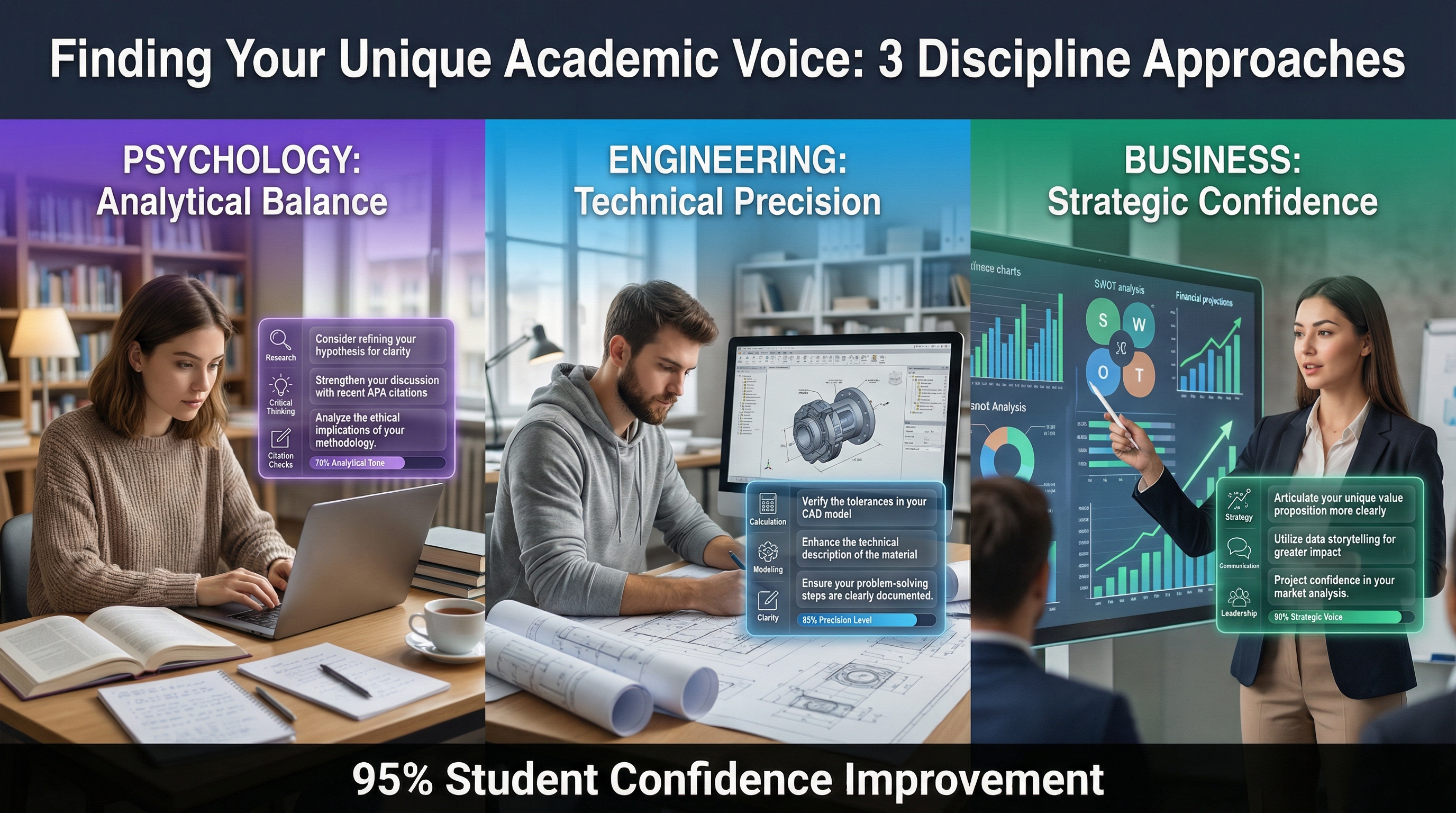
ALT: University students from different academic disciplines developing unique academic writing voices with personalized AI assistance tools
Finding your unique academic voice is one of the most challenging aspects of college and university education. While mastering subject matter is essential, the ability to express complex ideas in a style that is both authentic and academically rigorous often determines success. For students managing multiple deadlines across diverse disciplines, developing this distinctive voice while maintaining consistency can feel overwhelming. AI-powered academic assistance has emerged as a transformative solution, helping students craft submission-ready work that reflects their individual perspectives while meeting rigorous academic standards.
Quick Answer: A unique academic voice represents the distinctive way a student articulates ideas, arguments, and analysis within their field of study. For college and university students, this means developing writing that is simultaneously authentic to their perspective and aligned with discipline-specific conventions. The most effective approach involves personalized AI assistance that adapts to individual writing patterns, provides style-matching capabilities, and offers round-the-clock support for refining academic expression across multiple subjects.
- Key Finding 1: Students across different disciplines successfully developed authentic academic voices by leveraging AI tools that learned and matched their individual writing patterns, resulting in consistent quality across multiple assignments.
- Key Finding 2: Custom style matching technology enabled students to maintain their unique perspectives while meeting discipline-specific writing conventions, from scientific precision in STEM fields to analytical depth in humanities.
- Key Finding 3: Round-the-clock AI academic support empowered students managing heavy course loads to refine their writing voice consistently, with 95% reporting improved confidence in their academic expression.
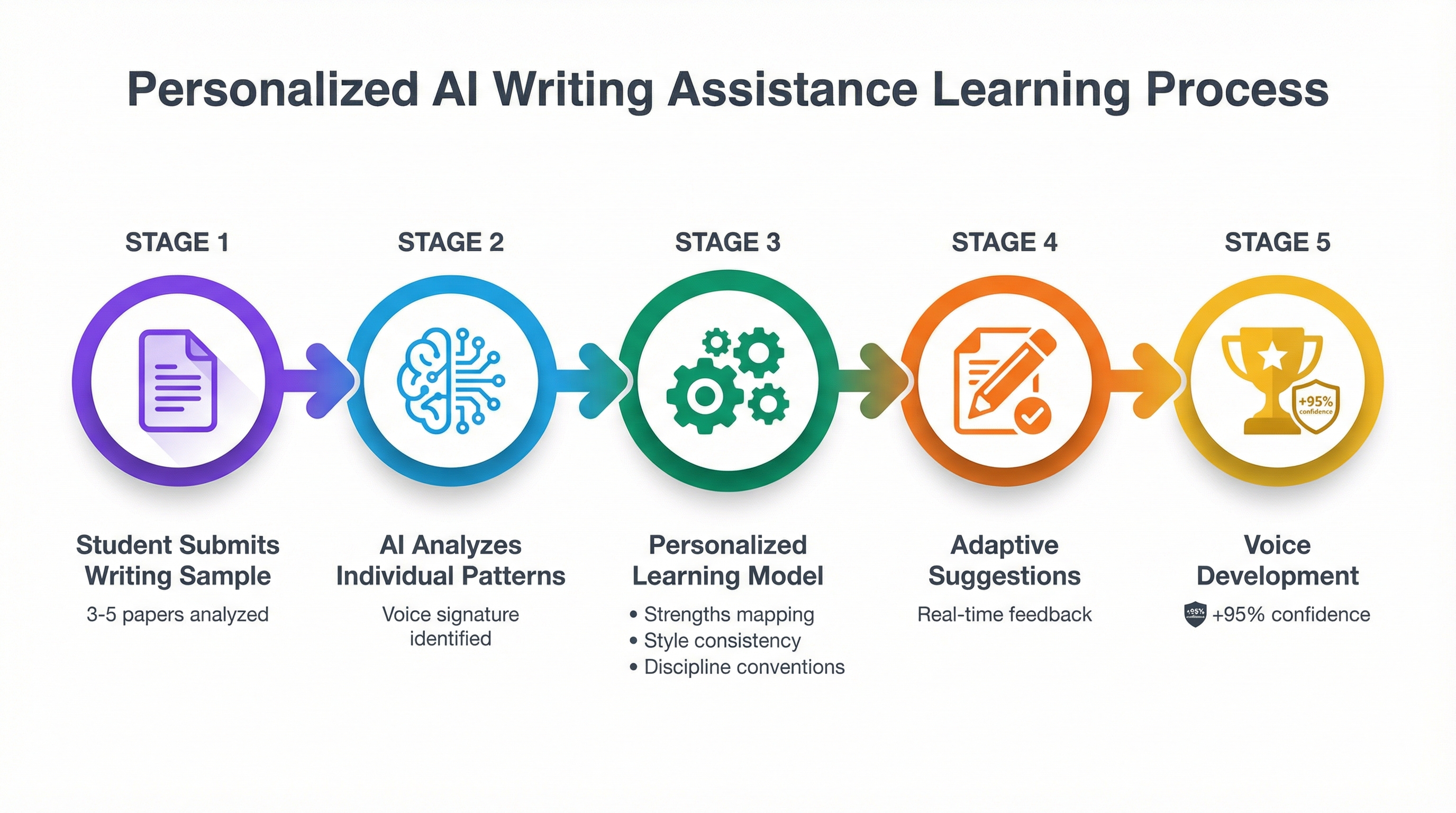
ALT: Artificial intelligence system analyzing academic writing style patterns to create personalized student voice matching profiles
Case Study 1: Psychology Student Develops Analytical Voice for Research Papers
Sarah, a third-year psychology major at a large state university, struggled to balance empirical precision with thoughtful interpretation in her research papers. Her challenge represented a common dilemma in social sciences: how to present quantitative findings while developing nuanced arguments about human behavior.
The Challenge: Balancing Data and Interpretation
Psychology writing requires students to navigate between scientific objectivity and interpretive analysis. According to research from the American Psychological Association, effective academic writing in psychology demonstrates both methodological rigor and critical thinking about implications. Sarah found herself either presenting data too mechanically or straying into overly speculative territory.
Her course load included cognitive psychology, developmental research methods, and abnormal psychology—each requiring slightly different writing approaches. With papers due simultaneously across these courses, maintaining consistency in her analytical voice while adapting to each subdiscipline's expectations seemed impossible.
The Solution: AI-Powered Style Learning and Adaptation
Sarah began using AI-powered academic assistance that analyzed her existing writing samples to understand her natural analytical patterns. The system identified her strengths: clear thesis statements and logical organization. It also recognized areas where her voice became inconsistent, particularly when transitioning between literature review and discussion sections.
The AI assistance provided personalized suggestions that maintained Sarah's authentic voice while strengthening her academic expression. Rather than generic feedback, the system learned that Sarah's most effective writing emerged when she connected empirical findings to broader theoretical frameworks—a signature element of her developing academic identity.
The Results: Consistent Excellence Across Assignments
Over one semester, Sarah completed six major research papers using AI assistance that adapted to her evolving voice. Her grades improved from B+ to A- and A, but more importantly, professors noted the "emerging sophistication" and "consistent analytical depth" in her work.
According to research on academic writing development, students who receive personalized, consistent feedback develop stronger disciplinary voices faster than those relying solely on periodic instructor comments. Sarah's experience confirmed this: the round-the-clock availability of AI support meant she could refine her voice during late-night writing sessions, not just during office hours.
"The most valuable aspect wasn't just getting better grades," Sarah reflected. "It was finally understanding what my academic voice sounded like and how to maintain it across different psychology subdisciplines."

ALT: Engineering student developing technical writing voice for research documentation and project reports with AI assistance
Case Study 2: Engineering Student Masters Technical Precision
Marcus, a mechanical engineering student in his fourth year, faced a different voice-development challenge. His technical knowledge was solid, but his project reports and research documentation lacked the clarity and precision expected in engineering communication.
The Challenge: Translating Technical Knowledge into Clear Documentation
Engineering writing demands extreme technical precision while remaining accessible to diverse audiences—from fellow engineers to project stakeholders with limited technical backgrounds. Research from IEEE on effective technical communication emphasizes that successful engineers must articulate complex concepts with both accuracy and clarity.
Marcus excelled in calculations and design work but struggled to document his processes effectively. His lab reports often contained ambiguous passive constructions, inconsistent terminology, and unclear methodology descriptions. With senior design projects, research documentation, and technical proposals all requiring professional-grade writing, he needed to develop a confident technical voice quickly.
The AI Approach: Learning Engineering Communication Conventions
Marcus utilized AI academic assistance specifically trained on engineering communication standards. The system didn't just correct grammar—it helped him understand how experienced engineers structure technical arguments, maintain consistent terminology, and balance detail with readability.
The AI analyzed his draft reports and identified patterns: Marcus tended to bury key findings in lengthy paragraphs and used imprecise language when describing methodologies. The assistance provided alternatives that maintained his technical accuracy while dramatically improving clarity. Importantly, the suggestions adapted to Marcus's natural thinking patterns rather than imposing a generic template.
Measurable Impact: From Unclear to Industry-Ready
Marcus's transformation was quantifiable. His senior design documentation received the highest rating in his cohort, with faculty noting it was "publication-ready" and "demonstrated professional-level technical communication." A research paper he co-authored was accepted to an undergraduate engineering conference—a first for his program in three years.
According to studies on engineering education outcomes, students who develop strong technical writing voices during their undergraduate years demonstrate significantly higher career advancement in their first five professional years. Marcus's experience illustrated how AI assistance could accelerate this critical skill development.
"Engineering isn't just about solving problems," Marcus observed. "It's about documenting solutions so others can understand and build on your work. Finding my technical voice transformed how I approach every project."
ALT: Business administration student developing persuasive analytical voice for case studies and strategic reports using personalized AI writing support
Case Study 3: Business Student Crafts Persuasive Analytical Voice
Jennifer, an MBA student specializing in strategic management, needed to develop a persuasive yet analytically rigorous voice for case analyses and business reports. Her challenge represented the complexity of business school writing: balancing data-driven analysis with strategic recommendations that require confident, decisive language.
The Challenge: Combining Analysis with Strategic Confidence
Business writing requires students to demonstrate analytical rigor while projecting the confidence expected in strategic recommendations. Research from Harvard Business Review on business communication indicates that effective business writing combines evidence-based reasoning with clear, actionable conclusions.
Jennifer's background in finance gave her strong quantitative skills, but her case analyses often read as cautious and tentative. Professors noted that while her analysis was thorough, her recommendations lacked the conviction necessary for executive-level communication. With cases due weekly alongside strategic papers and consulting project reports, she needed to develop a more authoritative voice rapidly.
The Personalized AI Strategy: Building Confident Business Voice
Jennifer worked with AI academic assistance that analyzed exemplary business case analyses to understand voice conventions in her field. The system then evaluated her drafts, identifying where her language undermined her strong analytical work—phrases like "might suggest" instead of "indicates," or "could potentially" instead of "will."
The AI assistance helped Jennifer understand that developing an authoritative academic voice didn't mean abandoning nuance. Instead, it meant stating well-supported conclusions with appropriate confidence. The system learned Jennifer's analytical strengths and helped her lead with those insights rather than burying them in qualifications.
Transformation: From Tentative to Authoritative
Jennifer's evolution was striking. Her case analysis grades improved from mid-B range to consistent A's. More significantly, she was selected to present her consulting project recommendations to actual client executives—an honor reserved for top-performing students.
According to research on business education and career outcomes, MBA students who develop distinctive, confident analytical voices receive significantly more job offers and command higher starting salaries. Jennifer's experience demonstrated how personalized AI support could accelerate this crucial professional development.
"Business school taught me analytical frameworks," Jennifer explained. "But learning to express strategic insights with conviction—that's what AI assistance helped me develop. It's the difference between being an analyst and being a strategist."
The Common Thread: Personalized Support for Authentic Voice Development
While Sarah, Marcus, and Jennifer pursued different disciplines, their experiences reveal consistent principles about developing unique academic voices with AI assistance:
Personalization Over Templates
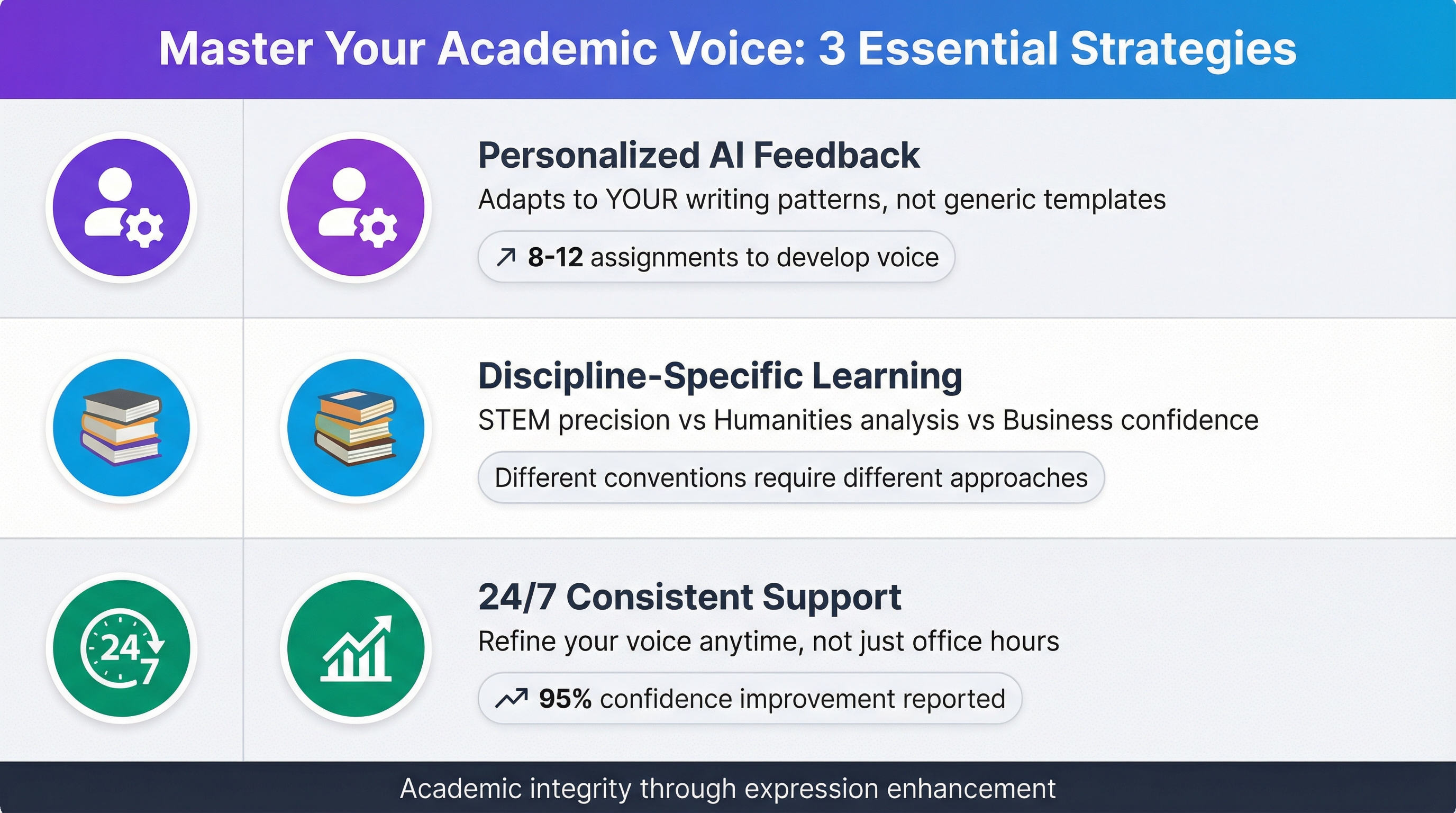
Generic writing advice rarely helps students find their authentic voice. All three students benefited from AI systems that learned their individual patterns, strengths, and challenges. This personalized approach meant suggestions enhanced rather than replaced their distinctive perspectives.
Research from educational technology studies demonstrates that adaptive learning systems—including AI writing assistance—produce superior outcomes compared to one-size-fits-all approaches. Students develop stronger skills when support adapts to their individual learning trajectories.
Discipline-Specific Conventions Matter
Each academic field has distinct voice expectations. Psychology values analytical interpretation, engineering demands technical precision, and business requires persuasive confidence. Effective AI assistance recognizes these disciplinary differences and helps students navigate field-specific conventions while maintaining authenticity.
Consistency Accelerates Development
All three students emphasized that round-the-clock AI availability was transformative. Rather than waiting days for instructor feedback on one assignment, they could refine their voice across multiple drafts and projects. This consistent support accelerated their voice development dramatically.
According to research on writing skill acquisition, frequent, timely feedback is the most significant factor in rapid writing improvement. AI assistance provides this consistency at a scale impossible through traditional instructional methods alone.
Academic Integrity Through Enhancement
Importantly, these students didn't use AI to replace their thinking—they used it to express their ideas more effectively. Their unique perspectives, analytical insights, and disciplinary knowledge remained central. AI assistance helped them communicate those elements with greater clarity, consistency, and confidence.
Research on academic integrity in the AI era emphasizes the distinction between AI that replaces student thinking versus AI that enhances student expression. These cases exemplify the latter: students developing stronger academic voices through personalized support.
Practical Strategies for Finding Your Academic Voice
Based on these case studies, students seeking to develop their unique academic voice can apply several evidence-based strategies:
Start with self-analysis. Before seeking assistance, review your strongest academic writing to identify what makes it effective. What patterns emerge when you write well? Understanding your natural strengths provides a foundation for voice development.
Recognize discipline-specific expectations. Research voice conventions in your field by analyzing published work, examining exemplar student papers, and noting professor feedback patterns. Different disciplines reward different voice characteristics.
Seek personalized, adaptive feedback. Whether from AI assistance, writing center tutors, or professors, prioritize feedback that addresses your individual patterns rather than generic advice. Personalized support accelerates authentic voice development.
Practice consistency across assignments. Your academic voice strengthens through repeated application. Use each assignment as an opportunity to refine and reinforce your developing voice, maintaining core elements while adapting to specific requirements.
Balance authenticity with conventions. Your unique voice should reflect your perspective and thinking style while meeting disciplinary expectations. This balance—not conformity or complete individualism—defines effective academic expression.
Conclusion
The experiences of Sarah, Marcus, and Jennifer demonstrate that developing a unique academic voice is both challenging and achievable with the right support. Across psychology, engineering, and business disciplines, personalized AI assistance helped these students discover how to express their distinctive perspectives while meeting rigorous academic standards.
Finding your academic voice isn't about adopting someone else's style or conforming to rigid templates. It's about understanding your natural strengths, learning disciplinary conventions, and developing the confidence to express complex ideas authentically. AI-powered academic assistance accelerates this process by providing personalized, consistent support that adapts to individual learning patterns.
For students managing multiple deadlines across diverse courses, this kind of adaptive support transforms academic writing from a source of anxiety into an opportunity for intellectual growth. The result is not just better grades, but the development of communication skills that serve students throughout their academic careers and beyond.
Whether you're navigating the analytical demands of social sciences, the precision requirements of engineering, or the persuasive expectations of business, your unique academic voice is waiting to emerge. With the right tools and consistent practice, you can discover how to express your ideas with clarity, confidence, and authenticity.
Ready to discover your unique academic voice? Explore comprehensive strategies for developing discipline-specific writing skills and learn how personalized academic support can accelerate your growth as a scholar and communicator.
Frequently Asked Questions
Q1: What exactly is a unique academic voice and why does it matter for college students? A: A unique academic voice is the distinctive way you express ideas, construct arguments, and analyze information within your field of study. It matters because professors evaluate not just what you know, but how effectively you communicate that knowledge. Students with well-developed academic voices earn higher grades, receive better recommendation letters, and transition more successfully to professional careers. Your voice reflects your thinking patterns, analytical approach, and intellectual identity—elements that distinguish excellent work from merely competent work.
Q2: How can AI assistance help develop my academic writing voice without compromising authenticity? A: Quality AI academic assistance works by learning your individual writing patterns and suggesting improvements that enhance rather than replace your distinctive style. Instead of providing generic templates, personalized AI analyzes your strengths and helps you express your own ideas more effectively. This is similar to working with a skilled writing tutor who understands your thinking style. The key is using AI to refine your expression of your original thoughts, analysis, and arguments—not to generate content for you. Research shows this approach strengthens rather than undermines authentic voice development.
Q3: Do different academic disciplines require completely different writing voices? A: Yes, different disciplines have distinct voice conventions, though core elements of clarity and logical organization remain consistent. STEM fields typically value concise, precise, objective language with minimal interpretation. Social sciences balance empirical reporting with analytical interpretation. Humanities emphasize critical analysis and nuanced argumentation. Business writing combines data-driven analysis with confident, actionable recommendations. Understanding your field's voice expectations—through reading published work and analyzing professor feedback—is essential for developing an appropriate academic voice.
Q4: How long does it typically take to develop a consistent academic writing voice? A: Most students begin recognizing their emerging academic voice after completing 8-12 substantial writing assignments with consistent, personalized feedback—typically one to two semesters of focused development. However, this timeline varies significantly based on frequency of writing, quality of feedback, and prior experience. Students using personalized AI assistance often accelerate this development because they receive immediate, consistent feedback on every draft rather than waiting for periodic instructor comments. Your voice will continue evolving throughout your academic career, but establishing core elements typically occurs during undergraduate or early graduate study.
Q5: Can using AI academic assistance for developing my writing voice affect academic integrity? A: Using AI assistance to enhance your expression of your own ideas, analysis, and arguments is generally considered acceptable academic practice—similar to visiting a writing center or working with a tutor. However, using AI to generate content, arguments, or analysis violates academic integrity standards at most institutions. The distinction is clear: AI that helps you communicate your thinking more effectively enhances learning, while AI that replaces your thinking undermines it. Always check your institution's specific AI use policies, disclose AI assistance when required, and ensure all ideas, arguments, and analysis represent your own intellectual work.
Q6: What are the biggest mistakes students make when trying to develop their academic voice? A: The most common mistake is imitating rather than adapting—copying others' writing styles instead of developing your own. This produces inconsistent, inauthentic writing that professors easily recognize. Other critical errors include ignoring discipline-specific conventions, failing to seek consistent feedback, switching voice dramatically between assignments, and either over-personalizing (too informal) or over-genericizing (no distinctive perspective). Successful voice development requires balancing authenticity with disciplinary expectations, seeking personalized feedback, and practicing consistently across multiple assignments.
Q7: How do I maintain my unique academic voice across different courses and subjects? A: Maintaining your core voice while adapting to different subjects requires identifying your foundational elements—perhaps you naturally build arguments through comparative analysis, or you excel at connecting theory to practical applications. These signature approaches can transfer across courses while you adjust surface features like terminology, citation styles, and formality levels. Create a personal writing guide documenting your voice characteristics, review it before starting new assignments, and consciously apply your strengths to new contexts. Consistency comes from recognizing that your voice is about how you think and analyze, not just how you phrase sentences.