
Self-Checkout Revolution Creates $18.8B Market Opportunity for Retail Tech Providers by 2035
Revolutionizing Retail: AI-Powered Self-Checkout Solutions Unlock $18.8B Market Opportunity
Overview
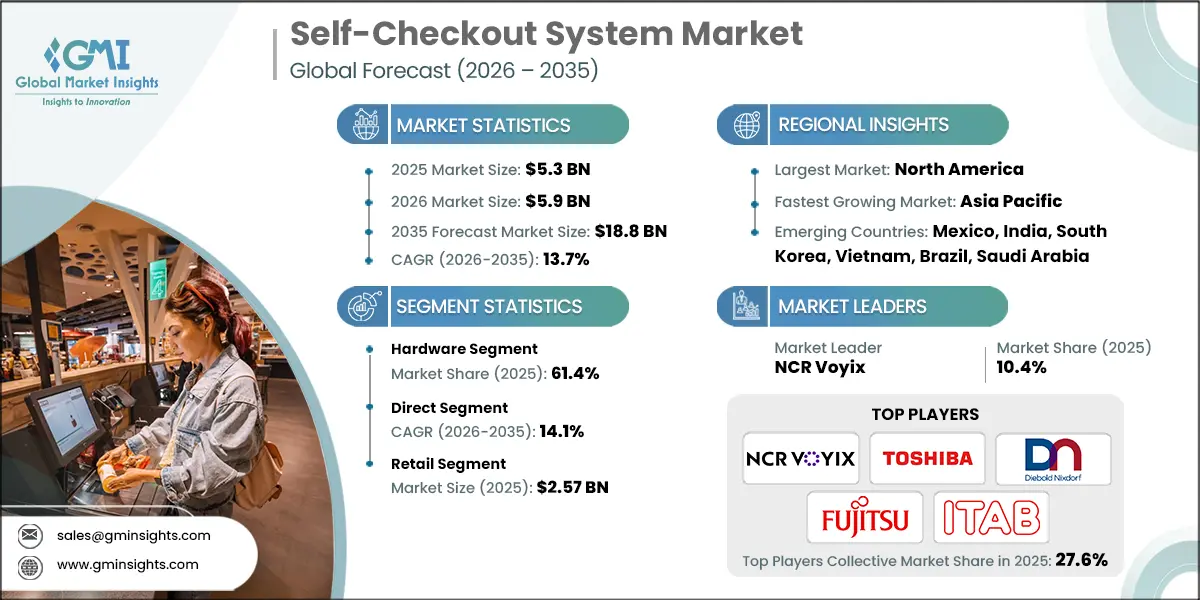
The global self-checkout technology market is experiencing explosive growth, projected to expand from USD 5.3 billion in 2025 to USD 18.8 billion by 2035 at a 13.7% compound annual growth rate. This transformation represents more than incremental improvement—it signals a fundamental restructuring of retail operations worldwide. North America currently leads adoption, while Asia Pacific emerges as the fastest-growing region, with emerging markets including Mexico, India, South Korea, and Brazil presenting unprecedented expansion opportunities. The convergence of contactless payment systems, artificial intelligence, and consumer preference for autonomous shopping experiences has created a perfect storm for retail automation adoption.
Three distinct opportunity categories have emerged from this technological shift, each offering concrete pathways to profitability. First, AI-powered checkout solution providers can capture significant market share by addressing the 68% of smaller retailers who report cost and complexity barriers to adoption. A Shenzhen-based retail technology startup launched AI-enabled self-checkout kiosks in October 2024, targeting mid-sized grocery chains across Southeast Asia. Within 90 days, they secured contracts worth $1.2 million by offering modular systems priced 40% below traditional solutions, with installation timelines reduced from 6 weeks to 10 days. Their success demonstrates that addressing the small-to-medium retailer segment with affordable, simplified technology creates immediate revenue opportunities. Second, mobile payment integration services represent a $3.2 billion sub-market, as retailers require seamless connections between self-checkout hardware and diverse payment platforms. Third, maintenance and support services for deployed systems generate recurring revenue streams, with annual service contracts typically valued at 15-20% of initial hardware costs.
Retail technology providers can establish market presence through a structured 30-day deployment strategy that prioritizes rapid proof-of-concept demonstrations. Week one focuses on identifying 5-10 target retailers in high-growth regions, particularly grocery chains with 3-15 locations that lack resources for custom development. During week two, conduct on-site assessments and prepare customized proposals highlighting labor cost reductions of 25-35% and checkout speed improvements of 40-50%. Week three involves pilot installation at a single location, collecting performance data that demonstrates ROI within 60-90 days. The final week centers on contract negotiation and expansion planning, with initial contracts typically ranging from $50,000 to $200,000 depending on store size and system complexity. Early adopters following this approach can generate $150,000-$400,000 in first-quarter revenue with 30-40% gross margins.
Return on investment analysis indicates that technology providers investing $75,000-$125,000 in initial product development and market entry can achieve break-even within 6-9 months through a combination of hardware sales, software licensing, and service contracts. Compared to traditional retail software solutions yielding 20-25% margins, self-checkout systems offer 30-40% margin potential due to hardware-software bundling and recurring maintenance revenue. Risk mitigation requires focusing on scalable, modular designs that accommodate diverse retail environments without extensive customization. Geographic diversification across North America and Asia Pacific markets reduces dependency on single-region economic fluctuations.
The retail automation transformation creates a rare alignment of technological capability, market demand, and favorable economics. Providers who establish partnerships with regional retail chains before market saturation in late 2025 will secure long-term competitive advantages through installed base effects and switching costs. The Q1-Q2 2025 window represents optimal timing, as retailers plan technology budgets for fiscal year implementations while competition remains fragmented across the $18.8 billion opportunity landscape.
Questions 4
How big is the self-checkout technology market expected to grow by 2035?
The global self-checkout technology market is projected to expand from USD 5.3 billion in 2025 to USD 18.8 billion by 2035, representing a 13.7% compound annual growth rate. This significant growth is driven by retail automation solutions and contactless payment systems.
What are the key opportunities for retail technology providers in self-checkout markets?
Three primary opportunities exist: AI-powered checkout solutions for smaller retailers, mobile payment integration services worth $3.2 billion, and recurring maintenance and support services generating 15-20% of initial hardware costs. Providers can target mid-sized retailers with affordable, modular systems.