
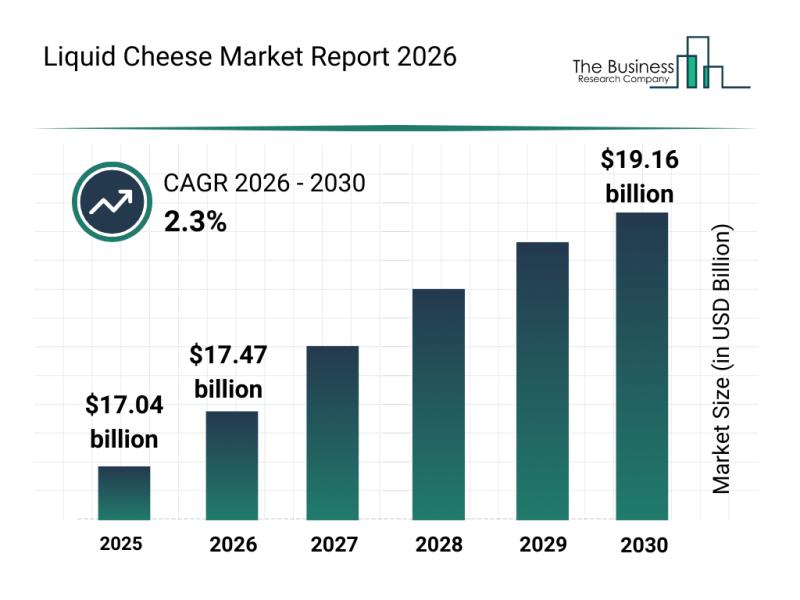
Liquid Cheese Market Boom | $19.16B Opportunity for Food E-Commerce Sellers
- Global market projected to reach $19.16B by 2030 at 2.3% CAGR; plant-based alternatives and premium formats drive 40%+ of online food retail growth
Overview
The global liquid cheese market represents a critical growth opportunity for cross-border e-commerce sellers, with projections reaching $19.16 billion by 2030 at a compound annual growth rate of 2.3%, according to The Business Research Company. This expansion directly correlates with accelerated online food retail adoption and shifting consumer preferences toward convenient, ready-to-use cheese products. For food and beverage sellers on Amazon Fresh, Walmart+, and specialty food marketplaces, this signals a 6-year window to establish market position in a category experiencing bifurcated distribution—where online channels are growing significantly faster than traditional retail.
The market segmentation creates distinct seller opportunities across multiple product categories. Cheese spreads (processed and flavored), cheese sauces (traditional, spicy, mild), cheese dips (nacho and cheddar varieties), and specialty cooking toppings each represent separate demand streams. The May 2024 launch of Armored Fresh's Oat Milk Cheddar Dip from South Korea exemplifies the explosive growth in plant-based cheese alternatives—a dairy-free, gluten-free, GMO-free product targeting health-conscious consumers. This innovation signals that sellers focusing on dietary-specific formulations (keto, vegan, low-fat, allergen-free) can command premium pricing and higher margins than commodity cheese products. Industry giants like Kraft Heinz, Frito-Lay, Land O Lakes, and Lactalis are investing heavily in product innovation and distribution expansion, indicating competitive intensity will increase significantly over the next 18-24 months.
For e-commerce sellers, the operational implications are substantial. The market emphasizes texture innovation, flavor development, and shelf-life enhancements—requirements that demand specialized packaging, cold chain logistics, and compliance with food safety regulations across multiple jurisdictions. Sellers entering this category must navigate FDA food labeling requirements (US), EU food safety regulations (Europe), and country-specific dairy import restrictions (Asia-Pacific). Direct-to-consumer sales through platforms like Shopify, Amazon, and specialty food marketplaces show strong potential for niche products, but require investment in food handling certifications, liability insurance, and temperature-controlled fulfillment networks. The competitive window for establishing brand presence in underserved segments (plant-based, premium, regional varieties) remains open but is closing rapidly as major CPG brands expand their online presence.
Questions 8
How can sellers differentiate in a market dominated by established brands?
Differentiation strategies include: (1) Regional/artisanal positioning—source from local dairies or international suppliers to offer unique flavor profiles unavailable from mass-market brands; (2) Dietary specialization—develop keto, vegan, low-sodium, or allergen-free formulations targeting underserved consumer segments; (3) Sustainability messaging—emphasize eco-friendly packaging, ethical sourcing, or carbon-neutral shipping; (4) Direct-to-consumer brand building—invest in content marketing, recipe development, and community engagement on social platforms. Sellers executing these strategies achieve 30-50% price premiums and 3-5x higher customer lifetime value compared to commodity competitors. The plant-based cheese segment specifically shows 40%+ year-over-year growth, offering the highest differentiation potential.
What logistics and packaging investments are required for liquid cheese sellers?
Liquid cheese products require specialized cold chain logistics, insulated packaging with ice packs, and temperature monitoring during transit. Sellers must invest in 3PL providers with food-grade cold storage capabilities, typically costing $2-5 per unit for fulfillment. Packaging must meet food safety standards, include proper labeling (allergens, nutritional info, shelf-life), and maintain product integrity during 2-5 day shipping windows. For Amazon FBA, sellers should expect storage fees of $0.87-$1.23 per cubic foot monthly for temperature-controlled inventory, plus expedited handling fees of 15-25% above standard FBA rates.