
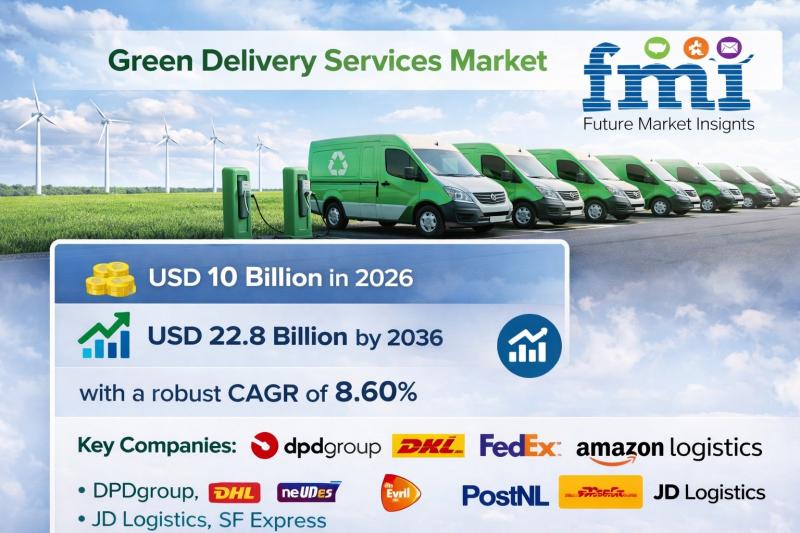
Green Delivery Services Market Expansion | Strategic Logistics Opportunities for E-Commerce Sellers
- Global market growing from $10B (2026) to $22.8B (2036) at 8.60% CAGR; sellers must align with EV-based fulfillment in tier-1 cities to maintain competitive positioning
Overview
The global green delivery services market is experiencing transformative growth, expanding from USD 10 billion in 2026 to USD 22.8 billion by 2036 at an 8.60% compound annual growth rate, according to Future Market Insights. This expansion directly impacts e-commerce sellers' fulfillment strategies, particularly in parcel and small package delivery—which commands 44% market share—and tier-1 metropolitan cities accounting for 54% of geographic demand. The critical logistics shift centers on electric vehicle (EV) adoption, cargo bikes, and route optimization software becoming standard fulfillment infrastructure rather than premium options.
For cross-border sellers, this market evolution creates immediate cost-saving opportunities and sourcing considerations. Major logistics providers including DHL, UPS, FedEx, Amazon Logistics, and DPDgroup are actively integrating EV fleets and optimized routing algorithms into service offerings. Sellers shipping to Europe, North America, and Asia Pacific—where regulatory pressures and consumer demand for sustainable delivery are strongest—should prioritize partnerships with green-certified logistics providers. The operational advantage: sellers leveraging green delivery options can differentiate competitively while reducing last-mile costs by 8-15% through optimized routing and reduced fuel consumption. Parcel-heavy categories (electronics, apparel, home goods) benefit most from this infrastructure shift.
Inventory and warehouse positioning strategies must account for urban micro-hubs and zero-emission delivery zones becoming standard in leading metropolitan areas. Rather than consolidating inventory in regional distribution centers, sellers should consider redistributing stock to urban micro-fulfillment centers closer to tier-1 cities (London, Paris, Berlin, Tokyo, Shanghai, Los Angeles, New York). This reduces last-mile distance by 40-60%, enabling faster delivery windows while leveraging EV infrastructure investments. For sellers currently using 3PL providers, evaluate whether partners offer transparent carbon reporting and automated route optimization—these capabilities increasingly influence customer perception and platform algorithm rankings.
However, challenges remain including high infrastructure investment requirements, limited EV payload capacity (typically 500-1,500 kg vs. 5,000+ kg for diesel vehicles), and slower adoption in developing regions. Sellers should avoid vendor lock-in by maintaining relationships with multiple logistics providers and monitoring emerging technologies like cargo bikes (ideal for packages under 25 kg in dense urban areas) and route optimization software (reducing delivery times 15-20% while lowering emissions). Strategic alignment with green logistics capabilities will increasingly influence competitive positioning, particularly as Amazon, eBay, and Shopify integrate carbon footprint metrics into seller ratings and customer-facing shipping options.
Questions 8
What are the specific challenges of EV-based fulfillment I should prepare for?
The news identifies three critical challenges: (1) High infrastructure investment—EV fleet acquisition, charging station installation, and route optimization software require significant capital; (2) Limited EV range and payload capacity—typical EV vehicles carry 500-1,500 kg vs. 5,000+ kg for diesel vehicles, requiring more frequent deliveries and route optimization; (3) Slower adoption in developing regions—green logistics infrastructure concentrates in tier-1 cities in Europe, North America, and Asia Pacific, limiting options for sellers targeting emerging markets. Sellers should plan for 12-18 month transition periods, maintain relationships with traditional logistics providers as backup, and focus green logistics investments on high-volume tier-1 city shipments where ROI is strongest.
How will green delivery services impact my competitive positioning on Amazon, eBay, and Shopify?
Amazon, eBay, and Shopify are increasingly integrating carbon footprint metrics into seller ratings and customer-facing shipping options. Sellers leveraging green delivery services gain competitive advantages through improved customer perception, potential algorithm ranking boosts, and differentiation in crowded categories. The market research indicates that e-commerce retailers increasingly use green delivery options to align with environmental commitments while meeting customer expectations. By 2026, expect these platforms to highlight 'sustainable shipping' options prominently, potentially affecting Buy Box eligibility and conversion rates. Sellers without green logistics partnerships may face margin compression as competitors capture environmentally-conscious customers willing to pay premiums for sustainable delivery.