


AI-Driven Legacy System Automation Reshapes Enterprise Tech Spending | Seller Infrastructure Risk
- IBM stock plunges 26.8% in February 2026 as Claude Code threatens $12.5B AI business; payment/SaaS vendors face investor scrutiny affecting e-commerce infrastructure stability




















/tpg/sources/c6306648-4910-47c2-a6af-5d64575d02aa.jpeg)


/International%20Business%20Machines%20Corp_%20logo%20on%20phone-by%20rafapress%20via%20Shutterstock.jpg)






Overview
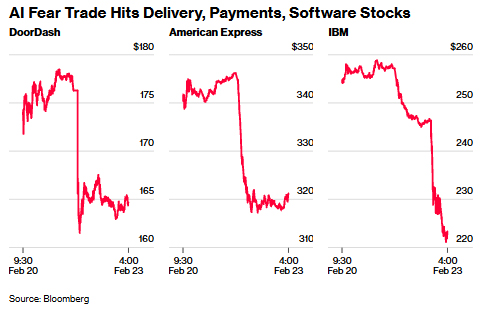
The February 2026 market shock triggered by Anthropic's Claude Code announcement reveals a critical vulnerability in enterprise software spending patterns that directly impacts e-commerce sellers' operational infrastructure. On February 23, 2026, IBM's stock fell 13.2%—the worst single-day performance since March 2020—with the month-to-date decline reaching 26.8%, positioning it for the worst month since December 1992. The catalyst: Claude Code can automate COBOL modernization, a process historically requiring months or years of specialized consulting that generated substantial revenue for IBM's consulting divisions and Z mainframe business (which achieved 48% year-over-year growth in Q4 2025, reaching its highest revenue in 20 years).
The AI Automation Threat to Enterprise Infrastructure Spending: COBOL powers 95% of U.S. ATM transactions and critical systems across banking, travel, insurance, and government sectors. IBM's traditional consulting model relied on labor-intensive modernization projects—a revenue stream now threatened by AI automation that can compress timelines from years to quarters. This market reaction signals broader concerns about AI's disruptive potential on established business models. The Citrini Research report released February 22-23, 2026, amplified these concerns, triggering what analysts termed an "AI scare trade" affecting payment processing companies, SaaS providers, and software vendors—the exact infrastructure layer that e-commerce sellers depend upon for inventory management, payment processing, and logistics optimization.
Direct E-Commerce Seller Implications: For cross-border sellers, this volatility carries significant operational risks. Payment processing companies and SaaS providers that experienced notable stock declines face potential constraints on investment capacity and service development. Sellers relying on platforms like Shopify, BigCommerce, or specialized 3PL software should monitor these vendors' financial stability and service continuity. The market correction demonstrates how AI announcements can trigger rapid reassessment of technology vendor valuations, potentially affecting service pricing, feature development roadmaps, and platform reliability investments. IBM's stock rebound on February 24 (defended by analysts citing mainframe resilience and 100% uptime guarantees) suggests the market may stabilize, but the underlying concern persists: AI automation is compressing the timeline for legacy system modernization, reducing the consulting revenue that historically funded enterprise infrastructure investments.
Competitive Intelligence Opportunity: The market's overreaction to Claude Code's capabilities reveals a critical insight: enterprises are far more entrenched in legacy systems than AI vendors assume. Analysts noted that mainframe migration is not novel—IBM's customers have consistently chosen to remain on the platform despite having opportunities to leave. This suggests that while AI can automate code translation, the operational complexity of migration (resilience, performance tuning, change management) remains a significant barrier. For sellers, this indicates that enterprise software vendors will likely survive the AI disruption wave, but their growth rates may compress as automation reduces consulting revenue. Sellers should anticipate potential price increases from SaaS vendors seeking to offset margin compression from AI-driven automation.
Questions 7
How does Anthropic's Claude Code threat to IBM's business affect e-commerce sellers?
Claude Code's ability to automate COBOL modernization threatens IBM's consulting revenue model, which historically funded enterprise infrastructure investments. For e-commerce sellers, this matters because payment processors, SaaS vendors, and logistics platforms depend on enterprise software spending to fund their own development and reliability improvements. IBM's stock decline from 13.2% on February 23, 2026, signals investor concerns about technology vendor profitability. Sellers should monitor their SaaS vendors' financial stability and anticipate potential price increases as vendors seek to offset margin compression from AI-driven automation reducing consulting revenue.
What is the connection between IBM's stock decline and e-commerce payment processing?
The February 2026 market shock triggered by Claude Code announcements catalyzed an 'AI scare trade' affecting payment processing companies and software vendors—critical infrastructure for online merchants. News reports indicate that payment processing companies experienced notable stock declines, potentially affecting their investment capacity and service development. Sellers dependent on payment gateways like Stripe, Square, or PayPal should monitor these companies' financial health, as reduced investment capacity could slow feature development, increase processing fees, or impact service reliability. The market correction demonstrates how AI disruption concerns can rapidly affect the technology ecosystem supporting e-commerce operations.