





AI Market Volatility Threatens E-Commerce Seller Financing | Capital Crunch 2026
- $1 trillion software sector selloff disrupts SaaS platforms for inventory/payment processing; venture capital drying up for seller expansion; consumer staples rotation signals flight from growth tech investments












Overview
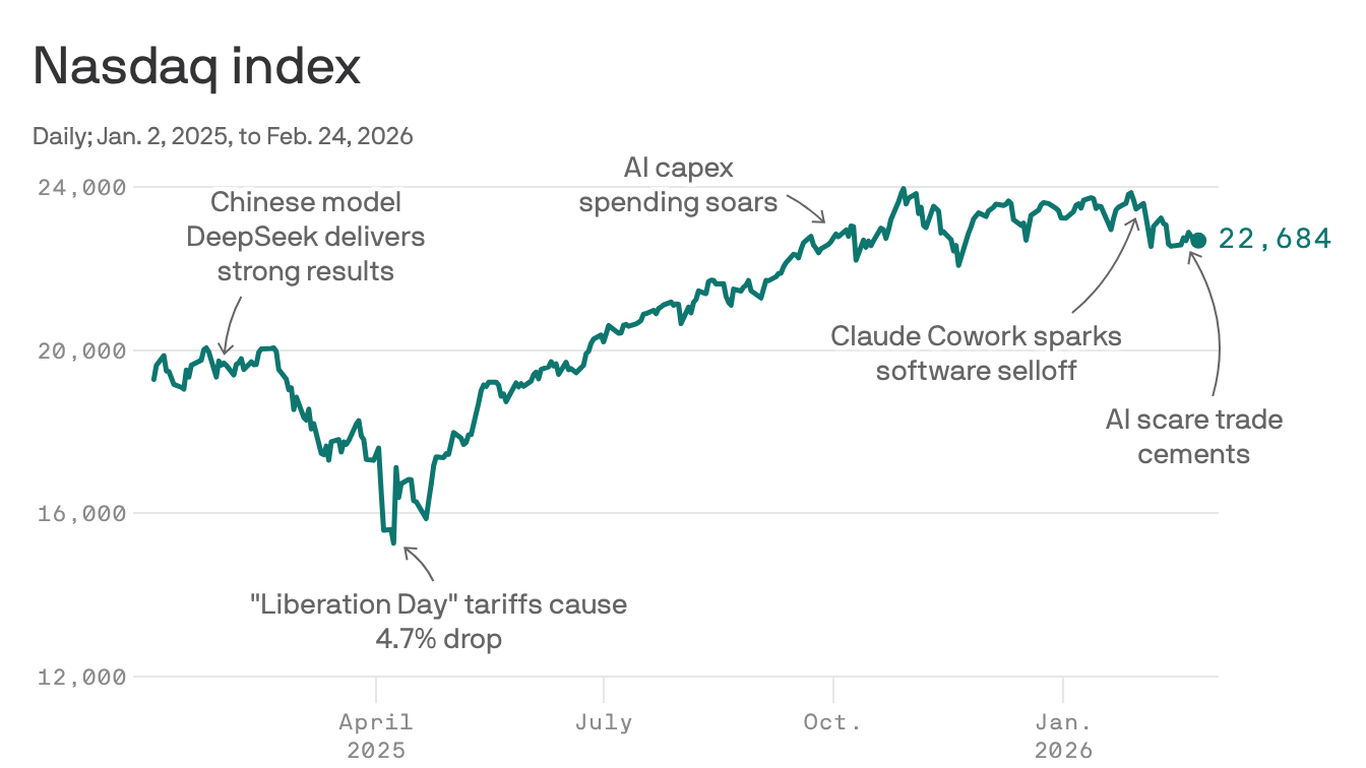
The AI market volatility crisis directly threatens e-commerce sellers' access to growth capital and operational infrastructure. Between January 2025 and February 2026, the Nasdaq experienced extreme boom-bust cycles triggered by AI announcements—including DeepSeek's open-source model launch and Anthropic's Claude Code release—that sparked a $1 trillion software sector selloff. This volatility creates cascading operational challenges for technology-dependent e-commerce businesses. The $1 trillion software sector decline directly impacts the SaaS platforms that e-commerce sellers rely on daily: inventory management systems (Shopify, Sellfy), payment processors (Stripe, Square/Block), and logistics optimization tools. Block's 40% workforce reduction announcement in February 2026 signals accelerating AI-driven cost-cutting across fintech and payment infrastructure providers, potentially affecting service reliability and feature development for seller platforms.
Capital availability for seller growth has contracted sharply. The market rotation toward consumer staples stocks (which became more expensive than technology stocks by February 2026) indicates investor flight from growth-oriented technology investments. This directly reduces venture capital availability for e-commerce infrastructure improvements, 3PL innovations, and seller acquisition tools. Sellers relying on tech stock valuations for acquisition financing or expansion capital face increased uncertainty—particularly mid-market sellers ($1-10M revenue) who depend on venture-backed payment processors and logistics platforms. The "narrative roulette" environment means investor sentiment can swing 30% in either direction based on product announcements (Nvidia's earnings provided temporary stabilization in Q1 2026), creating unpredictable conditions for sellers planning capital expenditures.
Immediate operational risks emerge from SaaS platform instability. The software sector's 9-13% stock declines (Microsoft down 9%, Oracle down 13% on February 27, 2026) directly threaten the financial stability of smaller SaaS providers that e-commerce sellers depend on. Payment processors like Stripe and Square face pressure to reduce costs, potentially through feature cuts, price increases, or service consolidation. Inventory management platforms may reduce R&D spending on AI-powered demand forecasting and dynamic pricing tools—capabilities that give sellers competitive advantages. The Dow's 500-800 point declines on AI-related news create uncertainty for sellers planning quarterly budgets, as platform pricing and feature availability remain unpredictable. Sellers should monitor their SaaS provider stock performance and financial health as leading indicators of potential service disruptions or cost increases.
Questions 8
What SaaS tools should I evaluate or replace due to financial instability?
Audit your SaaS stack for financial risk: (1) Check provider stock performance and funding status—venture-backed companies with no clear path to profitability face higher risk; (2) Evaluate alternatives for critical functions (payment processing, inventory management) to reduce single-provider dependency; (3) Prioritize tools with strong parent companies (Shopify, Amazon, Microsoft) over standalone startups; (4) Negotiate multi-year contracts at fixed prices before Q2 2026 to lock in current rates; (5) Test backup solutions for payment processing (Stripe, PayPal, Adyen) to ensure continuity if primary provider experiences disruptions. The software sector's 9-13% declines suggest 15-25% of smaller SaaS providers may face funding pressure through 2026, making diversification critical for operational resilience.
How should I adjust my capital planning during AI market volatility?
The current environment exhibits 'narrative roulette'—investor sentiment swings 30% based on AI product announcements and competitive developments. For capital planning, adopt a conservative approach: (1) Reduce planned capital expenditures by 20-30% until volatility stabilizes in Q2 2026; (2) Prioritize cash-on-hand over debt financing, as interest rates may rise if market corrections accelerate; (3) Accelerate any planned acquisitions or financing before Q2, when capital becomes scarcer; (4) Build 6-month cash reserves instead of typical 3-month buffers. Nvidia's earnings reports provide temporary market stabilization, so watch for these as windows for capital-intensive decisions. The underlying concern remains that AI valuations may be unsustainable, suggesting caution through mid-2026.