
Mandatory Safety Compliance Drives $38.4B Sports Equipment Market | Seller Certification Opportunities
- Global market expanding 6.8% CAGR through 2036 as mandatory regulations eliminate non-compliant competitors; helmets capture 42% share with strict certification requirements across football, hockey, rugby, cycling
Overview
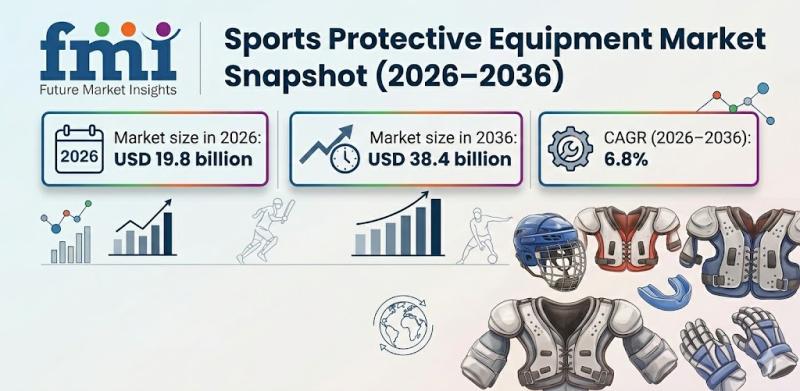
The global sports protective equipment market represents a compliance-driven growth opportunity expanding from $19.8 billion in 2026 to $38.4 billion by 2036 at a 6.8% CAGR. This explosive growth is fundamentally driven by mandatory safety compliance requirements across organized sports, creating a powerful market moat that eliminates non-certified sellers while rewarding compliant manufacturers. The market structure reveals critical compliance barriers: helmets dominate with 42% market share specifically because of concussion risk mitigation requirements across football, hockey, rugby, and cycling, while contact sports represent 46% of applications with strict league safety mandates and structured equipment replacement cycles.
Regional compliance fragmentation creates distinct seller opportunities. North America leads at 7.2% CAGR (US-focused), while Asia Pacific emerges as the fastest-growing region with China at 8.1% CAGR and India at 7.8% CAGR, driven by government-backed sports development programs and expanding school sports participation. Germany contributes steady 6.9% CAGR growth in Europe. This geographic variation means sellers face different certification pathways by region—US sellers must navigate NOCSAE (National Operating Committee on Standards for Athletic Equipment) standards, EU sellers require CE marking compliance, and Asian sellers must meet increasingly stringent national sports safety standards. The certification complexity creates a high barrier to entry that protects established manufacturers like Riddell Sports Group, Schutt Sports, Bauer Hockey, and Adidas AG, who compete primarily on certification compliance and material innovation rather than price alone.
Institutional purchasing decisions increasingly prioritize certified, data-validated equipment capable of meeting evolving insurance and liability requirements, transforming protection systems into strategic safety investments. This institutional focus creates a service gap opportunity: schools, sports leagues, and athletic departments need compliance verification, certification tracking, and liability documentation services. Manufacturers integrating lightweight composites, multi-density foam systems, and impact monitoring technologies command premium pricing because they deliver both compliance and performance. The market faces challenges from advanced material cost pressures and regional regulatory fragmentation, but these barriers actually protect compliant sellers by raising the cost of market entry. Sellers without existing certification infrastructure face 6-12 month timelines and $50,000-$200,000+ investment to achieve multi-region compliance, effectively winnowing the competitive field and protecting established players with existing certifications.
Questions 8
What compliance requirements are driving the $38.4B sports equipment market growth through 2036?
Mandatory safety compliance requirements across organized sports are the primary growth driver, with the market expanding from $19.8B in 2026 to $38.4B by 2036 at 6.8% CAGR. Helmets capture 42% market share specifically due to concussion risk mitigation requirements in football, hockey, rugby, and cycling. Contact sports represent 46% of applications with strict league safety mandates and structured equipment replacement cycles. These regulations create a compliance moat that eliminates non-certified sellers while protecting established manufacturers competing on certification compliance rather than price alone.
How do regional compliance standards differ for sports equipment sellers across North America, Europe, and Asia?
Regional compliance fragmentation creates distinct certification pathways: US sellers must navigate NOCSAE (National Operating Committee on Standards for Athletic Equipment) standards for helmet certification, EU sellers require CE marking compliance under product safety directives, and Asian sellers face increasingly stringent national standards. China leads Asia Pacific growth at 8.1% CAGR while India grows at 7.8% CAGR, both driven by government-backed sports development programs. This geographic variation means sellers entering multiple regions face 6-12 month certification timelines and $50,000-$200,000+ investment per region, creating a high barrier to entry that protects compliant competitors.