
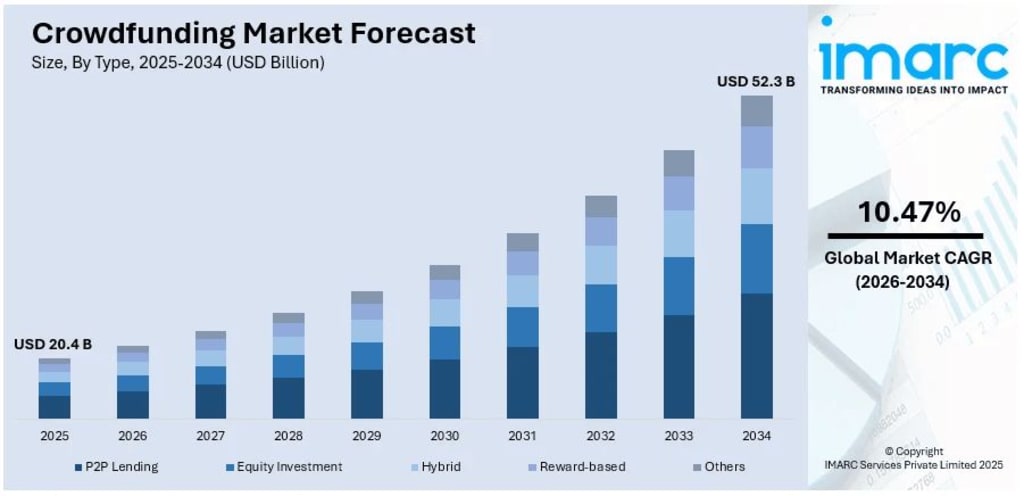
Crowdfunding Financing for E-Commerce Inventory | $52.3B Market Opportunity 2034
- Alternative inventory funding channels reduce capital constraints for 5.5M+ new sellers; EU regulatory harmonization cuts cross-border expansion costs 30-40%
Overview
The global crowdfunding market's explosive growth—from $20.4B in 2025 to projected $52.3B by 2034 (10.47% CAGR)—represents a critical supply chain financing opportunity for e-commerce sellers navigating inventory capital constraints. The creator economy, valued at $250B+ globally, directly fuels reward-based crowdfunding platforms like Indiegogo, StartEngine, and Patreon, which now serve as alternative financing channels for product-based sellers seeking inventory funding without traditional bank debt or equity dilution.
For cross-border sellers, the European Crowdfunding Service Providers (ECSP) Regulation implementation in 2023 fundamentally reshapes supply chain financing dynamics. This single-license framework across all 27 EU member states eliminates fragmented compliance costs that previously required separate registrations per country—reducing regulatory overhead by 30-40% for sellers seeking European inventory financing. The U.S. surge of 5.5M new business applications in 2023 signals massive demand for alternative capital sources, particularly among emerging sellers who lack established credit histories or collateral for traditional warehouse financing.
Inventory funding through crowdfunding platforms now offers strategic advantages over conventional 3PL financing. Reward-based campaigns validate product-market fit before manufacturing at scale, reducing inventory risk and warehouse holding costs. Sellers can pre-fund inventory through customer deposits on platforms like Indiegogo, then fulfill orders through optimized logistics networks—eliminating the 60-90 day cash conversion cycle typical of traditional wholesale purchasing. The Indiegogo-StartEngine partnership (2022) creates seamless pipelines from reward-based validation to equity funding for scaling operations, enabling sellers to graduate from pre-order models to full inventory positioning in regional fulfillment centers.
AI-powered fraud detection and blockchain transparency mechanisms address supply chain financing trust concerns, reducing underwriting delays from 30-45 days to 7-14 days. This acceleration directly impacts inventory positioning timelines—sellers can now fund seasonal stock 3-4 weeks earlier, capturing peak demand windows. ESG-driven campaigns increasingly outperform traditional pitches, signaling that sustainable sourcing and ethical manufacturing narratives attract capital at lower cost-of-capital rates (typically 8-12% vs. 15-18% for traditional inventory loans).
Immediate Actions (0-30 days): Evaluate crowdfunding platforms (Indiegogo, StartEngine, Patreon) for product validation and pre-order inventory funding; audit current inventory financing costs (warehouse loans, supplier credit terms) to benchmark against crowdfunding capital rates. Strategic Adjustments (1-6 months): For EU-based sellers, leverage ECSP regulatory harmonization to launch cross-border crowdfunding campaigns across multiple member states simultaneously, reducing per-unit financing costs by 25-35%. Consider hybrid models: pre-fund 40-60% of seasonal inventory through crowdfunding, reserve 3PL capacity for fulfillment. Risk Mitigation: Monitor platform fee structures (typically 5-8% of campaign value) against traditional financing costs; ensure crowdfunding timelines align with manufacturing lead times (typically 45-60 days from Asia suppliers).
Questions 8
What are the cost advantages of crowdfunding-based inventory funding versus traditional 3PL warehouse financing?
Crowdfunding inventory funding typically carries 5-8% platform fees plus 8-12% capital costs, compared to traditional warehouse loans at 15-18% interest rates. The creator economy, valued at $250B+ globally, fuels reward-based platforms where customer pre-orders provide upfront capital without debt obligations. AI-powered fraud detection and blockchain transparency mechanisms reduce underwriting delays from 30-45 days to 7-14 days, enabling sellers to fund seasonal stock 3-4 weeks earlier and capture peak demand windows. For sellers managing $100K-$500K annual inventory, crowdfunding can reduce total financing costs by $8K-$25K annually while improving cash flow predictability.
Which product categories benefit most from crowdfunding-based inventory models?
Technology startups, creative industries, and consumer products with strong social media appeal perform best on crowdfunding platforms, leveraging the 5B global social media users for campaign reach. The creator economy ($250B+ valuation) particularly fuels reward-based crowdfunding for consumer electronics, home goods, fashion accessories, and sustainable/ESG-aligned products. ESG-driven campaigns increasingly outperform traditional pitches, attracting capital at lower cost-of-capital rates. Sellers in these categories can validate product-market fit through crowdfunding campaigns before committing to large manufacturing runs, reducing inventory risk by 40-60% compared to traditional wholesale purchasing models.