




AI Infrastructure Revolution: How NextEra and Google Are Rewriting the Energy Playbook
- Massive data center power generation signals a transformative tech-energy convergence














Overview
The strategic partnership between NextEra Energy and Google Cloud represents a watershed moment in technological infrastructure, revealing how AI-driven computational demands are fundamentally reshaping traditional industries. By committing to build 15 gigawatts of dedicated data center power generation by 2035, these companies are not just expanding infrastructure—they're creating an entirely new ecosystem where energy and technology become seamlessly integrated.
Computational power now drives energy strategy, not the reverse. NextEra's CEO John Ketchum candidly acknowledges their 15-gigawatt target as "fairly conservative", suggesting potential expansion up to 30 gigawatts. This signals a profound shift: tech companies are no longer passive consumers of electricity but active architects of power generation infrastructure. By developing multi-source generation capabilities—including nuclear, natural gas, and renewable technologies—they're creating a flexible, AI-optimized energy framework.
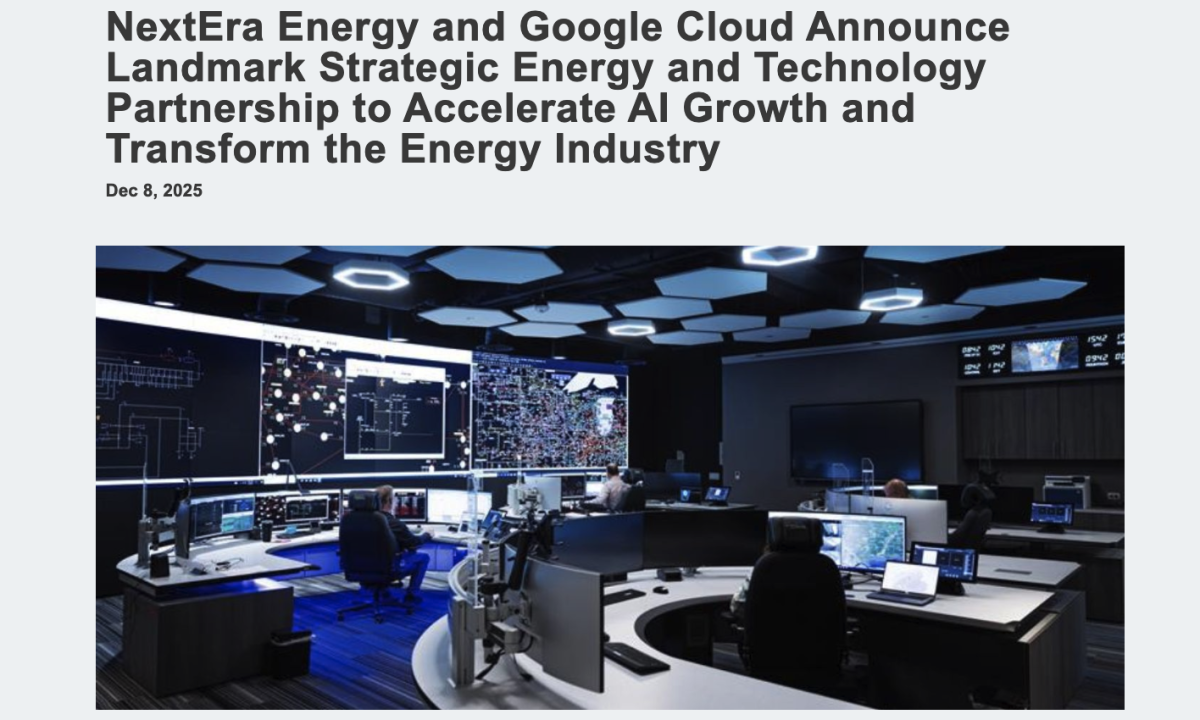
The collaboration's most intriguing aspect is its AI-enhanced operational approach. Leveraging Google Cloud's machine learning capabilities, NextEra will implement generative AI for predictive maintenance, crew scheduling, and grid management. This isn't just technological enhancement; it's a complete reimagining of utility operations. The first commercial product, expected in mid-2026, will focus on dynamic field operations and grid resilience, demonstrating how AI transforms traditionally reactive infrastructure into proactive, intelligent systems.
For technology and energy sectors, this partnership represents more than a power generation strategy—it's a blueprint for cross-industry technological convergence. By bringing computational intelligence directly into energy infrastructure, NextEra and Google are creating a new paradigm where technological capability and energy supply are no longer separate domains, but deeply interconnected ecosystems.
Questions 3
Why are tech companies like Google now investing directly in power generation?
The massive computational demands of AI require unprecedented electricity infrastructure. By developing their own power generation capabilities, tech companies can ensure reliable, sustainable, and cost-effective energy supply tailored specifically to their computational needs, reducing dependency on traditional grid systems.
How will AI transform utility operations according to this partnership?
AI will enable predictive maintenance, optimize crew scheduling, and enhance grid management through generative technologies. Instead of reactive maintenance, utilities can now proactively identify potential issues, schedule interventions, and manage complex grid dynamics with unprecedented precision and efficiency.