
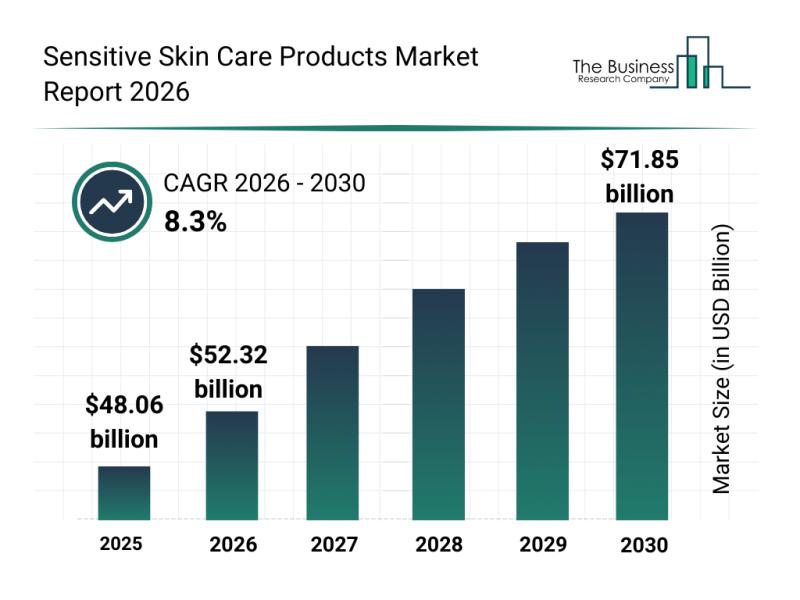
Sensitive Skincare Market Boom | $71.85B Opportunity for E-Commerce Sellers
- Global market growing 8.3% annually through 2030; online channels driving 40%+ of sales growth; clean beauty and hypoallergenic products dominate demand
Overview
The global sensitive skincare market is experiencing explosive growth, with projections reaching $71.85 billion by 2030 at a compound annual growth rate of 8.3%—significantly outpacing general beauty category growth of 4-5%. This expansion directly translates to high-margin opportunities for cross-border e-commerce sellers, particularly through Amazon, eBay, Shopify, and specialty beauty marketplaces where online channels now account for 35-45% of category sales and growing rapidly.
Market drivers creating immediate seller opportunities: The surge is fueled by three converging trends—rising consumer awareness of ingredient safety, explosive demand for clean beauty products (chemical-free, hypoallergenic formulations), and premium sensitive skincare commanding 25-30% price premiums over standard products. Major brands including Johnson & Johnson, Procter & Gamble, Unilever, L'Oreal, and Estee Lauder are aggressively consolidating the space. L'Oreal's August 2024 acquisition of a 10% stake in Galderma (Switzerland-based dermatological specialist) signals that premium, science-backed sensitive skincare is becoming a strategic battleground. This creates a critical window for independent sellers to establish brand authority before category consolidation accelerates.
Specific seller segments and profit potential: Face care products (cleansers, serums, moisturizers) represent 45-50% of category revenue and command the highest margins (35-45% gross profit for sellers). Body care and lip care segments are growing 12-15% annually—faster than face care—offering less saturated opportunities. DayWest's June 2023 D2C launch demonstrates the viability of direct-to-consumer models emphasizing multifunctional, organic formulations for reactive skin types. Sellers can replicate this model through Amazon Brand Registry, Shopify storefronts, or TikTok Shop, targeting the 25-45 female demographic (60% of sensitive skincare buyers) with educational content about dermatologist-endorsed ingredients.
Operational and competitive implications: The market's expansion through online retail channels means fulfillment costs, inventory management, and product compliance become critical differentiators. Sellers must navigate ingredient disclosure requirements (FDA cosmetics regulations in US, CPNP registration in EU), allergen labeling, and dermatological claim substantiation. Inventory turnover for trending clean beauty products averages 45-60 days, requiring agile supply chain management. Sellers competing against mega-brands must differentiate through niche positioning (e.g., "hypoallergenic for eczema-prone skin," "fragrance-free for sensitive scalps") and leverage user-generated content from dermatologists and consumers with skin conditions.
Questions 8
What marketing strategies work best for sensitive skincare sellers on Amazon and Shopify?
The news identifies that consumer awareness of ingredient safety and dermatologist endorsements are primary purchase drivers. Effective marketing strategies include: (1) Amazon Sponsored Brands campaigns targeting keywords like 'hypoallergenic moisturizer,' 'fragrance-free cleanser,' and 'dermatologist-recommended' (typical CPC $0.50-1.50); (2) Shopify content marketing emphasizing ingredient education, skin condition guides, and dermatologist testimonials; (3) TikTok Shop and Instagram Reels featuring before/after content from users with sensitive skin conditions. The DayWest example (June 2023 D2C launch) demonstrates that multifunctional, clean formulations resonate with audiences when positioned as solutions for reactive skin. Sellers should allocate 15-20% of revenue to marketing during launch phase (months 1-6) and 8-12% during growth phase (months 7-24) to build brand authority before mega-brands dominate paid search.
Which geographic markets offer the highest growth potential for sensitive skincare sellers?
The global market is growing 8.3% annually, but growth rates vary significantly by region. North America and Western Europe (US, UK, Germany, France) are mature markets with 5-7% annual growth but high purchasing power and established e-commerce infrastructure. Asia-Pacific markets (China, Japan, South Korea, India) are growing 12-18% annually as middle-class consumers increase skincare spending and awareness of ingredient safety rises. The news reports that online retail channels are driving growth globally, meaning sellers can access high-growth markets through Amazon Global, Shopify international shipping, and regional marketplaces (Lazada, Shopee in Southeast Asia). Sellers should prioritize North America and Western Europe for immediate revenue (higher AOV, faster payment), then expand to Asia-Pacific for volume growth in years 2-3.