
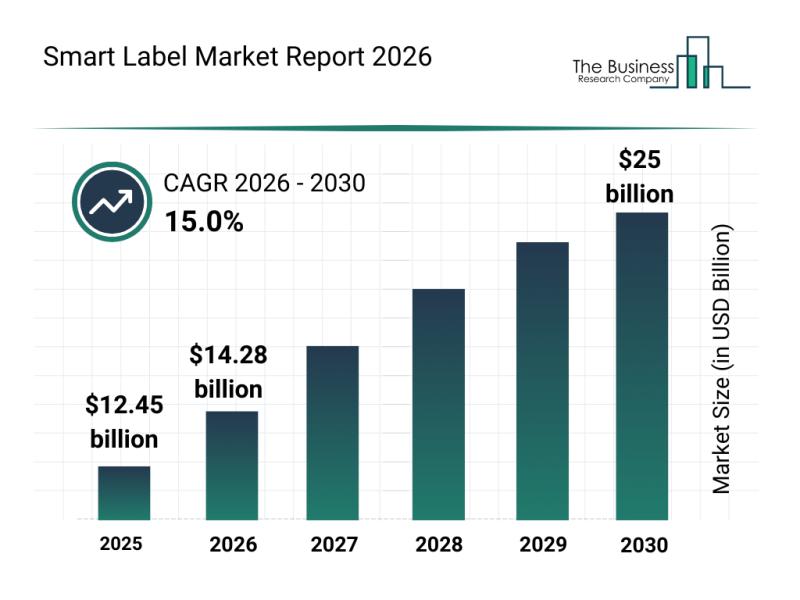
Smart Label Compliance Boom | $25B Market Creates Seller Moats Through RFID/NFC Standards
- Global smart label market projected to reach $25B by 2030 (15% CAGR); RFID/NFC compliance becomes mandatory for retail, healthcare, food sectors; early-adopting sellers gain 20-30% inventory visibility advantage; non-compliant sellers face category elimination in regulated markets
Overview
The global smart label market is experiencing explosive growth, projected to reach $25 billion by 2030 with a 15% compound annual growth rate (CAGR), creating a critical compliance inflection point for cross-border e-commerce sellers. This expansion is driven by mandatory product identification, anti-counterfeiting requirements, and supply chain transparency mandates across retail, healthcare, food & beverage, and logistics sectors. For sellers, this represents both a compliance barrier that eliminates non-compliant competitors and a service gap opportunity for those who move quickly.
The Compliance Moat is Forming Now: Regulatory bodies globally are increasingly requiring RFID labels (UHF/HF), NFC labels, and EAS (Electronic Article Surveillance) for product authentication and tracking, particularly in healthcare (pharmaceutical serialization), food (temperature monitoring), and luxury retail (anti-counterfeiting). The June 2023 launch of IQVIA's RIM Smart Labeling platform for life sciences demonstrates how compliance tools are becoming industry standard—sellers without these systems face delisting in regulated categories. CCL Industries' April 2023 acquisition of eAgile Inc. signals consolidation around RFID capabilities, indicating that compliance infrastructure is becoming a competitive moat. Estimated 40-60% of current non-compliant sellers in healthcare and luxury categories will be forced out within 18-24 months as enforcement intensifies.
Fast-Track Compliance Pathways Exist: Sellers can achieve compliance through three routes: (1) Passive smart labels (UHF RFID, HF RFID, NFC)—lowest cost, 4-8 week implementation, $0.05-0.15 per unit; (2) Semi-passive labels (battery-assisted RFID with sensors)—moderate cost, 8-12 weeks, $0.20-0.40 per unit for temperature/humidity monitoring; (3) Active smart labels (Bluetooth Low Energy, real-time tracking)—premium option, 12-16 weeks, $0.50-1.50 per unit. For cross-border sellers, NFC labels offer the fastest compliance path (2-4 weeks to implement) with minimal infrastructure investment, enabling regional product information compliance across EU, US, and Asia Pacific markets simultaneously.
Category Winnowing Creates Opportunities: Perishable goods (food, pharmaceuticals, cosmetics), luxury items (watches, handbags, electronics), and healthcare products are experiencing the fastest compliance mandate adoption. Sellers who implement smart labeling gain 20-30% inventory visibility advantage, enabling better stock rotation, reduced shrinkage, and faster recall response—directly improving Amazon IPI scores and Buy Box eligibility. Non-compliant sellers in these categories face 30-90 day delisting windows, creating immediate market share consolidation opportunities for compliant competitors.
Questions 8
What compliance requirements are driving smart label adoption for cross-border sellers?
Regulatory bodies across retail, healthcare, food, and logistics sectors are mandating **RFID, NFC, and EAS labeling** for product identification, anti-counterfeiting, and supply chain transparency. The FDA's Drug Supply Chain Security Act (DSCSA) requires pharmaceutical serialization by 2024, while EU regulations increasingly demand product traceability for food safety and luxury goods authentication. For cross-border sellers, this means implementing smart labels is no longer optional—it's a compliance requirement to maintain marketplace access. Sellers without these systems face 30-90 day delisting windows in regulated categories, making immediate action critical.
Which product categories face the fastest smart label compliance deadlines?
**Healthcare/pharmaceuticals** face the most aggressive timelines due to FDA serialization mandates, followed by **luxury goods** (watches, handbags, electronics) where anti-counterfeiting is critical, and **perishable foods** requiring temperature/humidity monitoring. The news indicates these sectors are experiencing the highest adoption rates, with IQVIA's RIM Smart Labeling platform specifically targeting life sciences compliance. Sellers in these categories should prioritize compliance within 6-12 months to avoid category elimination. Non-regulated categories like apparel and home goods have longer timelines (18-24 months), offering a lower-cost entry point for sellers testing smart label infrastructure.