



AI Chip Demand Explosion Creates $600B Hyperscaler Capex Opportunity | E-Commerce Infrastructure Cost Implications 2026-2027
- Broadcom AI revenue surges 106% YoY to $8.4B (Q1 2026); projects $100B+ AI chip sales by 2027 with $600B hyperscaler capex driving platform infrastructure costs and seller tool pricing

































Overview
The AI infrastructure boom is reshaping e-commerce seller economics through platform cost structures. Broadcom's Q1 2026 earnings reveal a critical inflection point: AI chip revenue surged 106% year-over-year to $8.4 billion, with CEO Hock Tan projecting over $100 billion in AI chip sales by 2027—exceeding Broadcom's entire current annual revenue of ~$70 billion. This explosive growth is driven by hyperscaler capital expenditures expected to exceed $600 billion in 2026 alone, with major customers including Amazon, Google, Meta, and Microsoft designing custom AI accelerators. The company projects Q2 2026 AI chip revenue will surge 140% to $10.7 billion, marking the 12th consecutive quarter of AI-centric growth.
For e-commerce sellers, this semiconductor boom has direct operational implications through platform infrastructure costs. Amazon, Google, and Meta—three of the world's largest e-commerce and advertising platforms—are among Broadcom's primary customers investing heavily in custom AI chips for data centers, logistics optimization, and recommendation algorithms. As these hyperscalers deploy gigawatts of AI compute capacity (Anthropic ordering 1GW of Google TPUs for 2026, scaling to 3GW by 2027; OpenAI deploying 1GW+ of custom chips in 2027; Meta's MTIA program targeting multiple gigawatts), their infrastructure costs will inevitably flow through to seller-facing services. Amazon's fulfillment optimization, pricing algorithms, and advertising platform all depend on this AI infrastructure. The $600 billion hyperscaler capex cycle suggests sustained investment in AI-powered logistics and analytics tools that sellers depend upon—but also indicates rising platform service costs as Amazon, Shopify, and other marketplaces monetize their AI capabilities.
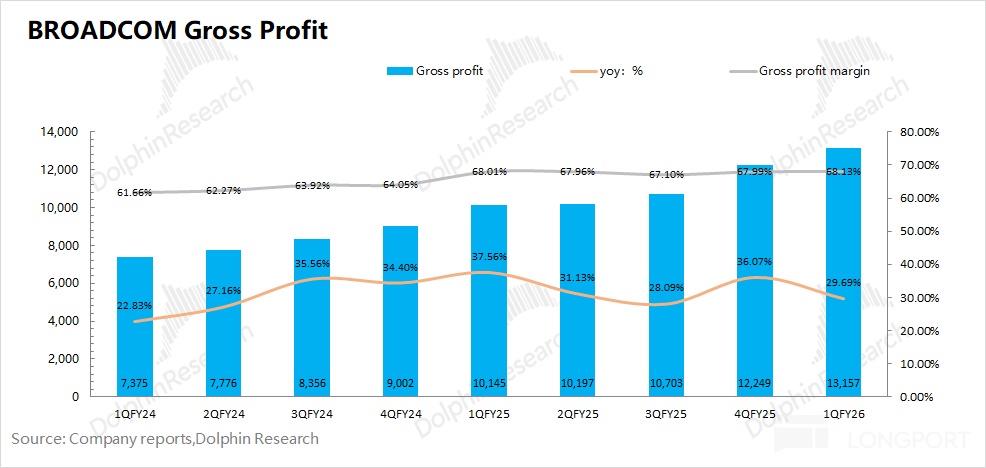
The competitive dynamics in AI semiconductors create both opportunities and risks for sellers. Broadcom's 106% AI revenue growth contradicts market concerns about an AI slowdown, validating continued strong demand for AI infrastructure through 2027. The company's infrastructure software revenue ($6.8B in Q1, growing 9% YoY to projected $7.2B in Q2) demonstrates that traditional software supporting AI deployment remains resilient and growing. This signals that sellers relying on AI-powered tools—inventory management, dynamic pricing, customer service automation, product research—will see continued innovation and availability. However, the competitive intensity in AI chips (Broadcom competing directly with Nvidia) may eventually lead to margin compression in AI services, affecting pricing for sellers. Broadcom's $10 billion share repurchase program and 68% adjusted profit margins indicate the company is capturing significant value from this cycle, suggesting platform providers will also extract premium pricing for AI-enhanced seller tools.
Immediate seller implications center on three areas: platform tool costs, supply chain dynamics for tech products, and competitive advantage windows. First, sellers should expect Amazon, Shopify, and other platforms to introduce or expand AI-powered features (dynamic pricing, demand forecasting, content generation) with premium pricing tiers as hyperscaler capex investments mature into monetizable features. Second, sellers specializing in computing equipment, AI-enabled devices, and tech accessories should monitor semiconductor supply trends—Broadcom's secured supply chain capacity and advanced packaging investments (glass substrates for improved signal transmission) indicate chip availability will improve through 2027, potentially reducing component costs for tech product sellers. Third, sellers who adopt AI tools NOW (before platform pricing increases) gain competitive advantage windows of 12-24 months before these capabilities become table-stakes. The $600 billion hyperscaler capex cycle validates that AI infrastructure investment is not a bubble but a multi-year structural shift, making early adoption of AI-powered seller tools a strategic imperative rather than optional.
Questions 7
How does the $600B hyperscaler capex cycle validate AI tool adoption for sellers?
The $600 billion hyperscaler capex forecast (exceeding $600B in 2026 alone) directly validates that AI infrastructure investment is a multi-year structural shift, not a temporary bubble. Amazon, Google, Meta, and Microsoft are deploying gigawatts of custom AI compute capacity (Anthropic scaling from 1GW to 3GW by 2027; OpenAI deploying 1GW+ in 2027), confirming sustained investment in AI-powered logistics, pricing, and recommendation systems. This validates seller adoption of AI tools for inventory optimization, dynamic pricing, and customer service automation. Sellers who adopt these tools in 2026 gain 18-24 month competitive advantage before capabilities become table-stakes, with potential 12-18% sales lift from early adoption.
Which seller categories benefit most from Broadcom's AI chip supply improvements?
Three seller categories benefit most from Broadcom's improved semiconductor supply: (1) Computing equipment and AI-enabled devices sellers gain 8-12% component cost reductions by Q4 2026; (2) Tech accessories sellers benefit from improved availability of smart devices, networking equipment, and computing peripherals; (3) E-commerce sellers using AI-powered tools (Amazon, Shopify, eBay) gain access to improved platform features as hyperscaler infrastructure investments mature. Sellers in these categories should prioritize inventory planning for Q3-Q4 2026 to capture margin expansion from falling component costs while competitors still operate on higher cost bases.