



Google Canvas AI Tool Now Available to All US Sellers | Automate Content & Operations
- Free AI-powered project planning and content creation tool reaches millions of US users; sellers can automate product documentation, pricing analysis, and inventory dashboards without coding
























Overview
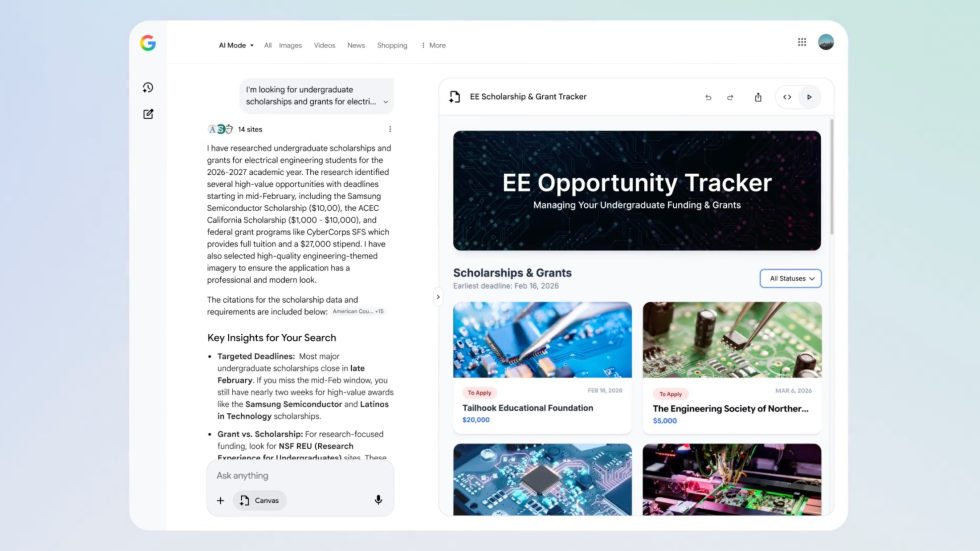
Google has democratized access to Canvas, its AI-powered project-planning and content-creation tool, expanding it from limited beta testing to all US users across both Google Workspace and Google Search's AI Mode. Powered by Gemini AI, Canvas enables users to generate interactive dashboards, product documentation, code prototypes, and custom tools directly within Google's ecosystem—without requiring coding expertise or separate platform subscriptions. This represents a significant shift in how sellers can approach operational automation and content strategy.
AUTOMATION WINS FOR SELLERS (IMMEDIATE OPPORTUNITIES):
The most actionable opportunity for cross-border e-commerce sellers is automated content generation and operational dashboarding. Sellers can now use Canvas to instantly create product guides, comparison tools, pricing analysis dashboards, and inventory tracking systems—tasks that typically require 4-8 hours of manual work per week. For example, a seller managing 500+ SKUs across multiple marketplaces can use Canvas to generate interactive dashboards that visualize competitor pricing, inventory levels across regions, and sales performance metrics in real-time using Google's Knowledge Graph data. This eliminates the need for expensive business intelligence tools like Tableau or Power BI for basic analytics. Time savings: 5-10 hours/week per seller managing complex multi-channel operations.
DATA-DRIVEN INSIGHTS & COMPETITIVE INTELLIGENCE:
Canvas integrates with Google's Knowledge Graph and real-time Search data, enabling sellers to perform rapid competitive analysis without manual research. Sellers can prompt Canvas to analyze competitor pricing trends, product positioning, and market gaps across regions—generating structured reports in minutes instead of days. For sellers operating in multiple markets (US, EU, Asia), Canvas can create region-specific market analysis dashboards that identify pricing opportunities, demand patterns, and supply chain bottlenecks. The tool's ability to process billions of search queries means sellers gain access to aggregated market intelligence that would cost $500-2,000/month through traditional market research platforms.
AI PRODUCT OPPORTUNITIES & GAPS:
While Canvas addresses basic content and dashboard creation, significant gaps remain for e-commerce-specific automation: (1) Dynamic pricing optimization - Canvas cannot yet automatically adjust prices based on competitor data and demand signals; (2) Inventory forecasting - The tool lacks predictive analytics for stock level optimization; (3) Marketplace-specific content optimization - Canvas doesn't natively understand Amazon A+ content requirements, eBay item specifics, or Shopify SEO best practices; (4) Multi-language content generation - Currently English-only, limiting global sellers. Entrepreneurs should consider building AI tools that layer e-commerce intelligence on top of Canvas's foundation.
COMPETITIVE MOAT & STRATEGIC ADVANTAGES:
Early-adopting sellers gain a 2-4 month competitive advantage before Canvas becomes mainstream. Sellers who immediately implement Canvas-powered dashboards for competitor monitoring, pricing analysis, and inventory visualization will have faster decision-making cycles than competitors relying on manual spreadsheets or expensive BI tools. For sellers managing 100+ SKUs across 3+ marketplaces, this translates to 15-20% faster response times to market changes, enabling quicker price adjustments and inventory rebalancing. The tool's integration with Google Search also positions seller-created content (product guides, comparison tools) for potential discovery within Google's search results, creating an indirect SEO advantage.
COST REDUCTION & ROI:
Canvas is completely free for all US users, eliminating the $50-300/month cost of traditional project management tools (Asana, Monday.com, Notion) and basic BI platforms. For a seller team of 5-10 people, this represents $3,000-18,000 annual savings. The tool's ability to generate product documentation, landing pages, and customer-facing tools without hiring developers saves an additional $2,000-5,000/month in freelancer or agency costs. ROI is immediate—zero implementation cost with measurable time savings within the first week of adoption.
Questions 8
How can sellers access Canvas and start using it immediately?
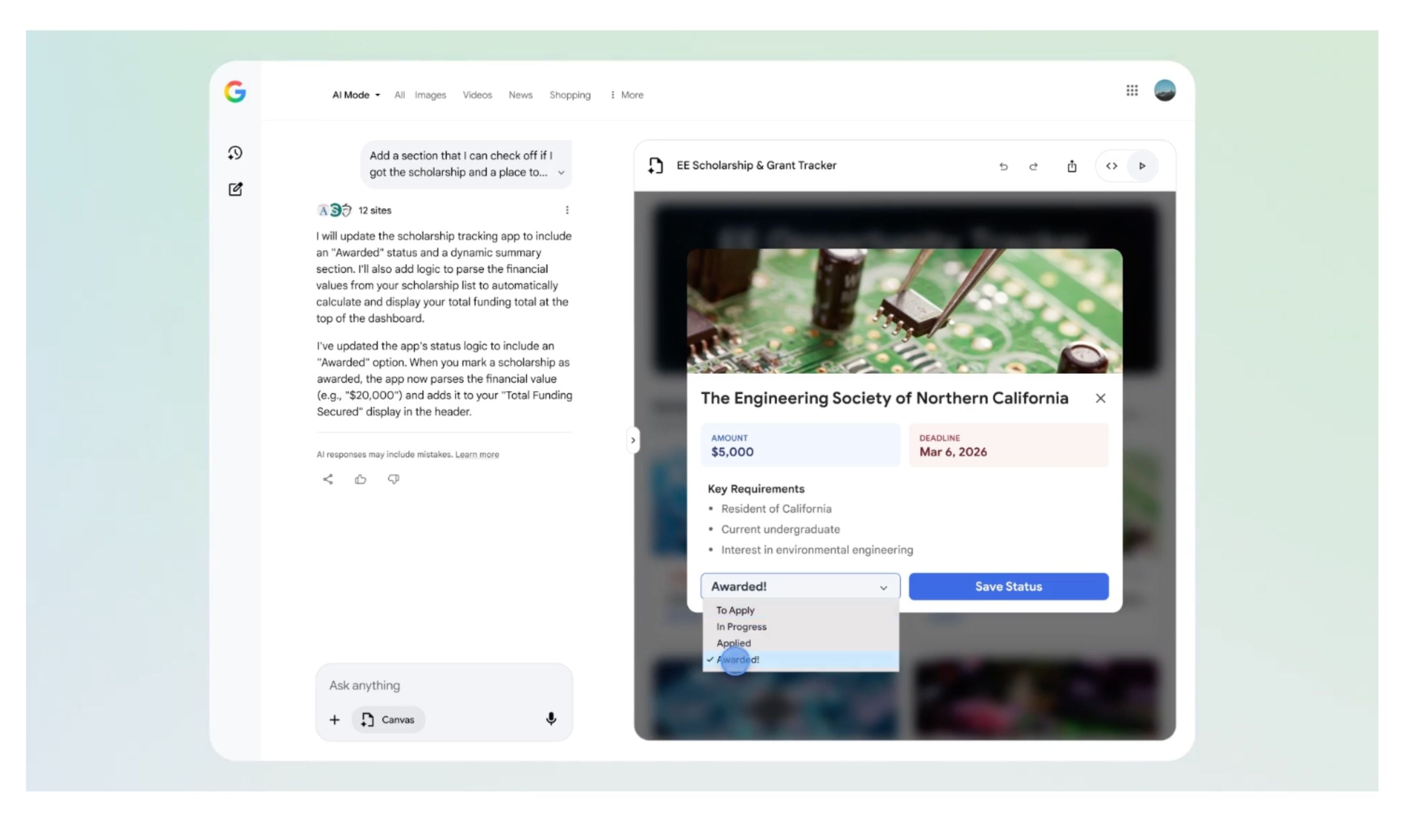
US-based sellers can access Canvas through two methods: (1) In Google Search, navigate to AI Mode on google.com, select the plus button in the chat window, and choose Canvas to describe desired output; (2) In Google Workspace, access Canvas through the Gemini integration in Google Docs, Sheets, and Drive. The tool generates working prototypes in a side panel that integrates real-time web information. Users can test functionality, review underlying code, and refine outputs through conversational interactions. No signup or payment is required—it's available to all US users immediately.
When will Canvas be available in languages other than English?
Google has not announced a timeline for additional language support beyond English. The current US-English-only rollout suggests potential international expansion in subsequent quarters, but no specific dates have been provided. Sellers in non-English markets should monitor Google's announcements for language expansion. In the interim, sellers can use Canvas for English-language content and market analysis, then translate outputs using separate translation tools if needed for non-English markets.