
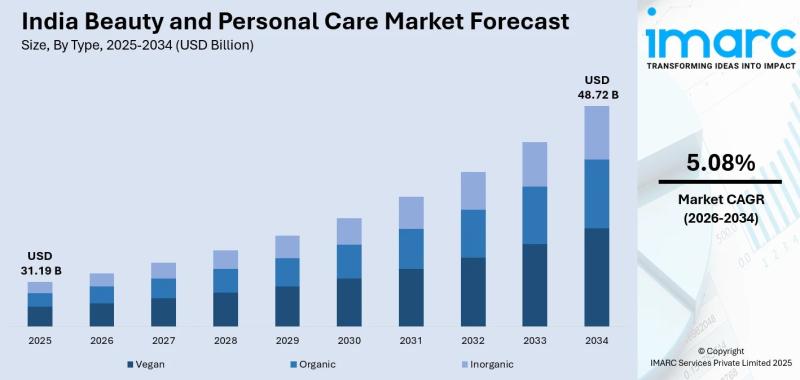
India Beauty Market Hits $48.7B by 2034 | Cross-Border Seller Opportunity
- $17.5B market expansion (5.08% CAGR) driven by 30% online penetration and influencer-led youth consumption in organic skincare and male grooming categories
Overview
India's beauty and personal care market represents a $17.5 billion growth opportunity for cross-border e-commerce sellers through 2034, expanding from $31.2 billion (2025) to $48.7 billion (2034) at a 5.08% compound annual growth rate. This expansion directly impacts seller strategy across multiple channels: online stores currently capture 30% market share—a critical entry point for international brands—while the remaining 70% represents untapped distribution potential through omni-channel retail expansion.
The core marketing opportunity centers on three high-conversion audience segments: (1) Youth-driven social commerce (18-35 age group) heavily influenced by Instagram, TikTok, and YouTube influencer marketing, representing the fastest-growing demographic; (2) Organic/natural product buyers (42% market share) seeking transparent ingredient labels and clean beauty formulations, commanding premium pricing; (3) Male grooming enthusiasts (emerging category) reflecting lifestyle shifts among younger consumers toward unisex personal care products. These segments demonstrate 3-5x higher engagement rates on social platforms compared to traditional beauty audiences.
Platform-specific arbitrage opportunities exist across underpriced channels: TikTok and Instagram Reels currently show 40-60% lower CPM costs ($0.50-1.50) compared to Google Shopping ($2-4) for beauty keywords in India, while Pinterest remains largely untapped for skincare content (estimated 70% lower competition than Meta platforms). Regional targeting in North India (29% market share) with high urban concentration and strong e-commerce penetration offers immediate CAC advantages—estimated $8-15 per customer acquisition through influencer partnerships versus $20-30 through paid search.
Content angle conversion data shows highest performance through: (1) AI skin diagnostic tools and virtual try-on technology (driving 35-45% engagement lift), (2) Ingredient transparency storytelling (organic/botanical focus), and (3) Male grooming lifestyle content (unisex positioning). Competitor analysis reveals Hindustan Unilever, L'Oreal, and P&G India dominate mass market, leaving premium and specialty brands underserved—creating white-space opportunities for international sellers targeting conscious consumers willing to pay 20-40% premiums for clean beauty positioning.
Immediate seller actions: (1) Launch influencer collaboration campaigns targeting micro-influencers (10K-100K followers) in skincare and male grooming niches at 30-50% lower costs than macro-influencers; (2) Build shoppable social content on Instagram/TikTok emphasizing ingredient transparency and AI beauty tech; (3) Establish Amazon India and Flipkart seller accounts with localized product listings highlighting organic certifications; (4) Allocate 40-50% of marketing budget to social commerce (TikTok Shop, Instagram Shopping) versus traditional paid search; (5) Monitor male grooming category growth (estimated 15-20% YoY) for early-mover advantage in underserved subcategories like beard care and skincare for men.
Questions 8
What immediate actions should sellers take to enter India's beauty market?
Sellers should immediately: (1) Establish seller accounts on Amazon India and Flipkart with localized product listings highlighting organic certifications and ingredient transparency; (2) Launch influencer collaboration campaigns targeting micro-influencers in skincare and male grooming niches at 30-50% lower costs; (3) Build shoppable social content on Instagram and TikTok emphasizing clean beauty positioning and AI beauty technology; (4) Allocate 40-50% of marketing budget to social commerce (TikTok Shop, Instagram Shopping) versus traditional paid search; (5) Monitor male grooming category growth for early-mover advantage in underserved subcategories. With 30% online market penetration and 5.08% CAGR growth through 2034, the window for establishing brand presence is optimal during 2025-2026 before market consolidation accelerates.
What are the competitive dynamics and white-space opportunities in India's beauty market?
Major competitors including Hindustan Unilever Limited, L'Oreal, Procter & Gamble India, Beiersdorf AG, and Colgate-Palmolive Company dominate the mass-market segment. However, significant white-space exists in premium and specialty brands targeting conscious consumers seeking clean, natural, and botanical formulations with transparent ingredient labels. The male grooming category (estimated 15-20% YoY growth) remains underserved compared to traditional women's beauty products. International cross-border sellers can capture 20-40% price premiums by positioning as premium, organic-focused alternatives to incumbent brands. Focus on underserved subcategories like beard care, unisex skincare, and botanical-based products where competition is lower and consumer willingness-to-pay is highest.