
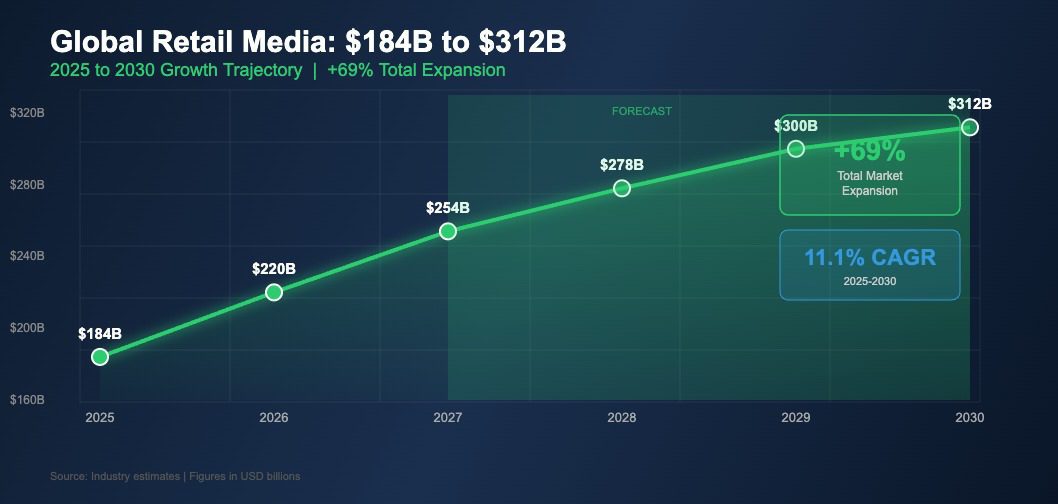
Retail Media Advertising Surges to $312B by 2030 | Seller PPC Strategy Shift
- $184B market in 2025 grows 11% annually; Amazon dominates $50B+ segment; Europe fastest-growing at 20% CAGR; sellers must pivot from trade budgets to platform advertising
Overview
The global retail media advertising market is experiencing a structural transformation, expanding from $184 billion in 2025 to a projected $312 billion by 2030—a 69% increase representing an 11% compound annual growth rate. This explosive growth fundamentally reshapes how sellers allocate marketing budgets and compete for visibility across e-commerce platforms.
Market concentration reveals critical platform dependencies for sellers. The United States commands 38% of global retail media spend ($70 billion), with Amazon's advertising business alone exceeding $50 billion annually—dwarfing Walmart, Kroger, and Target combined. This concentration means US-based sellers face escalating PPC costs as competition intensifies for Amazon Sponsored Products, Sponsored Brands, and Display Ads. China represents 35% of the market ($65 billion), where Alibaba, JD.com, and Pinduoduo operate integrated "full-funnel commerce media" ecosystems combining sponsored placements, live-streaming commerce, influencer storefronts, and interactive video advertising. Europe ($22 billion), Asia-Pacific excluding China ($18 billion), and Latin America ($9 billion) represent emerging opportunities with lower CPM/CPC costs but fragmented retailer bases.
The China model is reshaping global platform strategies and seller advertising requirements. Unlike Western platforms separating advertising from commerce, Chinese retailers embed ads, product discovery, social influence, live-streaming, and transactions within unified ecosystems. This model has directly influenced Amazon, TikTok Shop, Instagram, and YouTube Shopping, which now offer commerce-integrated advertising formats. Sellers must adapt content strategies to these new formats—moving beyond static product listings to dynamic video content, influencer partnerships, and live-streaming commerce. The shift requires sellers to allocate budgets across multiple content types and platforms simultaneously, increasing complexity and CAC (Customer Acquisition Cost).
Europe represents the highest-growth opportunity for sellers willing to navigate fragmentation. Retail media is projected to exceed 20% annual growth through 2028, driven by major grocery retailers—Carrefour, Tesco, Lidl, and Ahold Delhaize—redirecting budgets from traditional trade spending toward measurable digital alternatives. Unlike the US market dominated by Amazon, Europe's fragmented landscape means sellers can negotiate better rates with regional retailers and build diversified advertising portfolios. However, this requires managing separate advertising accounts, compliance requirements, and audience data across multiple platforms.
Five structural forces will sustain growth through 2030, each creating distinct seller opportunities and challenges. US market maturation through trade budget conversion means sellers must shift 15-25% of traditional retail marketing spend to platform advertising. Chinese retail media expansion via live-streaming commerce requires sellers to develop video content and influencer partnerships. European market catch-up (replicating US trajectories with 3-5 year lag) creates a 36-60 month window for sellers to establish market position before competition intensifies. Southeast Asian and Latin American retail media emergence opens new geographic markets with lower CAC but requires localization. Convergence with connected television extends audience data into streaming environments, enabling sellers to run integrated campaigns across e-commerce and CTV platforms.
Immediate implications for seller marketing strategy: Sellers must increase advertising budgets by 12-18% annually to maintain visibility as CPM/CPC costs rise. Platform diversification becomes critical—relying solely on Amazon exposes sellers to algorithm changes and fee increases. Live-streaming commerce and video content production shift from optional to essential. Regional arbitrage opportunities exist in Europe and emerging markets where CPM costs remain 40-60% lower than US platforms.
Questions 8
How should sellers adjust their marketing budgets given the 11% annual growth in retail media?
Sellers should increase advertising budgets by 12-18% annually to maintain visibility as CPM/CPC costs rise with market growth. The shift from trade budgets to platform advertising means reallocating 15-25% of traditional retail marketing spend to Amazon, Walmart, and emerging platforms. Sellers should also allocate 20-30% of advertising budgets to video content production and live-streaming commerce to compete in the evolving full-funnel model. Regional arbitrage opportunities exist in Europe and emerging markets where CPM costs remain significantly lower than saturated US platforms.
What is the timeline for European retail media market maturation compared to the US?
Europe is replicating US retail media trajectories with a 3-5 year lag, meaning the European market will reach US-level maturity and pricing by 2028-2030. This creates a 36-60 month window for sellers to establish market position, build advertiser relationships with regional retailers, and optimize campaigns before competition intensifies and CPM/CPC costs rise. Sellers should prioritize European market entry now to capture first-mover advantages and negotiate favorable rates with Carrefour, Tesco, Lidl, and Ahold Delhaize before these platforms consolidate.