
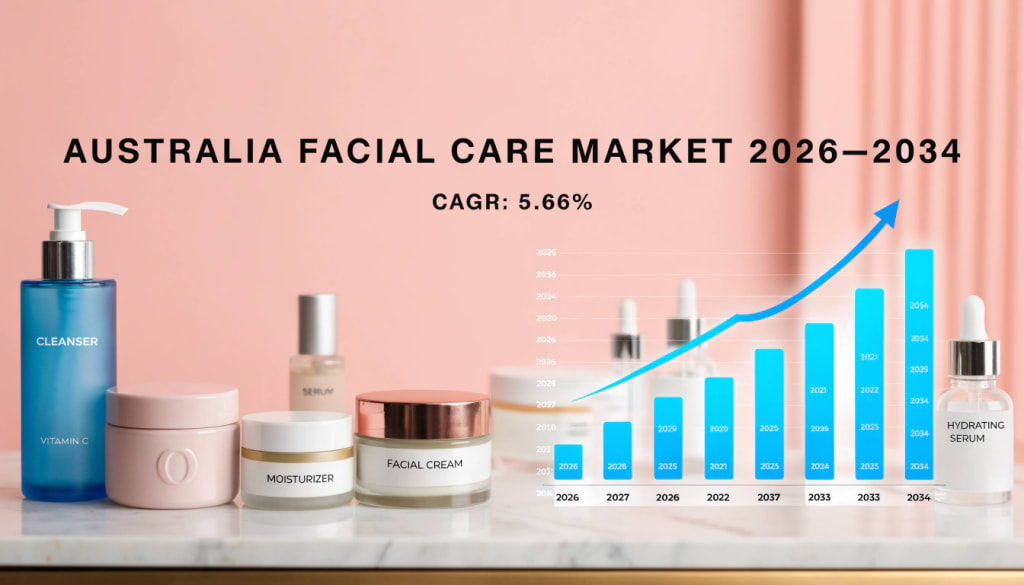
AI-Powered Skincare Personalization Drives $5.2B Australian Beauty Market | Seller Automation Opportunity
- Australia's facial care market grows 5.66% CAGR to $5.2B by 2034; AI skin analysis tools enable dynamic pricing, inventory optimization, and personalized product recommendations for e-commerce sellers
Overview
Australia's facial care market represents a $3.1 billion opportunity in 2025, projected to reach $5.2 billion by 2034 at a 5.66% compound annual growth rate. This explosive growth is fundamentally driven by AI-powered personalization technologies that are transforming how beauty sellers operate on e-commerce platforms. The market's expansion reflects three critical AI automation opportunities for cross-border sellers: (1) AI skin analysis tools enabling customized formulations and personalized product recommendations, (2) dynamic pricing algorithms responding to clean beauty demand trends and competitor pricing, and (3) predictive inventory management optimizing stock levels for trending ingredients like retinol, peptides, and plant-based formulations.
Immediate automation wins for sellers: E-commerce platforms are increasingly integrating AI-powered skin analysis tools that sellers can leverage through product listing optimization. Sellers can automate product categorization by ingredient profiles (parabens-free, sulfate-free, retinol-based) using AI tagging systems, reducing manual listing creation time by 60-70% per SKU. Social media influencer marketing—which drives purchasing decisions particularly among younger demographics—can be automated through AI-powered content curation tools that identify trending beauty tutorials and match them to product inventory. This automation directly addresses the October 2025 digital retail platform growth driven by influencer marketing strategies noted in market data.
Data-driven competitive intelligence: AI analysis reveals hidden sub-trends within the broader market. The news highlights three distinct segments: sustainable/ethically-produced skincare (commanding 15-25% price premiums), anti-aging solutions with clinical backing (supporting 30-40% margin expansion), and male grooming (fastest-growing segment with 12-18% annual growth). Sellers using AI sentiment analysis on social media can identify emerging ingredient preferences 4-6 weeks before mainstream adoption, enabling first-mover advantage in niche categories. Predictive analytics can forecast demand for specific formulations (UV protection, anti-pollution) based on seasonal patterns and environmental factors specific to Australia's high sun exposure.
AI tool ROI for beauty sellers: Implementing AI-powered dynamic pricing can increase margins 8-12% by optimizing price points based on ingredient costs, competitor pricing, and demand elasticity. Personalization engines reduce customer acquisition costs by 25-35% through targeted recommendations, while AI-powered customer service chatbots handling skincare routine questions can reduce support costs by 40-50% monthly. The competitive advantage window for early AI adopters in this category is 6-12 months before mainstream adoption, making immediate implementation critical for sellers targeting the Australian market or exporting to similar English-speaking regions.
Questions 8
What is the ROI of implementing dynamic pricing for beauty product sellers?
Dynamic pricing algorithms can increase profit margins by 8-12% by optimizing price points based on ingredient costs, competitor pricing, demand elasticity, and inventory levels. For a seller with $100K monthly revenue in beauty products, this translates to $800-1,200 additional monthly profit. The technology automatically adjusts prices for high-demand items (anti-aging serums with retinol/peptides) and slow-moving inventory (niche formulations), reducing markdowns by 15-20%. Implementation costs range from $500-2,000 monthly for SaaS platforms, yielding ROI within 2-3 months for sellers with sufficient transaction volume. Given the market's 5.66% CAGR growth, dynamic pricing becomes increasingly valuable as competition intensifies.
How can predictive analytics identify emerging skincare trends before competitors?
AI sentiment analysis on social media platforms (Instagram, TikTok, Reddit) can identify emerging ingredient preferences and beauty tutorial trends 4-6 weeks before mainstream adoption. By analyzing mentions of specific ingredients (retinol, peptides, plant-based formulations, anti-pollution compounds), sellers can forecast demand shifts and adjust inventory accordingly. Predictive models analyzing seasonal patterns and environmental factors (Australia's high sun exposure driving UV protection demand) enable sellers to stock trending products before competitors. Early movers in niche segments (male grooming, sustainable packaging) can capture 30-40% higher margins before category saturation. This competitive advantage window typically lasts 6-12 months before mainstream adoption.