
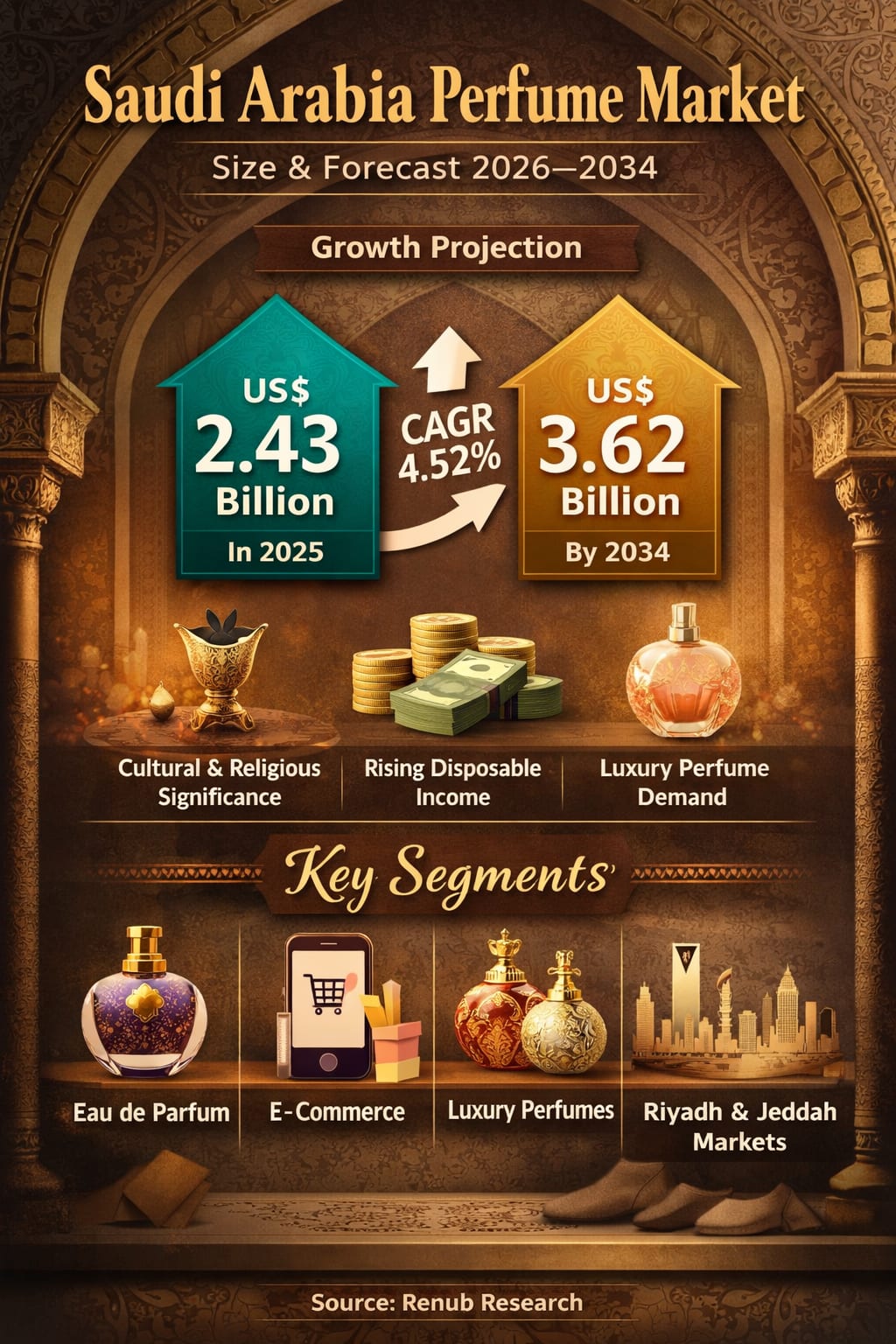
Saudi Perfume Market Expands to $3.62B by 2034 | Cross-Border Seller Opportunity
- Market grows 4.52% CAGR from $2.43B (2025) to $3.62B (2034); affluent Saudi consumers ($18,260 avg income) drive premiumization in luxury fragrances and niche Arabic scents
Overview
Saudi Arabia's perfume market represents a $1.19 billion growth opportunity for cross-border e-commerce sellers through 2034, expanding from $2.43 billion in 2025 to $3.62 billion by 2034 at a 4.52% compound annual growth rate. This expansion is driven by deep cultural integration of fragrances in Saudi society—perfumes are essential to daily life, prayers, social gatherings, weddings, and celebrations—creating consistent, high-frequency purchasing behavior. The market encompasses traditional Arabic fragrances (oud, amber, musk, rose) alongside international luxury brands, with eau de parfum (EDP) dominating due to superior fragrance oil concentration and longevity. Rising disposable incomes (Saudi households averaging $18,260 annually in 2025) fuel premiumization trends favoring luxury and niche fragrances, while Vision 2030 development and tourism growth (visitors purchasing perfumes as luxury gifts) expand demand channels.
E-commerce has become the critical sales channel, with digital marketing, influencer promotions, and social media campaigns driving brand awareness and consumer engagement. Modern retail infrastructure expansion—luxury shopping malls, specialized fragrance boutiques, airport duty-free outlets—combined with rapid e-commerce platform growth has fundamentally transformed purchasing behavior. V Perfumes' expansion to its 51st store at Mall of Arabia in Jeddah (February 2025) demonstrates active market momentum. The May 2024 'Perfumes of the East' exhibition in Riyadh, featuring 200+ artifacts showcasing regional fragrance heritage, highlights the market's cultural significance and consumer engagement potential.
However, sellers face substantial competitive and operational challenges. Intense competition from international luxury brands and regional manufacturers, counterfeit product proliferation, and price sensitivity among certain segments create margin pressure. Cross-border sellers must navigate authentication requirements, premium positioning strategies, and influencer partnership investments to capture market share. The affluent, culturally-engaged Saudi consumer base offers high customer lifetime value (LTV) potential, but requires sophisticated digital marketing strategies, authentic product sourcing, and brand credibility to succeed in this luxury-focused market.
Questions 8
How are e-commerce platforms transforming Saudi perfume purchasing behavior?
E-commerce platforms have become critical sales channels, enabling consumers to compare products, access exclusive online launches, and purchase luxury fragrances with convenience. Digital marketing strategies, influencer promotions, and social media campaigns significantly increase brand awareness and drive consumer engagement. The expansion of modern retail infrastructure—luxury shopping malls, specialized fragrance boutiques, and airport duty-free outlets—combined with rapid e-commerce growth has fundamentally shifted purchasing behavior toward online channels. This creates substantial opportunities for cross-border sellers to reach affluent, digitally-engaged Saudi consumers through targeted social media and influencer marketing campaigns.
Which fragrance product categories dominate Saudi Arabia's market?
Eau de Parfum (EDP) represents the dominant product category in Saudi Arabia's perfume market due to its higher fragrance oil concentration and long-lasting qualities. Traditional Arabic fragrances including oud, amber, musk, and rose command significant market share alongside international luxury brands. The market's cultural foundation—fragrances are integrated into prayers, social gatherings, weddings, and celebrations—creates consistent demand across premium and niche segments. Sellers should prioritize EDP formulations and authentic Arabic fragrance sourcing to align with consumer preferences and cultural expectations.