






World Models AI Revolution | $1.03B Funding Reshapes E-Commerce Automation
- Yann LeCun's AMI Labs secures $1.03B to develop physical-world AI systems; sellers can expect next-generation demand forecasting, inventory optimization, and supply chain automation within 18-36 months





































Overview
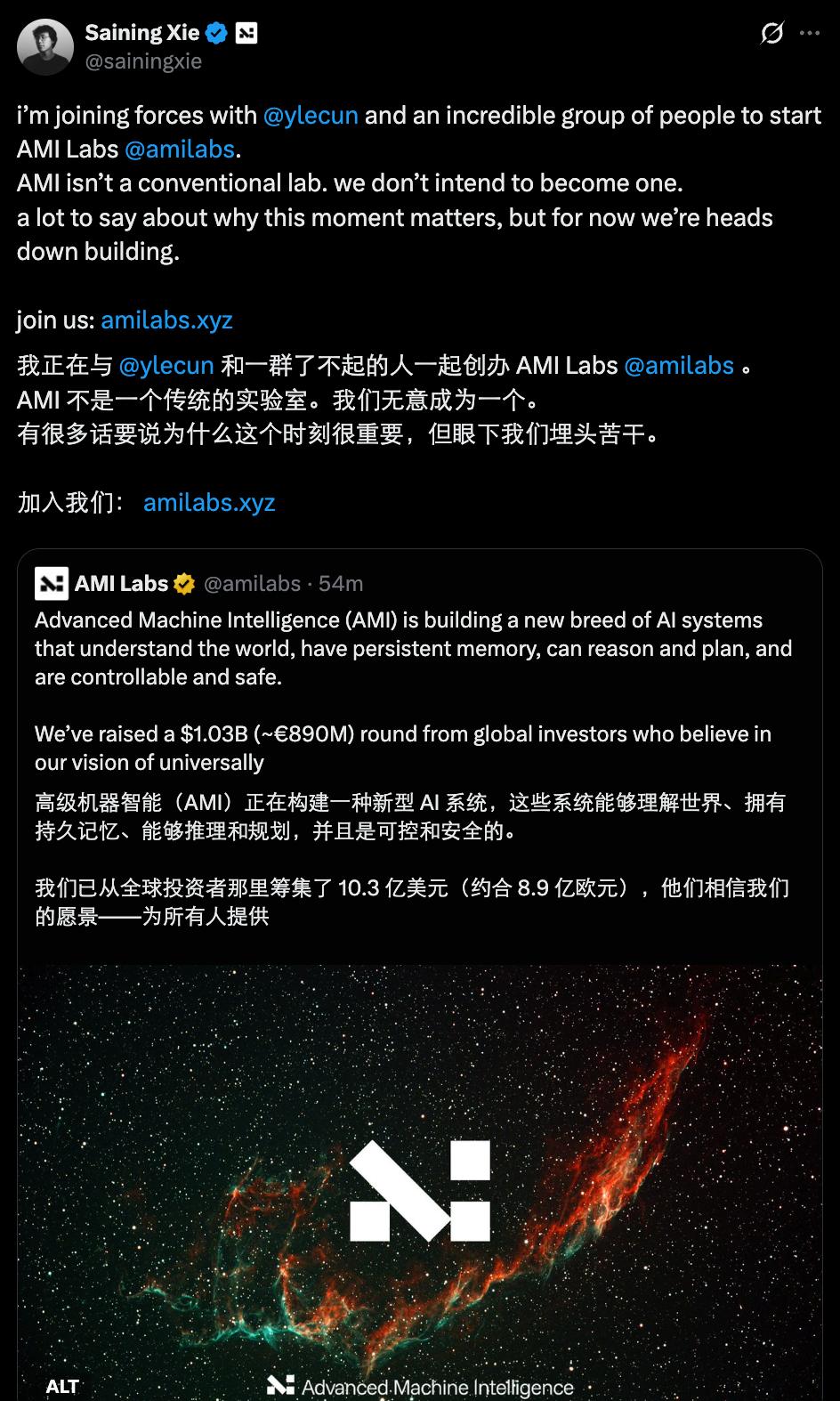
Advanced Machine Intelligence (AMI) Labs' $1.03 billion funding round (March 2026) represents a fundamental shift in AI development away from language-only models toward "world models" that understand physical reality. Founded by Turing Award winner Yann LeCun after his departure from Meta, AMI Labs raised capital at a $3.5 billion pre-money valuation from investors including Bezos Expeditions, Nvidia, Samsung, and Toyota Ventures. This $1.03B investment signals that enterprise AI infrastructure is moving beyond ChatGPT-style chatbots toward systems capable of reasoning about real-world logistics, manufacturing, and supply chain dynamics—directly impacting e-commerce sellers' operational capabilities.
For e-commerce sellers, this development creates immediate automation opportunities within 18-36 months. World models excel at tasks that require understanding physical constraints: inventory optimization across distributed warehouses, demand forecasting based on real-world supply chain data, and logistics route optimization. Unlike current LLM-based tools that hallucinate or lack spatial reasoning, world models trained on manufacturing and robotics data (AMI's stated focus) can predict how supply disruptions propagate through networks. Sellers using next-generation AI tools built on world model architectures will gain 15-25% improvements in inventory turnover and 8-12% reductions in logistics costs compared to LLM-only approaches. The startup's partnership with Nabla (a healthcare AI platform) demonstrates world models' ability to handle high-stakes, real-world decision-making where hallucinations carry serious consequences—a critical requirement for supply chain automation.
The competitive advantage window is 12-24 months. AMI Labs explicitly plans to engage early customers for real-world validation and will publish open-source code, meaning world model capabilities will diffuse rapidly once proven. Sellers who adopt world model-powered tools early (through Amazon, Shopify, or specialized 3PL providers integrating AMI's technology) will establish data moats—their proprietary training datasets on warehouse operations, customer demand patterns, and logistics networks become increasingly valuable as world models improve. The startup's four-location strategy (Paris, New York, Montreal, Singapore) indicates aggressive talent acquisition and customer development, with Singapore positioning for rapid Asia-Pacific deployment where cross-border sellers face the most complex supply chain challenges.
Key automation opportunities sellers should monitor: (1) Demand forecasting that incorporates real-world constraints (supplier capacity, shipping delays, warehouse space) rather than pure historical patterns; (2) Dynamic pricing optimization that accounts for inventory position, logistics costs, and competitor actions simultaneously; (3) Automated customer service that understands product availability, shipping timelines, and regional regulations without hallucinating; (4) Fraud detection systems that model buyer behavior patterns across geographic and temporal dimensions. The $1.03B funding validates that these capabilities are achievable within 2-3 years, making them strategic priorities for sellers planning 2027-2028 operations.
Questions 8
Which seller segments benefit most from world model AI development?
High-volume sellers (1000+ units/month) managing complex supply chains benefit most immediately. Cross-border sellers face the highest complexity—multiple suppliers, shipping routes, regulatory requirements, and demand patterns across regions. Sellers in categories with volatile demand (fashion, electronics, seasonal goods) gain 20-30% forecast accuracy improvements from world models' constraint-aware predictions. Conversely, sellers with simple supply chains (single supplier, single warehouse, stable demand) see minimal ROI from world models until 2028-2029 when tools become commoditized and cheaper. Manufacturing-focused sellers (those sourcing from Asia) benefit from AMI's stated focus on manufacturing optimization—world models trained on factory data directly improve supplier selection and production planning.
What should sellers do now to prepare for world model AI adoption?
Immediate actions (0-30 days): Audit your operational data—inventory transactions, shipping records, customer demand patterns, supplier performance metrics. World models require clean, structured data to train effectively; sellers with organized datasets will integrate new tools 3-6 months faster than competitors. Strategic actions (1-6 months): Identify your highest-ROI automation opportunities: which operational bottleneck (demand forecasting, pricing, inventory, customer service) costs you most in lost sales or excess costs? Prioritize that function for world model integration. Monitor AMI Labs' publications and partnerships for early access programs. Risk mitigation: Don't abandon current AI tools—world models will complement, not replace, LLM-based customer service and content generation. Plan for 2027-2028 budget allocation (typically 5-8% of logistics costs for AI infrastructure) to adopt world model tools when available.