



Ticketmaster Service Fee Cap & Venue Divestment | Marketplace Fragmentation Opportunity for Alternative Ticketing Platforms
- 15% service fee cap and 50% ticket allocation to competitors creates $2B+ market opportunity for StubHub, SeatGeek, and regional ticketing platforms; 27 states challenge settlement, extending regulatory uncertainty through 2026






Overview
The U.S. Justice Department's antitrust settlement with Live Nation Entertainment and Ticketmaster (announced March 2025) establishes a critical regulatory framework that fundamentally restructures the $15B+ live events ticketing market. The settlement mandates three compliance mechanisms: capping service fees at 15% of face value (down from current 20-25% rates), requiring Live Nation to divest 13 exclusive booking agreements with amphitheaters in major markets (Milwaukee, Cincinnati, Syracuse, New York, Austin), and permitting venues to allocate up to 50% of amphitheater tickets to competing platforms like StubHub, SeatGeek, and regional providers.
Compliance Barriers as Market Moats: The settlement creates immediate competitive advantages for alternative ticketing platforms that can absorb the 15% fee cap while maintaining profitability. Sellers and platforms operating below this threshold gain protected market access—venues are now legally required to partner with competitors, eliminating Ticketmaster's exclusive distribution control. This represents a forced market-opening mechanism affecting approximately 13 major venue markets and an estimated 40-50% of amphitheater ticket inventory (roughly 8-12M tickets annually across divested venues).
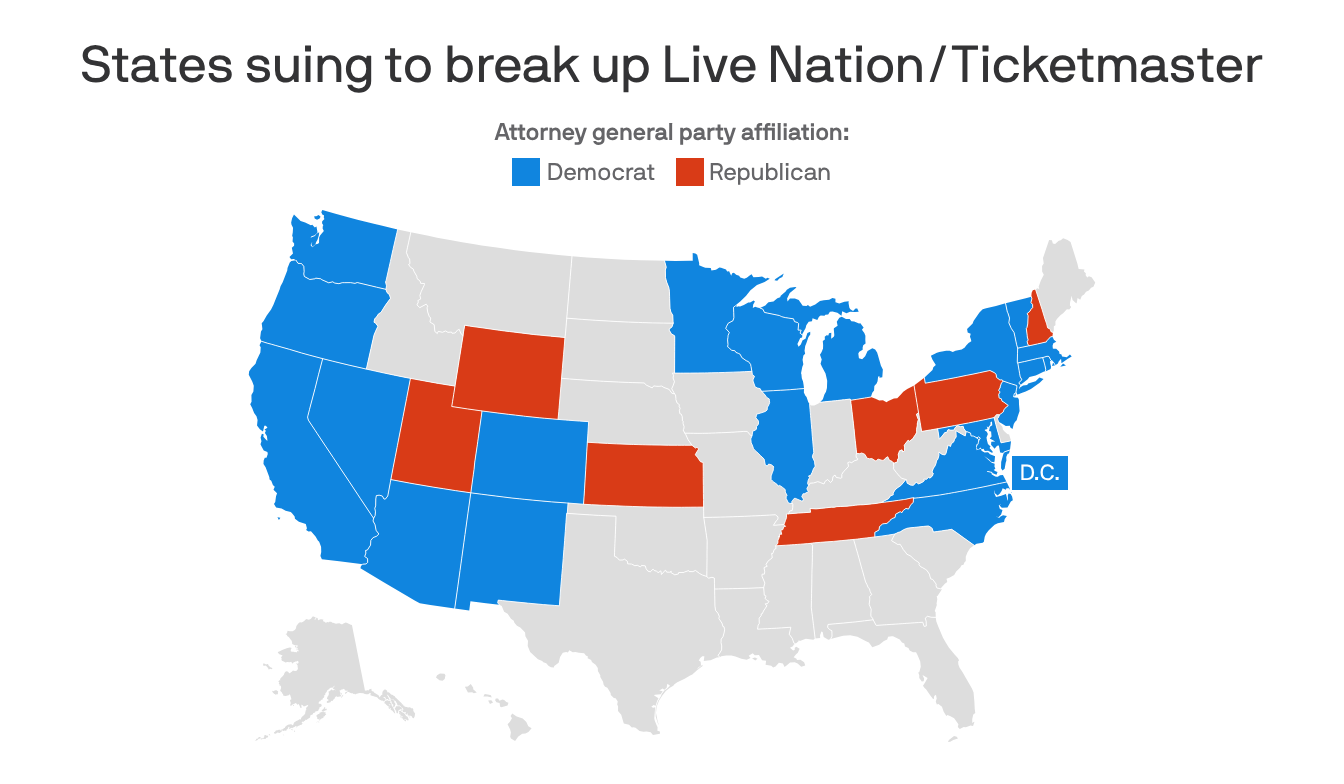
Market Elimination & Category Winnowing: The settlement eliminates Ticketmaster's monopolistic pricing power in specific venue categories. Independent promoters and regional ticketing platforms previously locked out of major venues now have guaranteed access. However, 27 states plus Washington D.C. filed for mistrial (as of March 2026), arguing the settlement inadequately addresses structural monopoly issues. This legal uncertainty delays full implementation—venues cannot confidently commit to alternative platforms until the mistrial challenge is resolved, potentially extending the transition period 12-18 months.
Service Gap Opportunities: The settlement creates urgent demand for compliance infrastructure: venue ticketing system integration services, multi-platform inventory management tools, and fee reconciliation software. Venues managing tickets across Ticketmaster (50%) and alternative platforms (50%) require middleware solutions to prevent overselling, synchronize pricing, and manage refunds across systems. This represents a $200-400M service market opportunity for ticketing technology providers.
Fast-Track Compliance Path: Alternative platforms can achieve compliance immediately by accepting the 15% fee cap and integrating with venues' existing systems. The divestment requirement forces Live Nation to transfer exclusive booking agreements—creating a 90-120 day integration window where venues must activate alternative platforms. Platforms that pre-build venue integration templates and offer white-label solutions can capture market share during this window before competitors establish relationships.
Questions 8
How does this settlement compare to previous failed antitrust actions against Live Nation?
Senator Amy Klobuchar criticized the settlement as ineffective, comparing it to previous failed Justice Department settlements with Live Nation that failed to prevent anticompetitive behavior. The current settlement avoids company breakup (the most aggressive remedy) and instead relies on structural constraints: fee caps, divestment, and forced platform access. However, critics argue these measures don't address the core monopoly—Live Nation retains control over artist management, venue operations, and 50% of ticket distribution. The settlement's weakness is evident in the mistrial challenge: 27 states argue it inadequately addresses monopoly structure and will harm consumers. If the mistrial succeeds, the case could result in more aggressive remedies (breakup, higher penalties, stricter fee caps). The settlement represents a compromise reflecting the Justice Department's difficulty proving anticompetitive harm under current antitrust law, suggesting future enforcement may require stronger evidence or different legal theories.
How does the mistrial filing by 27 states affect the settlement timeline?
The mistrial challenge filed by 27 states (led by New York, North Carolina, and Kansas) argues the settlement inadequately addresses Live Nation's structural monopoly. Federal Judge Arun Subramanian ordered settlement negotiations in March 2026, but Live Nation's legal team stated there was 'zero chance' of reaching agreement with remaining states by the Friday deadline. If the mistrial is granted, the entire settlement could be voided, forcing the case back to trial with potential for more aggressive remedies (company breakup, higher penalties, stricter fee caps). This legal uncertainty extends the compliance timeline 12-18 months—venues cannot confidently commit to alternative platforms until the mistrial challenge is resolved, delaying the 50% ticket allocation requirement and divestment implementation.