
Astringent Skincare Boom | $4.35B Market Opportunity for E-Commerce Sellers 2025-2032
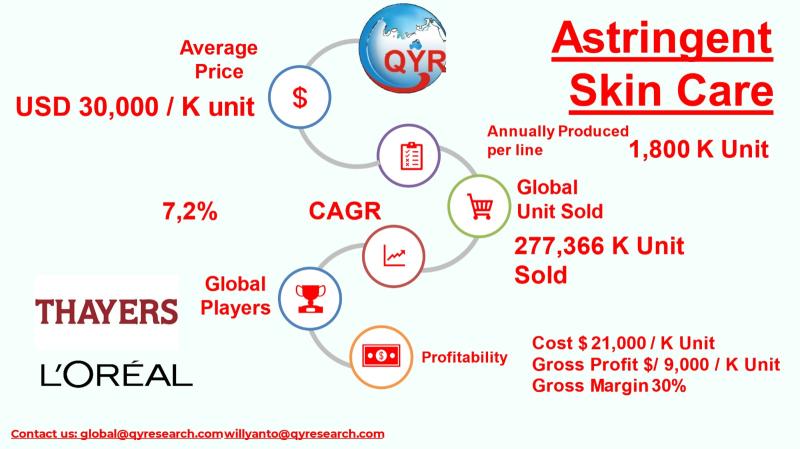
- 7.2% CAGR growth to $12.67B by 2032; Asia dominates 46% demand; e-commerce DTC brands capture 15% of $8.32B market with 30% factory margins
Overview
The global astringent skincare market represents a $4.35 billion growth opportunity for e-commerce sellers, expanding from $8.32 billion in 2025 to $12.67 billion by 2032 at a 7.2% compound annual growth rate. This explosive growth in liquid toners, astringent pads, gels, serums, and mist sprays—formulated with witch hazel, salicylic acid, and botanical extracts—is directly fueled by rapid growth in online beauty retail platforms and social media beauty trends, making this a prime category for Amazon, TikTok Shop, Shopify, and eBay sellers.
Market fundamentals favor e-commerce sellers immediately: Current data shows 277.37 million units sold globally in 2025 at an average selling price of $30 per unit, with factory COGS at $21, yielding a 30% gross margin. E-commerce direct-to-consumer brands currently capture only 15% of downstream demand (versus 48% for personal skincare retail), indicating massive white space for sellers to capture market share. The category benefits from rising skincare awareness, increased urban pollution exposure, and growing acne incidence among teenagers and adults—demographics highly active on TikTok, Instagram, and Amazon.
Asia-Pacific represents the highest-velocity opportunity: Asia dominates consumption at 46% of global demand, with China, South Korea, Japan, and India as major growth markets. ASEAN specifically shows 8-9% CAGR (faster than global average), representing 11-13% of demand. This regional concentration enables sellers to source from established Korean beauty manufacturers (who are launching pad-type astringents with BHA and Centella Asiatica targeting global acne routines) and leverage existing supply chains. Platform-specific advantage: TikTok Shop and Shopify are ideal for this category due to social media beauty trend integration and direct-to-consumer positioning, while Amazon offers scale through beauty category dominance and established skincare buyer audiences.
Competitive landscape shows low-to-medium saturation in emerging niches: Recent innovations—alcohol-free formulations, microbiome-friendly probiotic toners, smart UV-protective packaging, and AI-driven skincare personalization apps—indicate the category is still in early innovation phases. Emerging sellers can differentiate through niche formulations (probiotic-focused, alcohol-free, sustainable packaging) rather than competing on established brands. Contract manufacturing organizations are becoming critical partners, enabling startups to launch private-label products within 60-90 days. Speed-to-market advantage: Sellers can source finished goods from CMOs, create branded listings, and achieve first sales within 30-45 days on Amazon or Shopify, with TikTok Shop enabling viral social commerce acceleration.
Key seller opportunities: (1) Private-label astringent pads targeting acne-prone teens (high TikTok engagement); (2) Alcohol-free toner formulations for sensitive skin (underserved niche); (3) Probiotic/microbiome-friendly astringents (innovation trend); (4) Bundled skincare routines combining astringents with complementary products (higher AOV). Regulatory compliance varies by region—EU sellers must navigate cosmetics regulations, while US sellers benefit from lighter FDA oversight for non-drug claims. Botanical ingredient supply volatility presents a risk, but established CMOs have secured supply chains.
Questions 8
Which e-commerce platforms are best positioned for astringent skincare sellers?
**TikTok Shop** and **Shopify** are ideal for this category due to direct-to-consumer positioning and social media beauty trend integration—critical for reaching acne-prone teens and young adults who drive demand. **Amazon** offers scale through established beauty category dominance and high-intent skincare buyer audiences, with beauty category conversion rates typically 8-12%. **eBay** serves value-conscious buyers seeking established brands. For maximum reach, sellers should prioritize TikTok Shop for viral growth potential, Shopify for brand control and margin optimization, and Amazon for volume and trust.
What are the regulatory compliance requirements for astringent skincare sellers?
Regulatory requirements vary significantly by region. EU sellers must navigate strict cosmetics regulations including ingredient restrictions on alcohol-based formulations and botanical ingredient documentation. US sellers benefit from lighter FDA oversight for non-drug claims but must ensure salicylic acid products comply with OTC drug monograph requirements if making acne treatment claims. ASEAN countries have varying requirements—Singapore and South Korea have established cosmetics frameworks, while emerging markets may have less stringent oversight. Sellers should work with CMOs experienced in multi-region compliance to avoid costly reformulations.