
Cartoon Kidswear Market Hits $24.5B | Nostalgia-Driven IP Strategy for Sellers
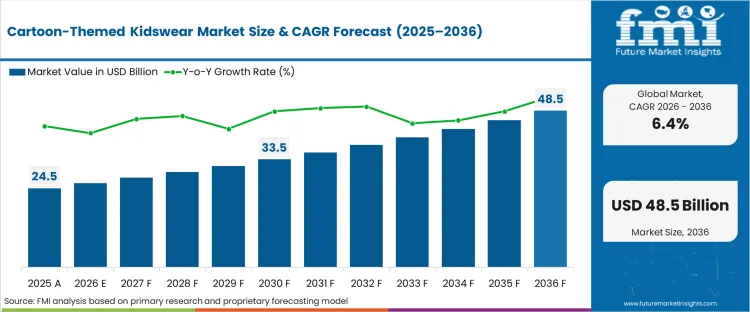
- Global market grows 6.4% CAGR to $48.7B by 2036; online retailers capture 45.5% of sales through streaming-linked algorithmic cross-selling
Overview
The global cartoon-themed kidswear market represents a $24.5 billion opportunity in 2025, projected to reach $48.7 billion by 2036 at a 6.4% compound annual growth rate. This explosive growth signals a fundamental shift in how e-commerce sellers should approach children's apparel merchandising, driven by three distinct consumer psychology triggers: generational nostalgia cycles where millennial parents purchase legacy franchise characters for infants, streaming platform content proliferation forcing shorter product lifecycles (6-week rotation windows), and peer-validation dynamics in the 6-12 age bracket during back-to-school spending peaks.
The market structure reveals critical seller opportunities across product categories and channels. T-shirts and shirts dominate with 34.2% market share in 2026, while the 6-12 years age group represents 42.8% of total demand—indicating that back-to-school periods (July-August in Northern Hemisphere, January-February in Southern Hemisphere) represent peak conversion windows. Most significantly, online retailers capture 45.5% of all sales through algorithmic cross-selling tied directly to streaming platform viewing habits, meaning sellers integrated with Netflix, Disney+, and Amazon Prime viewing data gain substantial competitive advantages. This integration enables real-time demand prediction: when a show trends on streaming platforms, related merchandise demand spikes within 2-3 weeks, creating arbitrage opportunities for agile sellers.
Regional growth disparities create geographic arbitrage opportunities for cross-border sellers. India leads at 8.5% CAGR, driven by conversion of unbranded retail spending into licensed apparel among expanding middle-class consumers—representing the fastest-growing segment. China (7.2% CAGR), Brazil (6.8%), and the United States (5.8%) follow, while mature markets like Germany (4.6%) and UK (4.9%) show slower growth. The highest-margin strategy, according to FMI analyst Ronak Shah, involves mining 20-year-old IP libraries for infant segments rather than chasing newest movie releases, since parents purchase characters they loved themselves rather than what toddlers watch. This insight contradicts typical retail thinking and creates a competitive moat: sellers focusing on legacy franchises (Disney Renaissance era, 1990s Nickelodeon, early 2000s Cartoon Network) achieve higher margins and more predictable demand than those chasing trending content.
Operational excellence determines competitive advantage in this market. Successful retailers synchronize inventory with content release schedules rather than seasonal patterns, integrating point-of-sale data directly with licensing partners to enable rapid-response supply chains capable of rotating franchise licenses within six-week lead times. This transition from reactive stocking to proactive demand capture represents the primary competitive differentiator. Sellers must implement real-time inventory management systems, establish direct relationships with licensing partners, and develop predictive algorithms linking streaming platform data to merchandise demand.
Questions 8
What is driving the 6.4% annual growth in cartoon-themed kidswear sales?
The market growth is driven by three interconnected factors: generational nostalgia cycles where millennial parents purchase legacy franchise merchandise for infants, content proliferation across streaming platforms forcing shorter product lifecycles, and peer-validation dynamics in the 6-12 age bracket during back-to-school periods. The market reached $24.5 billion in 2025 and is projected to reach $48.7 billion by 2036. Streaming platform integration enables algorithmic cross-selling, with online retailers capturing 45.5% of sales through viewing-habit-linked recommendations. Sellers should prioritize inventory synchronization with content release schedules rather than traditional seasonal patterns to capture demand spikes within 2-3 weeks of streaming trends.
Which age groups and product categories offer the highest seller margins?
The 6-12 years age group represents 42.8% of total market demand, making back-to-school periods (July-August Northern Hemisphere, January-February Southern Hemisphere) peak conversion windows. T-shirts and shirts dominate with 34.2% market share in 2026. However, the highest-margin strategy involves mining 20-year-old IP libraries for infant segments rather than chasing newest movie releases, since parents purchase characters they loved themselves rather than what toddlers watch. This legacy-focused approach delivers more predictable demand and higher margins than trend-chasing competitors. Sellers should develop SKU portfolios emphasizing 1990s-2000s franchises (Disney Renaissance, Nickelodeon, Cartoon Network) alongside current releases.