
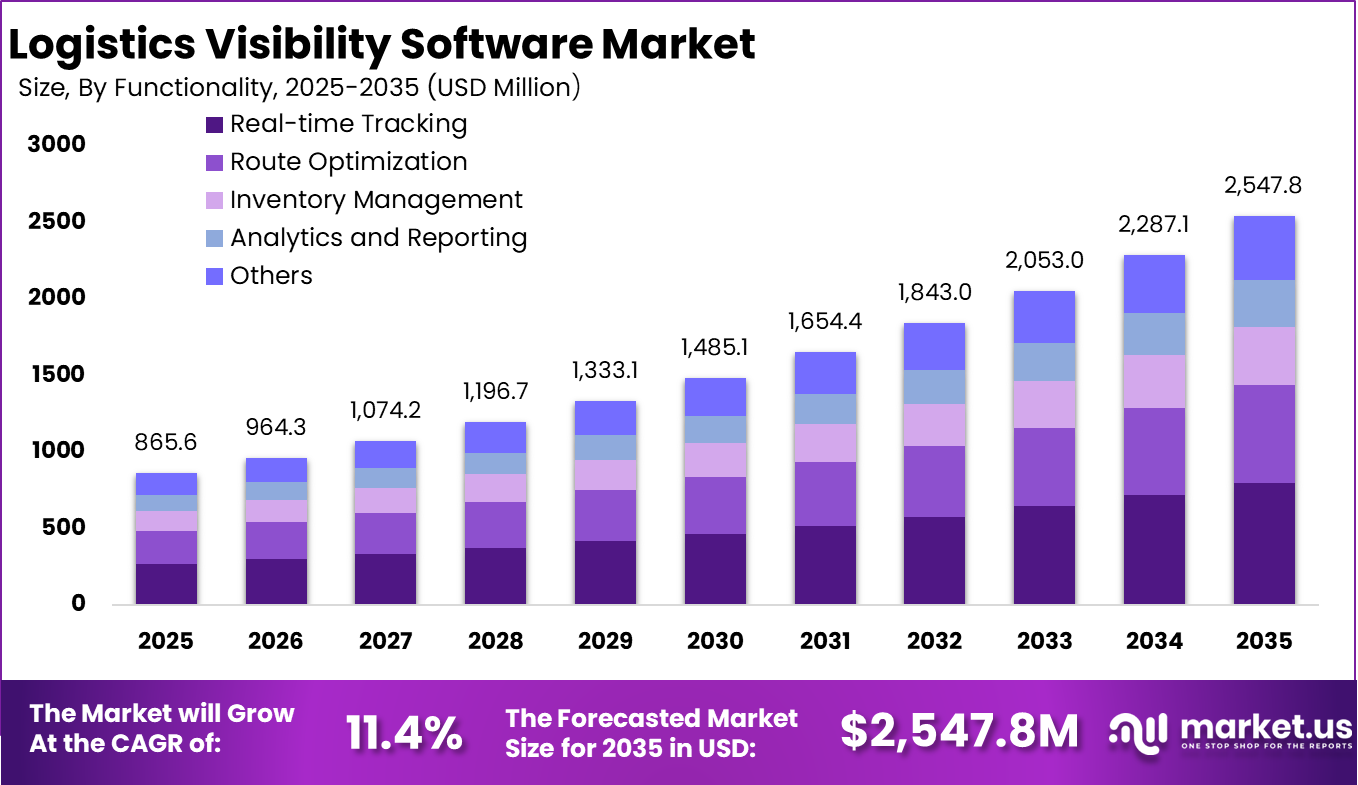
AI-Powered Logistics Visibility Transforms E-Commerce Supply Chains | 11.4% CAGR Growth
- Global market reaches $2.5B by 2035; AI automation reduces logistics costs 10-15% and improves on-time delivery 25-30% for cross-border sellers
Overview
The global logistics visibility software market is experiencing explosive growth, projected to expand from $865.6 million in 2025 to $2.5 billion by 2035 at an 11.4% CAGR, with North America commanding 37.35% market share ($323.3M). This AI-driven transformation directly impacts cross-border e-commerce sellers through three critical automation opportunities: real-time tracking automation (31.48% functionality share), cloud-based deployment (75.4% of implementations), and subscription pricing models (43.72% market adoption) that democratize enterprise-grade visibility for smaller sellers.
AI integration is the primary competitive differentiator in logistics visibility. Generative AI tools are already deployed by 44% of logistics teams, delivering measurable ROI: AI-driven systems reduce transportation expenses by nearly 20% and overall logistics costs by 10-15%, while automating up to 75% of manual tracking tasks. Blue Yonder's AI-driven Logistics Ops Agent optimized 23 million warehouse tasks in 2025, and Project44's predictive alert platform (launched January 2026) exemplifies the shift toward intelligent forecasting. For e-commerce sellers, these platforms improve warehouse efficiency by 30% and reduce demand prediction errors by 40%—directly translating to faster fulfillment and higher customer satisfaction scores.
Market adoption reveals urgent seller demand for visibility solutions. Currently, 50% of shippers and 59% of logistics service providers have implemented freight tracking, yet 62% report limited operational insight despite 70% identifying supply chain visibility as a top priority. This gap represents a critical automation opportunity: sellers using AI-powered visibility platforms can capture competitive advantage through predictive analytics, dynamic routing optimization, and automated exception handling. The data shows 76% of shippers experienced supply chain disruptions in 2024 (22% facing 20+ events), with port congestion causing 2+ week delays for 51% of firms and extreme weather impacting 22% of supply chains annually. Sellers adopting AI visibility tools NOW gain 6-12 month competitive advantage before market saturation.
Cloud-based subscription models enable rapid adoption for mid-market sellers. Large enterprises control 68.94% of the current market, but the shift toward cloud deployment (75.4%) and subscription pricing (43.72%) removes capital barriers for smaller sellers. This democratization means sellers with $500K-$5M annual revenue can now access predictive demand forecasting, automated carrier selection, and real-time exception management previously available only to Fortune 500 companies. The U.S. market alone ($284.1M in 2025, 9.36% CAGR) demonstrates sustained investment in logistics intelligence, signaling that sellers ignoring AI visibility adoption will face margin compression from less efficient fulfillment operations.
Questions 8
What is the competitive advantage timeline for sellers implementing AI visibility now?
Sellers adopting AI logistics visibility tools in Q1 2026 gain 6-12 months of competitive advantage before market saturation. Currently, only 44% of logistics teams use AI tools for decision acceleration, and 62% of organizations report limited operational insight despite 70% identifying visibility as a top priority. This gap represents a first-mover advantage window. Sellers implementing cloud-based visibility platforms now can reduce demand prediction errors by 40% and improve warehouse efficiency by 30%, translating to faster inventory turnover and lower carrying costs. After 12-18 months, as adoption reaches 60-70%, this advantage erodes as competitors catch up.
Which AI logistics tools should mid-market sellers prioritize for cross-border operations?
Mid-market sellers ($500K-$5M annual revenue) should prioritize cloud-based, subscription-model platforms that eliminate capital investment barriers. Project44's real-time tracking platform with predictive alerts (launched January 2026) and Blue Yonder's AI-driven Logistics Ops Agent represent enterprise-grade solutions now accessible via subscription. These platforms command 75.4% of cloud deployments and 43.72% of subscription-based market share, indicating proven ROI and vendor stability. For sellers managing cross-border shipments, prioritize tools offering: (1) real-time tracking across multiple carriers, (2) predictive delay alerts, (3) automated exception management, and (4) demand forecasting integration with inventory systems. Expected ROI: 6-9 month payback period through cost reduction and improved fulfillment speed.