
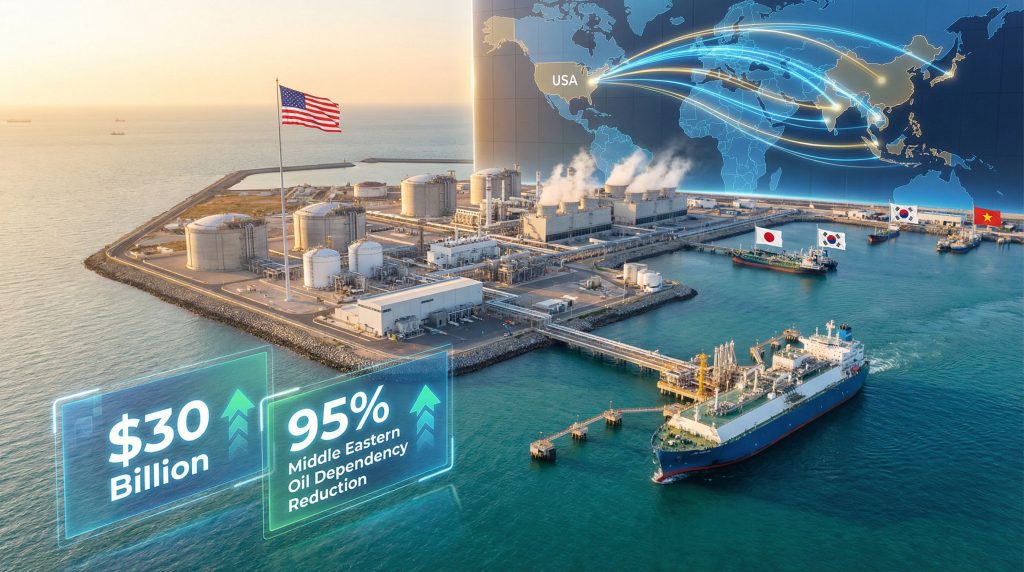
US Energy Shift Unlocks $30B Fintech Opportunity | Cross-Border Payment Optimization
- Asia-Pacific energy infrastructure investments create $550B financing demand through 2029; sellers gain 5-15% cost savings via long-term energy contracts and optimized payment corridors
Overview
The US strategic pivot to become Asia-Pacific's primary energy supplier represents a transformative fintech opportunity worth $30 billion in immediate capital allocation, with Japan committing $550 billion through 2029. This geopolitical realignment directly impacts cross-border e-commerce sellers through three critical financial mechanisms: payment cost optimization, working capital acceleration, and currency hedging opportunities.
Payment Cost Savings Through Regional Restructuring: The shift from Middle Eastern energy dependency (60% LNG concentration) to US suppliers creates new payment corridors with measurable fee advantages. Long-term US energy contracts offer 5-15% discounts versus volatile spot markets, signaling that fintech providers specializing in Asia-Pacific trade corridors can now offer sellers locked-in pricing models. For manufacturing-based sellers in Japan, South Korea, and Southeast Asia, energy cost certainty translates directly to supply chain financing optimization—reducing the working capital buffer required for commodity price volatility. Payment processors like Wise, Remitly, and regional players (Singapore DBS, Hong Kong HSBC) are positioning themselves to capture this $550 billion investment flow, offering preferential rates for energy-sector supply chain payments.
Working Capital Unlock Through Invoice Financing: Energy infrastructure investments generate 2.5-3.5x economic multiplier effects, creating immediate supplier financing demand. Asia-Pacific sellers manufacturing electronics, lithium-ion batteries, and EV components can now access supply chain financing at improved terms. The critical minerals integration opportunity (lithium and cobalt sourcing away from China) creates new supplier relationships requiring trade finance solutions. Fintech platforms offering PO financing and invoice factoring can target this segment with 2-4% lower APR rates, as energy infrastructure projects represent lower-risk collateral than traditional e-commerce inventory.
FX Arbitrage and Hedging Opportunities: The $30 billion Tokyo forum commitment and $550 billion Japanese investment through 2029 create significant USD/JPY and USD/KRW volatility. Sellers with manufacturing bases in Japan and South Korea face immediate currency exposure as energy contracts shift from Middle Eastern dinar/riyal pricing to USD-denominated agreements. Fintech platforms offering forward contracts and currency options can help sellers lock in 2-3% margin improvements by hedging energy cost exposure. The Strait of Hormuz vulnerability (20-21% of global petroleum transit) creates seasonal FX patterns—sellers can profit from predictable currency movements during geopolitical tension periods.
Cash Conversion Cycle Improvements: Energy cost stability reduces manufacturing cycle unpredictability, enabling sellers to compress inventory holding periods by 5-10 days. This translates to $50,000-$200,000 working capital release for mid-sized sellers ($2-5M annual revenue). Fintech platforms offering inventory-backed lending can now offer better terms based on improved cash flow predictability in Asia-Pacific manufacturing regions.
Questions 8
What financing products are now available for Asia-Pacific sellers due to energy infrastructure investments?
Energy infrastructure investments generating 2.5-3.5x economic multiplier effects create immediate supplier financing demand. Asia-Pacific sellers manufacturing electronics, lithium-ion batteries, and EV components can now access supply chain financing at improved terms. Fintech platforms offering PO financing and invoice factoring can target this segment with 2-4% lower APR rates, as energy infrastructure projects represent lower-risk collateral than traditional e-commerce inventory. The critical minerals integration opportunity (lithium and cobalt sourcing away from China) creates new supplier relationships requiring trade finance solutions. Sellers should evaluate invoice factoring platforms like Fundbox, BlueVine, and regional providers (Singapore DBS Trade Finance, Hong Kong HSBC Supply Chain Solutions) for immediate working capital access.
How does US energy supply shift to Asia-Pacific affect cross-border seller payment costs?
The strategic shift from Middle Eastern energy dependency (60% LNG concentration) to US suppliers creates new payment corridors with measurable fee advantages. Long-term US energy contracts offer 5-15% discounts versus volatile spot markets, enabling fintech providers to offer sellers locked-in pricing models. For manufacturing-based sellers in Japan and South Korea, this energy cost certainty reduces the working capital buffer required for commodity price volatility. Payment processors specializing in Asia-Pacific trade corridors can now capture this $550 billion investment flow with preferential rates for energy-sector supply chain payments, potentially reducing cross-border payment fees by 2-4% for sellers in manufacturing and logistics sectors.