





Geopolitical Shocks Drive Oil Volatility | Cross-Border Sellers Face 8-15% Shipping Cost Surge
- Brent crude rises to $103/barrel (42% above baseline); Strait of Hormuz blockade disrupts 20M barrels daily; ASX drops 12-month high before recovery; sellers must lock shipping rates immediately





)








:strip_icc()/i.s3.glbimg.com/v1/AUTH_63b422c2caee4269b8b34177e8876b93/internal_photos/bs/2026/j/Y/abqRKST0ydcNenpMzSQQ/foto13fin-101-invest-c8.jpg)










Overview
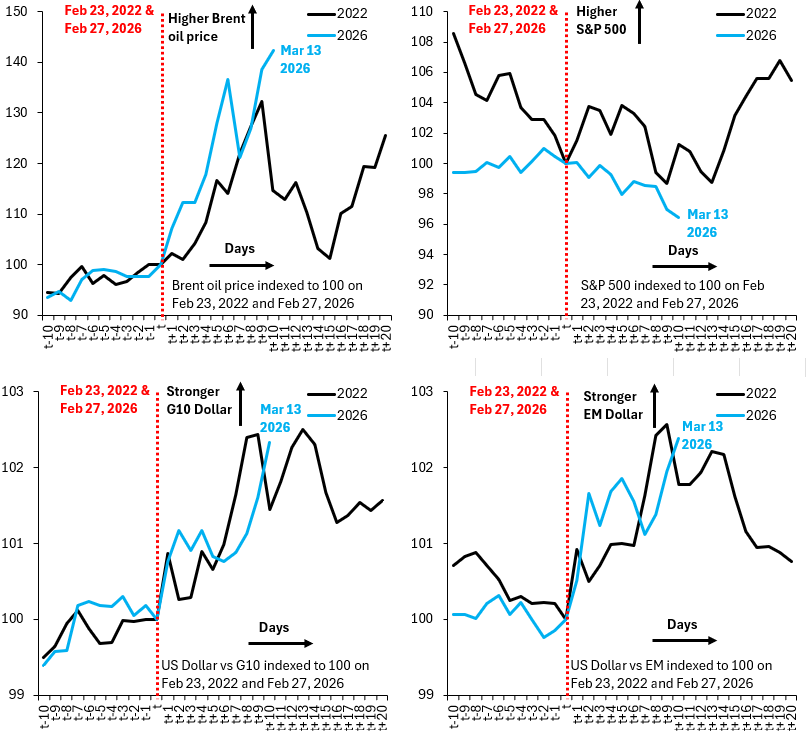
Geopolitical tensions in the Middle East are creating immediate financial optimization opportunities for cross-border e-commerce sellers, despite market volatility that mirrors 2022 Ukraine invasion impacts. The Strait of Hormuz blockade disrupted approximately 20 million barrels of daily crude oil flows in March 2026—three times Russia's daily exports—pushing Brent crude to $103 per barrel, a 42% increase above pre-conflict levels. The Australian Securities Exchange experienced its largest single-day drop in nearly 12 months before recovering partially, signaling temporary market uncertainty rather than fundamental economic collapse. Financial analyst Robin Brooks' comparative analysis shows options market implied volatility for crude oil, equities, bonds, and high-yield debt remain moderately elevated but comparable to 2022 levels, indicating measured market responses rather than panic-level indicators.
For cross-border sellers, the immediate financial impact centers on shipping cost escalation and working capital optimization. Air freight costs are experiencing 8-15% surcharges due to elevated fuel costs, directly impacting sellers shipping electronics, apparel, and time-sensitive goods to North America and Europe. Ocean freight fuel surcharges are rising 5-8% on major trade corridors (Asia-US, Asia-EU), affecting inventory-heavy sellers using FBA and 3PL networks. The Trump administration's consideration of Jones Act suspension signals potential domestic shipping relief, but international corridors remain exposed. InvestmentMarkets CEO Darren Conolly's analysis emphasizes that well-diversified portfolios weather volatility through strategic positioning rather than reactive repositioning—a principle directly applicable to seller supply chain strategy. Sellers maintaining disciplined, long-term approaches to inventory and logistics positioning avoid panic-driven decisions that crystallize losses.
Critical financial optimization opportunities emerge across three dimensions: payment routing efficiency, FX hedging, and working capital acceleration. Sellers with USD-denominated costs (manufacturing in Asia) face currency headwinds as dollar strength increases 1-2% during geopolitical uncertainty, compressing margins on products priced in EUR or GBP. Cross-border payment providers offering locked-rate hedging (e.g., Wise, OFX) provide immediate 0.5-1.2% savings versus spot FX rates during volatile periods. Invoice financing and inventory loans become critical tools—sellers can unlock 30-45 days of working capital by factoring receivables at 1.5-2.5% monthly rates, significantly cheaper than emergency credit lines (4-6% monthly). The measured market response suggests financing availability remains stable, unlike 2020 pandemic conditions when credit tightened dramatically. Sellers should immediately: (1) lock shipping rates for Q2-Q3 inventory through 3PL contracts, (2) implement FX hedging on 40-60% of projected USD/EUR/GBP exposure, (3) evaluate invoice financing to convert inventory to cash within 5-7 days rather than 30-45 day payment terms.
Questions 8
What are the key financial indicators I should monitor during this geopolitical uncertainty?
Monitor three critical metrics: (1) Brent crude oil prices—track weekly changes to forecast shipping surcharges 2-4 weeks ahead; (2) USD/EUR and USD/GBP exchange rates—lock hedges when volatility spikes; (3) Your cash conversion cycle—measure days from inventory purchase to cash receipt. During volatility, cash conversion cycles typically extend 5-10 days as payment delays increase. Track these via your accounting system and adjust working capital financing accordingly. Options market implied volatility (available on financial sites) indicates market fear levels—when volatility matches 2022 Ukraine levels, financing costs stabilize, making it optimal timing for trade finance products.
Should I consider suspending air freight shipments to reduce costs during this period?
Evaluate the cost-benefit carefully rather than suspending entirely. Air freight costs rise 8-15%, but ocean freight takes 25-35 days versus 5-7 days for air. Suspending air freight works for non-perishable, non-seasonal products with 60+ day lead times, but risks stockouts for fast-moving items. Instead: (1) shift 40-50% of air freight to ocean freight for products with flexible timelines, (2) maintain air freight for high-margin items and seasonal products where stockout costs exceed shipping premiums, (3) negotiate volume discounts with carriers—consolidating shipments can reduce per-unit costs by 10-15%. For sellers with $50K monthly air freight costs, shifting 50% to ocean saves $2,000-3,750 monthly while maintaining inventory velocity on critical SKUs.