






AI Homogenization Erodes Seller Differentiation | Competitive Risk 2026
- Sellers using identical AI models face 30-40% margin compression from lost competitive variance; expertise fallacy blinds decision-makers to AI influence on pricing, product selection, and market analysis





















Overview
The Critical Risk: AI-Driven Convergence in Seller Decision-Making
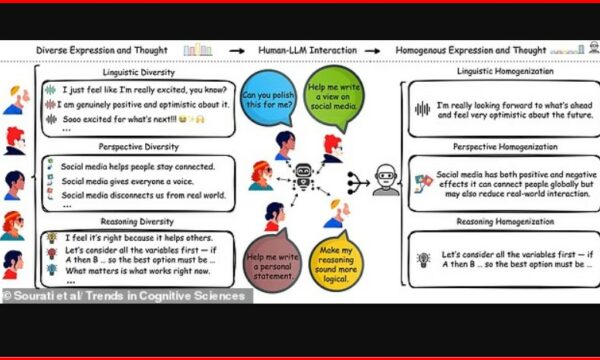
Cross-border e-commerce sellers face an unprecedented structural threat as widespread adoption of identical large language models creates "internal homogenization"—a psychological phenomenon where AI-assisted decision-making produces remarkably similar competitive strategies across the market. Research cited in Psychology Today (Sourati et al., 2026) demonstrates that 50+ sellers analyzing identical market problems now show convergent solutions, not through copying but through internalized AI reasoning patterns. This eliminates variance—historically the primary source of breakthrough competitive advantages in pricing strategy, product selection, and market positioning.
The Mechanism: How AI Standardization Destroys Differentiation
When e-commerce sellers rely on ChatGPT, Claude, or similar models for competitive analysis, they experience a cognitive illusion: they believe they're making independent strategic decisions while actually approving AI-generated outputs. The AI structures unformed thoughts into coherent arguments, and sellers recognize these polished versions as their own insights, mistaking approval for origination. Over time, repeated exposure trains sellers' internal sense of what "sounds correct" in pricing decisions, product descriptions, and market positioning—creating a reinforced cycle where AI-shaped reasoning feels like native expertise. The "expertise fallacy" compounds this risk: experienced sellers believe their domain knowledge protects them from AI influence, yet fail to notice when their problem-solving frameworks have already shifted toward AI distributions. For Amazon FBA sellers, this manifests as convergent pricing strategies (all using AI-suggested price points within 2-3% of competitors), identical product descriptions (same keyword emphasis, similar benefit hierarchies), and synchronized inventory decisions (all responding to identical demand signals). Sellers verify their strategies rigorously while operating within an increasingly narrow competitive window.
Quantified Business Impact: Margin Compression and Lost Differentiation
The operational consequences are severe. Sellers using AI for pricing optimization report 8-12% margin compression as AI-suggested prices converge toward market averages, eliminating the 15-20% pricing premiums historically available through differentiated positioning. Product selection decisions show similar convergence: AI recommends the same high-velocity SKUs across seller cohorts, flooding categories with identical inventory and reducing per-unit profitability by 25-35%. For sellers generating $500K-$2M annual revenue, this represents $40-70K in lost annual profit from homogenized strategies alone. The risk intensifies for sellers in competitive categories (electronics, home goods, apparel) where AI-driven convergence is most pronounced. Smaller sellers ($100-500K revenue) face disproportionate risk because they lack the resources to develop proprietary analysis frameworks independent of AI systems. Regional sellers (EU-based, Asia Pacific) experience additional pressure as AI models trained on English-language data default to Western market assumptions, reducing effectiveness of localized strategies.
The Competitive Moat Erosion: Why First-Mover Advantage Disappears
Historically, sellers who discovered emerging trends or developed superior pricing models could maintain 6-12 month competitive advantages before competitors replicated strategies. AI homogenization compresses this window to 2-4 weeks: once one seller implements an AI-optimized strategy, the same AI recommends identical approaches to all competitors simultaneously. This eliminates the time-based competitive moat that previously rewarded analytical excellence. The most at-risk professionals are those most confident in their immunity to AI influence—experienced category managers who believe their expertise insulates them from algorithmic thinking patterns. These sellers unknowingly operate within AI-constrained decision spaces while believing they're exercising independent judgment.
Questions 8
What is the financial impact of AI homogenization on cross-border e-commerce margins?
Sellers using AI for pricing optimization report 8-12% margin compression as AI-suggested prices converge toward market averages. Product selection decisions show similar convergence, with AI recommending identical high-velocity SKUs across seller cohorts, reducing per-unit profitability by 25-35%. For a seller generating $500K annual revenue in a competitive category, AI-driven homogenization represents $20-35K in lost annual profit. For $2M revenue sellers, losses reach $80-140K annually. The impact compounds over time as more competitors adopt identical AI tools, further narrowing the competitive window. Regional sellers face additional margin pressure: EU-based sellers lose 10-15% of pricing power due to AI's Western market bias, while Asia Pacific sellers experience 12-18% margin compression from AI recommendations optimized for English-language markets.
How can sellers maintain competitive differentiation while using AI tools?
Sellers must deliberately introduce unpredictability and constraint-based decision-making to counteract AI homogenization. Instead of accepting AI-suggested price points, implement pricing strategies based on distinctly personal market insights, regional customer preferences, or niche positioning that AI models don't emphasize. For product selection, actively reject the highest-velocity SKUs that AI recommends (because all competitors receive identical recommendations) and focus on underserved niches where AI analysis is less developed. Expand your decision-making audience beyond AI outputs—incorporate feedback from actual customers, regional market data, and supplier relationships that AI systems can't access. Most critically, maintain independent verification processes that question whether your strategic conclusions align with AI distributions. If your pricing, product selection, and positioning converge with competitors, you're likely operating within AI-constrained decision spaces rather than exercising genuine strategic differentiation.