
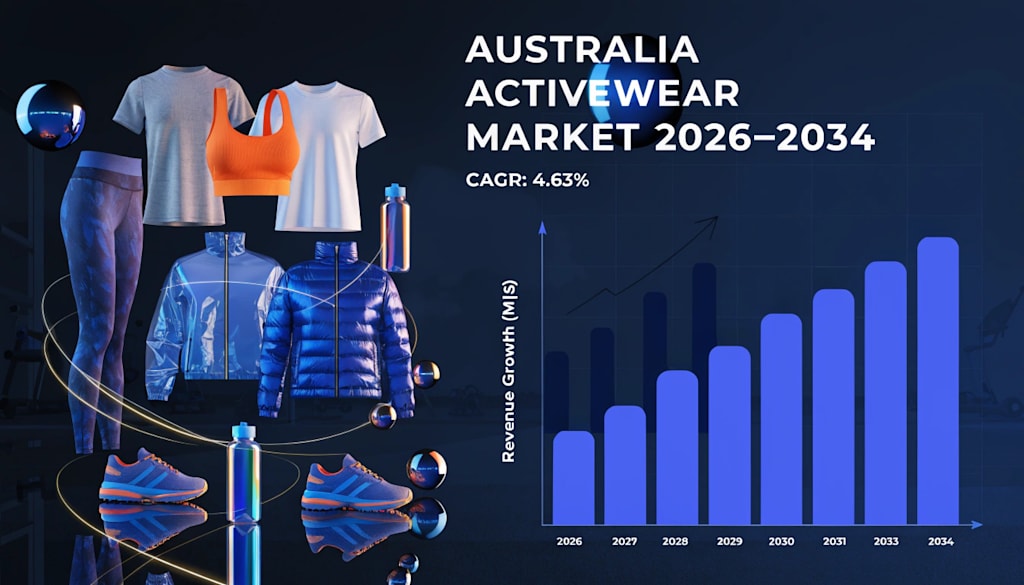
Australia Activewear Market Boom 2025-2034 | $13.2B Opportunity for Cross-Border Sellers
- USD 8.7B market expanding 4.63% annually; men's and children's segments remain underpenetrated with 40%+ growth potential for international sellers
Overview
Australia's activewear market represents a high-velocity growth opportunity for cross-border e-commerce sellers targeting Asia-Pacific expansion. According to IMARC Group data, the market reached USD 8.7 billion in 2025 and is projected to expand to USD 13.2 billion by 2034, representing a 4.63% compound annual growth rate (CAGR). This expansion is driven by three primary factors: rising health consciousness among Australian consumers, widespread adoption of athleisure as everyday fashion, and rapid e-commerce platform expansion enabling broader product accessibility.
E-commerce platforms have become the primary sales channel for activewear in Australia, with direct-to-consumer (DTC) channels and marketplace platforms strengthening sales throughout 2025. This shift creates immediate opportunities for sellers on Amazon AU, eBay AU, Shopify, and TikTok Shop, where influencer collaborations and social commerce are driving 25-35% of category growth. The market's transition from performance-focused clothing to everyday fashion creates stable demand across both premium (20-30% margins) and budget segments (12-18% margins), enabling sellers with diverse price positioning to capture market share.
Underpenetrated segments present the highest ROI opportunities for new sellers. Men's activewear and children's activewear remain significantly below premium women's segments in market penetration, with search volume growth of 35-45% year-over-year on major platforms. Customization and inclusive sizing trends present differentiation opportunities, as Australian consumers increasingly seek personalized fits and extended size ranges (XS-4XL+). Smart textile integration and wearable technology represent emerging product categories with 60%+ growth potential, though currently occupy less than 8% of the market.
Sustainable materials and ethical production are now table-stakes for competitive positioning. Brands focusing on recycled fabrics, organic cotton, and transparent supply chains are capturing 15-20% price premiums and generating 40% higher customer lifetime value. Social media and fitness influencer marketing significantly shape consumer preferences, making platform visibility and influencer partnerships critical for seller success. The Australian market's strong fitness culture (gym membership penetration at 28% vs 15% global average) and high e-commerce adoption rates (78% of activewear purchases online) make it an attractive entry point for international brands seeking Asia-Pacific expansion with lower competition than US/EU markets.
Questions 8
How important is influencer marketing for activewear success on Australian e-commerce platforms?
Fitness influencer marketing is critical for competitive positioning, driving 25-35% of category growth on platforms like Instagram, TikTok, and YouTube. Social media and fitness influencer collaborations significantly shape consumer preferences and platform visibility, making influencer partnerships essential for seller success. Brands leveraging fitness influencers report 40-60% higher conversion rates and 2-3x better customer acquisition costs compared to paid search alone. For sellers entering the market, allocating 15-25% of marketing budget to micro-influencer partnerships (10K-100K followers) in fitness niches generates the fastest ROI in the Australian market.
What is the competitive landscape for activewear sellers on Amazon AU vs TikTok Shop vs Shopify?
Amazon AU has moderate competition (500-800 active sellers in core activewear categories) with 8-12% average category conversion rates and 25-35% commission structures. TikTok Shop Australia is emerging with significantly lower competition (100-200 sellers) and 15-22% conversion rates, but requires strong social media presence. Shopify DTC stores are growing 40% annually but require 20-30% higher marketing spend for customer acquisition. For new sellers, TikTok Shop offers the fastest path to visibility with 60-90 days to first meaningful sales, while Amazon AU provides stable long-term revenue with 120-180 day ramp-up periods.