



Gmail E2EE Mobile Encryption | Enterprise Sellers Gain GDPR-Compliant Secure Communications
- Google rolls out native encryption for Android/iOS; Enterprise Plus users gain data sovereignty controls; HIPAA-regulated sellers eliminate third-party encryption tools; April 2025 beta launch expands to all CSE-licensed enterprises







Overview
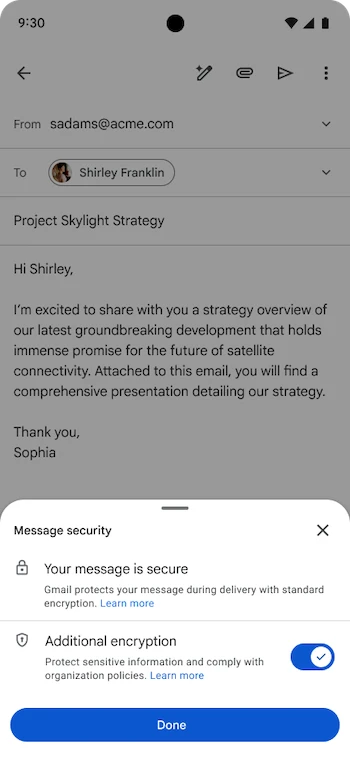
Google's rollout of end-to-end encryption (E2EE) for Gmail on Android and iOS mobile devices represents a critical infrastructure upgrade for cross-border e-commerce sellers managing sensitive business communications. Beginning April 2025, Enterprise Plus license holders with Assured Controls or Assured Controls Plus add-ons can now compose and read encrypted emails natively within the Gmail app, eliminating the need for third-party encryption tools that previously added operational friction and cost overhead.
The operational impact for enterprise sellers is substantial. The feature uses client-side encryption technology where messages and attachments encrypt on users' devices before transmission to Google's servers, ensuring Google and third parties cannot access data. This addresses three critical regulatory requirements: data sovereignty (encryption keys remain outside Google infrastructure), HIPAA compliance (essential for sellers in healthcare, pharmaceuticals, and regulated supplements), and export controls (critical for sellers managing cross-border transactions with restricted jurisdictions). For sellers currently paying $50-200/month for third-party encryption solutions like ProtonMail or Virtru, this native integration eliminates redundant costs while improving workflow efficiency.
Seller segments benefit differently based on business model. Large cross-border sellers managing supplier negotiations, payment information, and customer data across multiple jurisdictions gain immediate compliance advantages. A seller managing operations in EU, UK, and US markets can now implement encryption protocols satisfying GDPR, CCPA, and UK GDPR requirements simultaneously through a single Gmail interface. Sellers in HIPAA-regulated sectors (health supplements, medical devices, wellness products) eliminate the compliance risk of unencrypted supplier communications. Mid-market sellers ($5M-50M annual revenue) operating 3PL networks across Asia-Pacific and North America can secure logistics communications without workflow disruption.
The "catch" mentioned in initial reports involves feature limitations. E2EE restricts certain Gmail functionality: search within encrypted messages, spam filtering, and automatic forwarding may be limited or unavailable. Sellers must adjust workflows—maintaining unencrypted channels for routine communications while reserving E2EE for sensitive correspondence (payment terms, customer PII, supplier contracts). The feature requires admin enablement in the CSE admin interface, meaning sellers must coordinate with IT teams or Google Workspace administrators, adding 1-2 week implementation timelines.
Market context shows accelerating privacy infrastructure investment. Google's expansion of CSE technology from web (December 2022 beta) through Drive, Docs, Sheets, Slides, Meet, and Calendar (February 2023 general availability) to mobile Gmail (April 2025 beta) demonstrates systematic platform hardening. This reflects regulatory pressure from EU Digital Markets Act compliance requirements and GDPR enforcement actions (averaging €15-50M penalties for data protection violations). Sellers operating in regulated industries face increasing customer expectations for encryption—particularly B2B sellers where enterprise customers now mandate encrypted communications as contract requirements.
Questions 8
What is Gmail end-to-end encryption and how does it differ from standard Gmail security?
Gmail E2EE uses client-side encryption where messages encrypt on your device before reaching Google's servers, ensuring only sender and recipient can read content. Standard Gmail uses transport encryption (TLS) protecting data in transit but allowing Google to access message contents for spam filtering and search. For sellers handling sensitive business data, E2EE provides regulatory compliance (GDPR, HIPAA, export controls) that standard encryption cannot. The tradeoff: E2EE disables Gmail search, spam filtering, and forwarding within encrypted messages, requiring sellers to maintain separate unencrypted channels for routine communications.
How does Gmail E2EE help sellers comply with GDPR and data protection regulations?
Gmail E2EE addresses three GDPR requirements: encryption of personal data in transit and at rest, data controller authority over encryption keys (stored outside Google infrastructure), and data sovereignty for EU-based operations. Sellers managing EU customer data can now encrypt communications with suppliers, logistics partners, and payment processors, satisfying GDPR Article 32 security obligations. The feature also supports UK GDPR and CCPA compliance for sellers operating multi-jurisdictional businesses. Encryption keys remain under seller control through Google Workspace admin settings, providing the data controller authority required by GDPR. This eliminates compliance gaps from unencrypted supplier communications that regulators increasingly scrutinize.