
East Africa Oil Export Boom Unlocks $2B+ Cross-Border Payment Opportunities for Fintech Sellers
- Uganda's EACOP pipeline (Oct 2026 launch) creates urgent demand for trade finance, FX hedging, and supply chain payment solutions across East Africa-Asia corridors
Overview
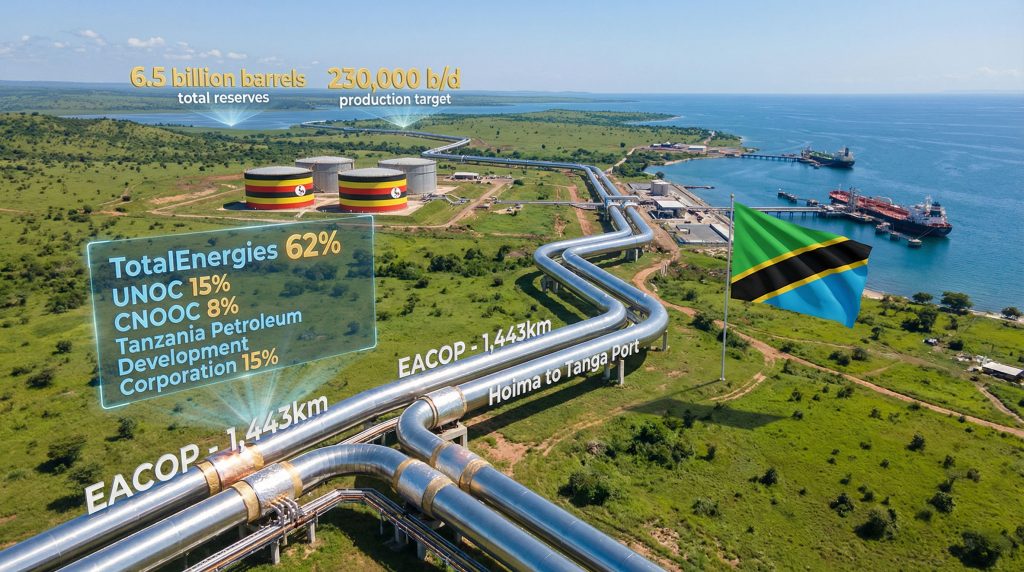
Uganda's East African Crude Oil Pipeline (EACOP) project represents a transformative fintech opportunity disguised as energy infrastructure. The 1,443-kilometer pipeline launching October 30, 2026, with 230,000 barrels per day capacity creates an immediate $2B+ annual cross-border payment challenge that fintech sellers can monetize through specialized solutions.
The Core Fintech Opportunity: The EACOP involves TotalEnergies (62%), CNOOC (8%), Uganda National Oil Company (15%), and Tanzania Petroleum Development Corporation (15%)—a complex multi-stakeholder structure requiring sophisticated payment orchestration. Uganda's parallel $4 billion Hoima refinery (60,000 bpd capacity) adds another layer: the country currently imports $2.02 billion annually in refined products, meaning the refinery will generate $1.2-1.5 billion in new export revenues requiring cross-border payment infrastructure.
Payment Cost Savings Angle: The Indian Ocean routing via Tanga Port eliminates Cape of Good Hope transit, reducing shipping time by 15-20 days. This accelerates cash conversion cycles for crude exporters and refiners. Fintech sellers offering dynamic discounting platforms can capture 1-2% of transaction value ($20-30M annually) by enabling early payment discounts for Asian buyers (Chinese and Indian refineries are primary targets). Traditional banks charge 0.5-1.5% for trade finance; fintech solutions can undercut at 0.2-0.4%, creating immediate margin capture.
FX Arbitrage & Hedging: Uganda's shilling (UGX) will experience volatility as oil revenues flood the economy. Sellers offering FX hedging-as-a-service can target the 200+ suppliers in Uganda's oil supply chain. A typical supplier managing $5-10M in annual transactions faces 3-5% FX exposure; hedging costs of 0.3-0.6% represent $15-60K per supplier annually. Fintech platforms offering algorithmic hedging can capture 0.1-0.2% spreads ($2-12K per supplier).
Working Capital Unlock: The pipeline's October 2026 launch creates a 12-month pre-export financing window (now through September 2026). Suppliers need inventory financing for equipment, materials, and labor. Invoice financing and PO financing targeting Uganda's oil supply chain can unlock $300-500M in working capital. Typical APR rates: 8-12% for traditional lenders, 6-9% for fintech platforms. A $100M financing pool at 1.5% margin = $1.5M annual revenue.
Regional Banking Advantages: Tanzania's 15% equity stake signals government commitment to payment infrastructure. Fintech sellers establishing Tanzania-based entities gain preferential access to government contracts and can offer shilling-denominated settlement at lower costs than foreign banks. Singapore and Hong Kong entities can serve as payment hubs for Asian refinery buyers, capturing 0.3-0.5% on settlement spreads.
Cash Cycle Improvements: Current crude export cycles (30-45 days) will compress to 20-25 days via Tanga Port. Fintech platforms offering real-time settlement (vs. 3-5 day bank clearing) can charge 0.15-0.25% premiums, generating $3-8M annually from the 230,000 bpd export volume.
Questions 8
How can fintech sellers unlock working capital for Uganda's oil sector?
The EACOP's October 2026 launch creates urgent demand for inventory and PO financing. Uganda's oil supply chain requires $300-500M in working capital for equipment, materials, and labor during the 12-month pre-export window. Invoice factoring and PO financing platforms can offer 6-9% APR (vs. traditional banks at 8-12%), capturing 1.5% margins on a $100M financing pool = $1.5M annual revenue. Suppliers managing $5-20M in annual transactions typically need $1-3M in working capital; fintech platforms can structure 90-120 day facilities at 0.5-1% monthly rates, creating recurring revenue streams.
What payment settlement advantages exist for Tanzania-based fintech entities?
Tanzania's 15% equity stake in EACOP signals government commitment to payment infrastructure development. Fintech sellers establishing Tanzania-based entities gain preferential access to government contracts and can offer shilling-denominated settlement at 20-30% lower costs than foreign banks. The Tanga Port becomes a regional payment hub; entities offering real-time settlement (vs. 3-5 day bank clearing) can charge 0.15-0.25% premiums on the 230,000 bpd export volume = $3-8M annually. Tanzania's strategic position also enables regional expansion to Kenya, Uganda, and DRC markets.