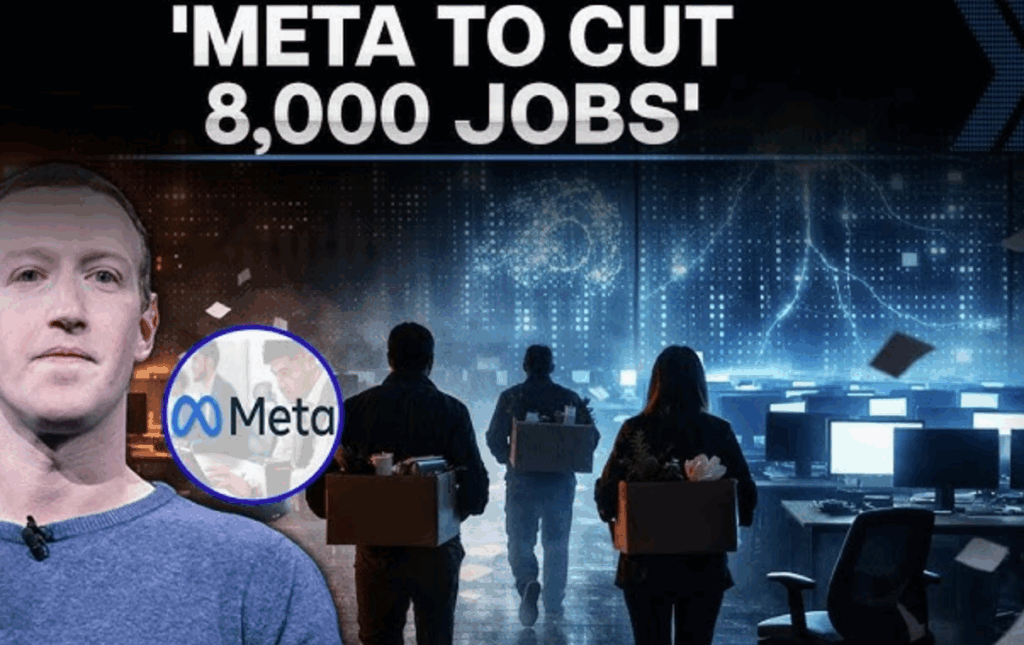


Meta Platforms is executing a strategic workforce restructuring that cuts approximately 8,000 employees (10% of its 78,865-person workforce) beginning May 20, 2025-2026, with additional reductions planned for the second half of 2026. This represents the latest phase in a broader reduction strategy that has eliminated roughly 25,000 positions since 2022. However, this is not a cost-cutting measure driven by financial distress—Meta closed 2025 with $201 billion in revenue (22% year-over-year growth), $22.8 billion in fourth-quarter net income, and $43.6 billion in free cash flow. Instead, the layoffs directly fund Meta's massive capital expenditure commitment of $115-135 billion in 2026 (nearly double the $72.2 billion spent in 2025) directed toward AI infrastructure, data centers, and GPU acquisition.
The restructuring fundamentally reorganizes Meta around AI-focused operational pods under newly appointed Chief AI Officer Alexandr Wang, 28-year-old CEO of Scale AI, whom Meta hired in June 2025 (acquiring a 49% stake in Scale AI for $14.3 billion). Affected divisions include Reality Labs, Facebook social division, recruiting, sales, and global operations, with California WARN Act filings confirming 124 positions at Burlingame (effective May 22) and 74 at Sunnyvale (effective May 29). The company is introducing new role titles including "AI builder," "AI pod lead," and "AI org lead," with roughly 1,000 employees already affected by rebranding.
For e-commerce sellers, this restructuring carries significant implications for Facebook and Instagram advertising platforms, which generate substantial revenue for Meta while serving as critical customer acquisition channels for millions of sellers globally. The sales division cuts and reorganization around AI infrastructure suggest Meta is prioritizing algorithmic ad targeting and delivery optimization over human-driven account management and advertiser support. CFO Susan Li warned that depreciation and operating costs from expanded data centers will significantly accelerate infrastructure expense growth, potentially pressuring operating margins and forcing Meta to extract greater value from advertising products. This pattern reflects broader industry trends, with the tech sector shedding over 95,000 jobs across 247 layoff events in 2026, averaging 882 per day. Amazon cut 16,000 employees in January, while Oracle eliminated up to 30,000 (18% of workforce) to fund $156 billion in AI infrastructure. Bank of America projects $7-8 billion in annualized savings from Meta's restructuring, suggesting the company expects significant operational efficiency gains from AI automation.
Meta's $115-135 billion AI infrastructure commitment in 2026 significantly exceeds most competitors' disclosed spending. Amazon cut 16,000 employees in January 2025 to fund AI initiatives, while Oracle eliminated up to 30,000 (18% of workforce) to fund $156 billion in AI infrastructure. This indicates a tech-wide race for AI dominance that will reshape advertising, logistics, and customer service capabilities. For sellers, this means all major platforms (Meta, Amazon, Google) are simultaneously upgrading AI-driven targeting and automation. Sellers should expect rapid feature changes across all platforms through 2026, with emphasis on AI-powered product recommendations, dynamic pricing, and automated customer service. Invest in tools that integrate with multiple platforms' APIs to adapt quickly to algorithm changes.
Meta cut 10-15% of Reality Labs workforce in January 2025 and closed several VR game studios, indicating reduced near-term investment in consumer VR experiences. However, the company is consolidating engineers into AI-focused divisions, suggesting VR commerce may eventually integrate with AI-powered virtual shopping assistants rather than standalone VR stores. The Reality Labs division remains affected by May 2026 layoffs, but the strategic pivot toward AI suggests Meta is exploring AI-driven virtual shopping experiences rather than traditional VR storefronts. Sellers should monitor Meta's announcements about AI-powered virtual try-on and shopping assistant features, which could emerge in 2026-2027. For now, focus on traditional Facebook/Instagram commerce rather than VR-specific strategies, as the technology remains in early development.
CFO Susan Li explicitly warned that depreciation and operating costs from expanded data centers will significantly accelerate infrastructure expense growth, pressuring earnings. Meta's strategy to offset these costs involves extracting greater value from advertising products—the company's primary revenue source. This creates upward pressure on advertising costs as Meta needs to maintain Wall Street's expected operating margins while absorbing $115-135 billion in annual AI infrastructure spending. Bank of America projects $7-8 billion in annualized savings from restructuring, but these savings may be reinvested in infrastructure rather than passed to advertisers as lower costs. Sellers should budget for 5-15% increases in Facebook/Instagram advertising costs through 2026 as Meta optimizes for profitability amid infrastructure expansion. Lock in favorable rates with annual commitments before Q2 2026 if possible.
Meta established a new Meta Small Business division and is reassigning some employees there as part of the restructuring. This suggests Meta is creating a dedicated business unit focused on small-to-medium seller support, potentially offering bundled services combining advertising, commerce tools, and business analytics. The division's creation during a broader cost-cutting phase indicates Meta sees SMB sellers as a growth opportunity worth dedicated resources. Sellers with $10K-$100K monthly revenue should monitor Meta Small Business announcements for new tools, training programs, or preferential advertising rates. This division may offer simplified advertising interfaces, pre-built campaign templates, and dedicated support tiers designed for sellers who lack large marketing teams. Expect product launches from Meta Small Business in Q3-Q4 2026 as the division matures.
Sellers should immediately audit their Facebook/Instagram advertising strategy and prepare for increased automation and reduced human support. Key preparation steps: (1) Document current campaign performance metrics and establish baseline benchmarks by June 2025; (2) Migrate to Meta's automated bidding strategies (Advantage+ Shopping Campaigns, Advantage+ App Campaigns) to align with AI-optimized systems; (3) Ensure product catalogs are fully optimized with high-quality images, detailed descriptions, and accurate inventory data—AI systems rely on data quality; (4) Test new AI-powered features as Meta releases them (expected Q2-Q4 2026); (5) Diversify advertising across Amazon Ads, Google Shopping, and TikTok Shop to reduce platform dependency. Sellers heavily dependent on Meta's sales division support should identify alternative account management resources or transition to self-service tools by Q1 2026. Budget for 10-20% testing spend to optimize campaigns for new AI systems before full migration.
Meta's layoffs are part of a broader tech industry pattern: the sector shed over 95,000 jobs across 247 layoff events in 2026, averaging 882 per day. This reflects a strategic shift across major platforms (Meta, Amazon, Oracle, Google) toward AI infrastructure investment and away from human-intensive support roles. For sellers, this signals that all major e-commerce and advertising platforms are simultaneously upgrading AI capabilities while reducing human support capacity. This creates both opportunities and risks: opportunities emerge in AI-powered tools that automate seller tasks (inventory management, pricing optimization, customer service), while risks include reduced platform support and increased complexity in managing AI-driven systems. Sellers should invest in learning AI-powered selling tools, consider hiring fractional marketing consultants to replace lost platform support, and build redundancy across multiple sales channels. The trend suggests 2026-2027 will be a critical transition period where sellers who adapt to AI-driven platforms gain competitive advantages over those relying on traditional support models.
Meta's shift toward AI-driven ad optimization and away from human account management suggests the company will prioritize algorithmic efficiency over advertiser support. With $115-135 billion committed to AI infrastructure in 2026 (double 2025 spending), Meta is building systems to automate ad targeting, bidding, and creative optimization. This typically leads to two competing effects: improved targeting efficiency can lower cost-per-acquisition for well-optimized campaigns, but reduced human support and increased automation may increase minimum ad spend requirements. Sellers should expect Meta to push toward higher-volume, algorithm-optimized campaigns rather than personalized account management. Monitor your Facebook Ads Manager for new AI-powered features and prepare to shift budget allocation toward automated bidding strategies by Q2 2026.
Meta's cuts to the sales division (one of the affected areas) indicate reduced capacity for direct seller support, account management, and custom solutions. The company is consolidating engineers into an Applied AI Engineering division focused on autonomous coding agents and multi-step task execution—essentially replacing human-driven support with automated systems. For sellers currently receiving dedicated account support, expect transition to self-service tools and AI chatbots. Sellers managing $100K+ monthly ad spend should document current account relationships and transition plans before May 2026 layoffs take effect. Consider diversifying advertising across Amazon Ads, Google Shopping, and TikTok Shop to reduce dependency on Meta's support infrastructure during this transition period.
Meta's $115-135 billion AI infrastructure commitment in 2026 significantly exceeds most competitors' disclosed spending. Amazon cut 16,000 employees in January 2025 to fund AI initiatives, while Oracle eliminated up to 30,000 (18% of workforce) to fund $156 billion in AI infrastructure. This indicates a tech-wide race for AI dominance that will reshape advertising, logistics, and customer service capabilities. For sellers, this means all major platforms (Meta, Amazon, Google) are simultaneously upgrading AI-driven targeting and automation. Sellers should expect rapid feature changes across all platforms through 2026, with emphasis on AI-powered product recommendations, dynamic pricing, and automated customer service. Invest in tools that integrate with multiple platforms' APIs to adapt quickly to algorithm changes.
Meta cut 10-15% of Reality Labs workforce in January 2025 and closed several VR game studios, indicating reduced near-term investment in consumer VR experiences. However, the company is consolidating engineers into AI-focused divisions, suggesting VR commerce may eventually integrate with AI-powered virtual shopping assistants rather than standalone VR stores. The Reality Labs division remains affected by May 2026 layoffs, but the strategic pivot toward AI suggests Meta is exploring AI-driven virtual shopping experiences rather than traditional VR storefronts. Sellers should monitor Meta's announcements about AI-powered virtual try-on and shopping assistant features, which could emerge in 2026-2027. For now, focus on traditional Facebook/Instagram commerce rather than VR-specific strategies, as the technology remains in early development.
CFO Susan Li explicitly warned that depreciation and operating costs from expanded data centers will significantly accelerate infrastructure expense growth, pressuring earnings. Meta's strategy to offset these costs involves extracting greater value from advertising products—the company's primary revenue source. This creates upward pressure on advertising costs as Meta needs to maintain Wall Street's expected operating margins while absorbing $115-135 billion in annual AI infrastructure spending. Bank of America projects $7-8 billion in annualized savings from restructuring, but these savings may be reinvested in infrastructure rather than passed to advertisers as lower costs. Sellers should budget for 5-15% increases in Facebook/Instagram advertising costs through 2026 as Meta optimizes for profitability amid infrastructure expansion. Lock in favorable rates with annual commitments before Q2 2026 if possible.
Meta established a new Meta Small Business division and is reassigning some employees there as part of the restructuring. This suggests Meta is creating a dedicated business unit focused on small-to-medium seller support, potentially offering bundled services combining advertising, commerce tools, and business analytics. The division's creation during a broader cost-cutting phase indicates Meta sees SMB sellers as a growth opportunity worth dedicated resources. Sellers with $10K-$100K monthly revenue should monitor Meta Small Business announcements for new tools, training programs, or preferential advertising rates. This division may offer simplified advertising interfaces, pre-built campaign templates, and dedicated support tiers designed for sellers who lack large marketing teams. Expect product launches from Meta Small Business in Q3-Q4 2026 as the division matures.
Sellers should immediately audit their Facebook/Instagram advertising strategy and prepare for increased automation and reduced human support. Key preparation steps: (1) Document current campaign performance metrics and establish baseline benchmarks by June 2025; (2) Migrate to Meta's automated bidding strategies (Advantage+ Shopping Campaigns, Advantage+ App Campaigns) to align with AI-optimized systems; (3) Ensure product catalogs are fully optimized with high-quality images, detailed descriptions, and accurate inventory data—AI systems rely on data quality; (4) Test new AI-powered features as Meta releases them (expected Q2-Q4 2026); (5) Diversify advertising across Amazon Ads, Google Shopping, and TikTok Shop to reduce platform dependency. Sellers heavily dependent on Meta's sales division support should identify alternative account management resources or transition to self-service tools by Q1 2026. Budget for 10-20% testing spend to optimize campaigns for new AI systems before full migration.
Meta's layoffs are part of a broader tech industry pattern: the sector shed over 95,000 jobs across 247 layoff events in 2026, averaging 882 per day. This reflects a strategic shift across major platforms (Meta, Amazon, Oracle, Google) toward AI infrastructure investment and away from human-intensive support roles. For sellers, this signals that all major e-commerce and advertising platforms are simultaneously upgrading AI capabilities while reducing human support capacity. This creates both opportunities and risks: opportunities emerge in AI-powered tools that automate seller tasks (inventory management, pricing optimization, customer service), while risks include reduced platform support and increased complexity in managing AI-driven systems. Sellers should invest in learning AI-powered selling tools, consider hiring fractional marketing consultants to replace lost platform support, and build redundancy across multiple sales channels. The trend suggests 2026-2027 will be a critical transition period where sellers who adapt to AI-driven platforms gain competitive advantages over those relying on traditional support models.
Meta's shift toward AI-driven ad optimization and away from human account management suggests the company will prioritize algorithmic efficiency over advertiser support. With $115-135 billion committed to AI infrastructure in 2026 (double 2025 spending), Meta is building systems to automate ad targeting, bidding, and creative optimization. This typically leads to two competing effects: improved targeting efficiency can lower cost-per-acquisition for well-optimized campaigns, but reduced human support and increased automation may increase minimum ad spend requirements. Sellers should expect Meta to push toward higher-volume, algorithm-optimized campaigns rather than personalized account management. Monitor your Facebook Ads Manager for new AI-powered features and prepare to shift budget allocation toward automated bidding strategies by Q2 2026.
Meta's cuts to the sales division (one of the affected areas) indicate reduced capacity for direct seller support, account management, and custom solutions. The company is consolidating engineers into an Applied AI Engineering division focused on autonomous coding agents and multi-step task execution—essentially replacing human-driven support with automated systems. For sellers currently receiving dedicated account support, expect transition to self-service tools and AI chatbots. Sellers managing $100K+ monthly ad spend should document current account relationships and transition plans before May 2026 layoffs take effect. Consider diversifying advertising across Amazon Ads, Google Shopping, and TikTok Shop to reduce dependency on Meta's support infrastructure during this transition period.
Meta's $115-135 billion AI infrastructure commitment in 2026 significantly exceeds most competitors' disclosed spending. Amazon cut 16,000 employees in January 2025 to fund AI initiatives, while Oracle eliminated up to 30,000 (18% of workforce) to fund $156 billion in AI infrastructure. This indicates a tech-wide race for AI dominance that will reshape advertising, logistics, and customer service capabilities. For sellers, this means all major platforms (Meta, Amazon, Google) are simultaneously upgrading AI-driven targeting and automation. Sellers should expect rapid feature changes across all platforms through 2026, with emphasis on AI-powered product recommendations, dynamic pricing, and automated customer service. Invest in tools that integrate with multiple platforms' APIs to adapt quickly to algorithm changes.
Meta cut 10-15% of Reality Labs workforce in January 2025 and closed several VR game studios, indicating reduced near-term investment in consumer VR experiences. However, the company is consolidating engineers into AI-focused divisions, suggesting VR commerce may eventually integrate with AI-powered virtual shopping assistants rather than standalone VR stores. The Reality Labs division remains affected by May 2026 layoffs, but the strategic pivot toward AI suggests Meta is exploring AI-driven virtual shopping experiences rather than traditional VR storefronts. Sellers should monitor Meta's announcements about AI-powered virtual try-on and shopping assistant features, which could emerge in 2026-2027. For now, focus on traditional Facebook/Instagram commerce rather than VR-specific strategies, as the technology remains in early development.