



AI's Battlefield: OpenAI's High-Stakes Race to Maintain Technological Supremacy
- Technological leadership becomes increasingly fragile in the hyper-competitive AI innovation landscape


























Overview
In the rapidly evolving artificial intelligence landscape, a critical inflection point has emerged where technological leadership is no longer guaranteed by early innovation. OpenAI, once the undisputed pioneer of generative AI, now finds itself in an intense technological arms race with Google and emerging global competitors, fighting to maintain its market dominance.
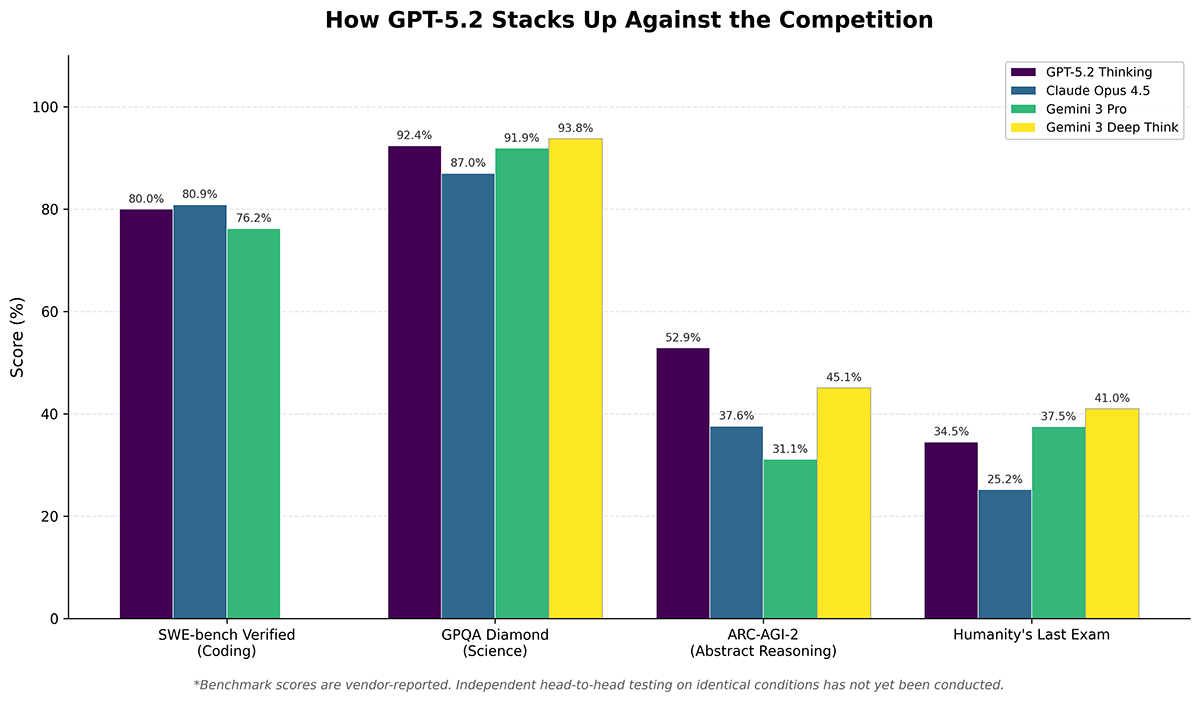
The launch of GPT-5.2 represents more than just another model upgrade—it's a strategic response to narrowing technological gaps and intensifying competitive pressures. With performance benchmarks showing the model outperforming industry professionals across 44 occupations and delivering outputs 11x faster, OpenAI is signaling its commitment to maintaining technological leadership through continuous, aggressive innovation.
Financially, the stakes are astronomical. OpenAI aims to reach $20 billion in annual revenue by 2025 while planning massive $1.4 trillion infrastructure investments. This unprecedented scale of investment underscores the company's recognition that marginal technological advantages can quickly evaporate in today's hyper-competitive AI ecosystem. The strategic hiring of Denise Dresser from Slack as chief revenue officer further indicates a laser focus on enterprise market penetration and monetization.
The competitive dynamics reveal a fascinating transformation in AI development. What was once a landscape dominated by breakthrough innovations is now becoming increasingly standardized, with major laboratories rapidly converging on similar technological capabilities. Industry experts like Rayan Krishnan from Vals AI note that foundational AI model development is losing its mystique, making continuous innovation not just a strategy, but a survival imperative.
Critically, the Walt Disney $1 billion investment and the market's immediate reaction—including Google's stock dip—demonstrate that AI technological leadership is now directly translatable into significant financial and strategic value. Companies are no longer just betting on potential; they're making substantial commitments based on demonstrated performance and future potential.
Questions 3
What strategic moves is OpenAI making to maintain its competitive edge?
OpenAI is pursuing an aggressive strategy of continuous model improvement, enterprise market expansion, and strategic hiring. The hiring of Denise Dresser from Slack and the launch of GPT-5.2 demonstrate a focused approach to maintaining technological leadership and market relevance.
What financial challenges does OpenAI face?
OpenAI aims to reach $20 billion in annual revenue by 2025 while planning massive $1.4 trillion infrastructure investments. Despite pioneering the AI boom, the company faces profitability challenges and intense competition from global tech giants.