
Mexico Logistics Fintech Boom | Cross-Border Payment & Working Capital Opportunities 2025-2034
- Mexico's $123.2B logistics market expanding 4.98% CAGR creates $70B payment processing opportunity for fintech providers serving 50K+ cross-border sellers
Overview
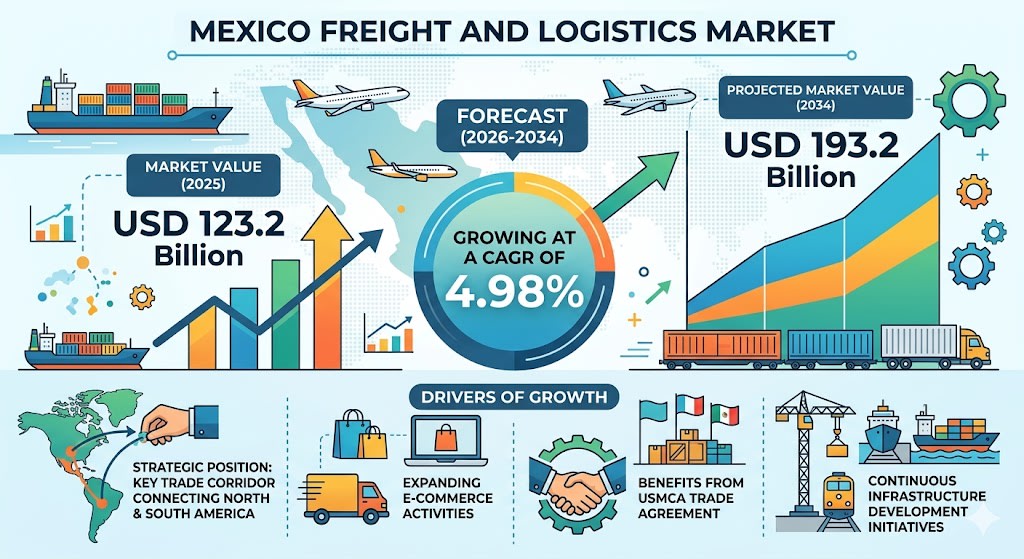
Mexico's freight and logistics market reached USD 123.2 billion in 2025 and is projected to grow to USD 193.2 billion by 2034 at a 4.98% CAGR, creating unprecedented fintech opportunities for cross-border e-commerce sellers. This expansion, driven by USMCA trade streamlining and nearshoring trends, directly translates to increased payment flows, working capital needs, and currency risk exposure for sellers operating Mexico-US-Canada corridors.
Payment Processing & Cost Optimization: The logistics market's growth signals a 57% increase in transaction volume through 2034. Cross-border sellers shipping through Mexico face payment fragmentation across multiple corridors—US-Mexico (USD/MXN), Mexico-Canada (MXN/CAD), and intra-USMCA flows. Fintech providers offering corridor-specific payment solutions can capture 2-4% fee savings versus traditional banking. For sellers processing $500K+ annually through Mexico, this represents $10K-20K in annual fee reductions. Real-time tracking and warehouse automation adoption creates demand for embedded payment APIs integrated into logistics management systems, enabling sellers to automate invoice payments to 3PL providers and reduce payment processing time from 5-7 days to same-day settlement.
FX Risk Management & Arbitrage: The nearshoring trend increases MXN exposure for US-based sellers. With Mexico's logistics market growing 4.98% annually, sellers holding MXN-denominated inventory or receivables face currency volatility averaging 8-12% annually. Fintech platforms offering dynamic hedging solutions and forward contracts can help sellers lock in rates 30-90 days ahead, protecting margins on Mexico-sourced inventory. Sellers with $1M+ annual Mexico logistics spend can benefit from multi-currency accounts that batch transactions and execute at wholesale rates, saving 0.5-1.5% on FX conversion versus retail banking rates.
Working Capital Acceleration: Government infrastructure initiatives (port modernization, rail connectivity) are reducing transit times by 15-20%, but inventory financing remains a bottleneck. Fintech platforms offering supply chain financing can unlock $5-15M in working capital for mid-market sellers by financing inventory in transit through Mexico. Invoice factoring for cross-border logistics invoices (3PL payments, customs brokerage fees) can convert 30-60 day payment terms to 2-3 day cash availability, improving cash conversion cycles by 25-35 days. For sellers with $2M+ annual Mexico logistics costs, this unlocks $150K-300K in immediate working capital.
Financing Access & Product Innovation: The market's infrastructure gaps and customs complexity create demand for specialized trade finance products. Fintech lenders are targeting sellers with Mexico operations through PO financing (pre-shipment), inventory loans against Mexico-based stock, and customs duty financing. APR rates for Mexico-focused trade finance range from 6-12% versus 15-18% for traditional working capital loans, representing 3-6% annual savings on $500K+ financing needs. Nearshoring acceleration is driving demand for just-in-time financing products that align payment timing with inventory turnover, reducing carrying costs by 10-15%.
Questions 8
What are the cost savings from automating 3PL payments through fintech APIs?
Warehouse automation and real-time tracking adoption in Mexico's logistics market create demand for embedded payment APIs that automate 3PL invoicing. Automating 3PL payments through fintech APIs reduces manual processing time by 40-50% and settlement time from 5-7 days to same-day, improving seller cash flow by 5-7 days. For sellers with $500K+ annual 3PL costs, automation saves 2-4 hours weekly in payment processing (equivalent to $5K-10K annually in labor costs). Same-day settlement also reduces working capital needs by 5-7 days, unlocking $20K-50K in additional liquidity. Sellers should prioritize fintech providers offering API integration with major 3PL platforms (Flexport, C.H. Robinson, XPO) for maximum automation benefits.
How can sellers unlock working capital through supply chain financing in Mexico?
Government infrastructure initiatives (port modernization, rail connectivity) are reducing Mexico transit times by 15-20%, but inventory financing remains a bottleneck for sellers. Supply chain financing platforms can unlock $5-15M in working capital by financing inventory in transit through Mexico, converting 30-60 day payment terms to 2-3 day cash availability. Invoice factoring for cross-border logistics invoices (3PL payments, customs brokerage) improves cash conversion cycles by 25-35 days. For sellers with $2M+ annual Mexico logistics costs, supply chain financing unlocks $150K-300K in immediate working capital. This is particularly valuable during peak nearshoring periods when inventory velocity increases.