
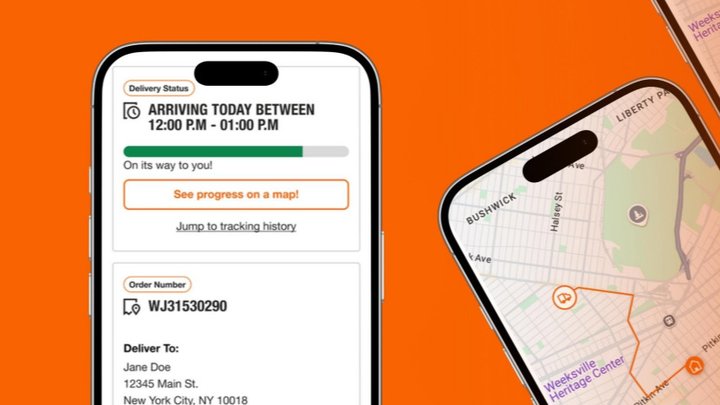
Home Depot's Real-Time Delivery Tracker | B2B Retail Operations Revolution
- Professional customer delivery visibility reduces 35% non-productive time; signals major O2O integration opportunity for 2,359+ retail locations and 1,250+ distribution hubs
Overview
Home Depot's launch of a proprietary real-time delivery tracker for Pro customers represents a fundamental shift in how major retailers operationalize the offline-to-online (O2O) integration for B2B segments. The system, deployed across 2,359 retail stores and 1,250+ SRS Distribution locations, addresses a critical pain point: construction professionals spend approximately 35% of their time (14+ hours weekly) on non-productive activities, with delivery unpredictability being a major cost driver. This initiative reveals three critical retail operations insights for cross-border sellers and omnichannel retailers.
First, the technology deployment model demonstrates the ROI of in-house logistics solutions. Home Depot built its proprietary Driver Handheld application rather than adapting third-party software, enabling complete control over functionality for oversized goods delivery. This approach directly solves the "last-mile blind spot" where trucks previously went off-grid after departure. For retailers considering O2O strategies, this signals that custom-built solutions targeting specific customer segments (Pro vs. consumer) can justify development costs through improved customer satisfaction and engagement metrics. The company's parallel tracker for large appliances shows category-specific customization is now table stakes for competitive retail operations.
Second, this reflects a broader market trend toward professional customer segmentation in retail. Construction professionals represent a high-LTV customer segment where delivery delays translate directly to idle labor costs and project delays—quantifiable business impact that justifies premium service investments. Retailers can now differentiate through operational transparency rather than price alone. The tracker's features (live GPS location, remaining stops, turn-by-turn updates, final arrival confirmation) create a customer experience that reduces anxiety and improves job site planning. For sellers in construction, home improvement, and industrial categories, this signals that B2B retail customers increasingly expect real-time visibility comparable to consumer e-commerce standards.
Third, the scale of deployment (2,359 stores + 1,250 distribution hubs) indicates this is now a competitive necessity, not a differentiator. Home Depot's evaluation since early 2026 launch, measured through customer satisfaction scores and user engagement metrics, suggests the company is optimizing for both operational efficiency and customer retention. Retailers without similar capabilities will face competitive pressure from professional customers who now expect this level of service transparency. For cross-border sellers supplying construction and home improvement categories, understanding that major retailers are investing heavily in delivery visibility means product quality and availability must be paired with logistics reliability to maintain shelf space and distribution partnerships.
The initiative directly addresses the cost-benefit equation where delivery delays create measurable business impact for professional customers, making this a critical O2O infrastructure investment that smaller retailers and online sellers must now consider to compete for B2B segments.
Questions 8
What is the scale of Home Depot's retail and distribution infrastructure supporting this technology?
Home Depot operates 2,359 retail stores and over 1,250 SRS Distribution locations across North America, making this technology deployment significant in scale. The company also operates a similar map-based tracker for large appliance orders, while smaller items continue using traditional carrier tracking through FedEx and UPS. This dual-system approach reflects category-specific optimization: high-value, oversized goods receive premium tracking, while standard items use established carrier networks. The scale of deployment indicates this is now a competitive necessity for major retailers serving professional customers.
Why did Home Depot build its own delivery tracking system instead of using third-party logistics software?
Home Depot built its proprietary Driver Handheld application in-house to maintain complete control over functionality tailored to oversized goods delivery challenges. Third-party logistics software typically optimizes for small-package delivery (like FedEx/UPS), not the specialized requirements of construction materials and large appliances. By developing custom solutions, Home Depot solved the 'last-mile blind spot' where trucks previously went off-grid after departure. This in-house approach allows the company to continuously optimize features based on customer satisfaction scores and engagement metrics, creating a competitive advantage that third-party solutions cannot match.