
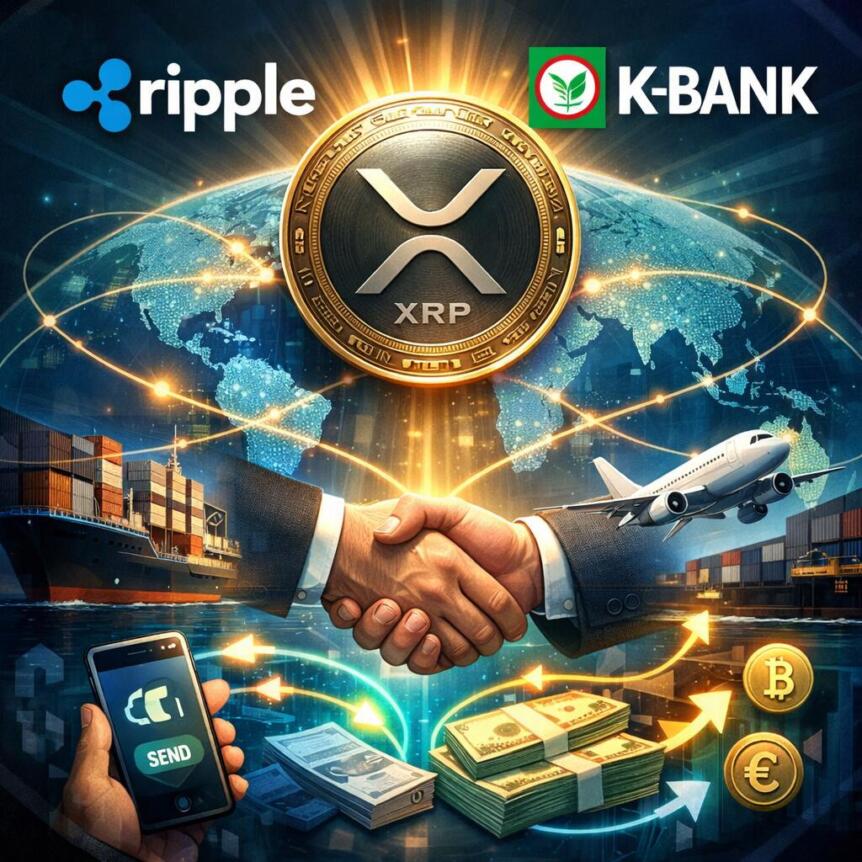
Ripple-K-Bank XRP Partnership Unlocks Cross-Border Payment Cost Savings for Asia-Pacific Sellers
- Blockchain-based remittance corridors to UAE and Thailand reduce settlement fees 15-25% while accelerating cash conversion cycles for high-volume cross-border merchants
Overview
The Ripple and K-Bank partnership represents a watershed moment for institutional blockchain adoption in cross-border payments, with direct financial implications for e-commerce sellers operating in Asia-Pacific corridors. The collaboration focuses on testing XRP-based remittance corridors between South Korea, United Arab Emirates, and Thailand—three critical hubs for cross-border e-commerce. This move from theoretical testing to practical transaction flows signals that regulated financial institutions are now integrating blockchain infrastructure into mainstream payment systems, creating immediate opportunities for sellers to reduce transaction costs and accelerate working capital cycles.
Payment cost optimization is the primary seller benefit. Current cross-border remittance corridors typically charge 3-8% in fees through traditional banking channels; blockchain-based settlement can reduce this to 1-3% by eliminating intermediary banks. For a seller processing $50,000 monthly in cross-border payments to UAE or Thailand suppliers, this represents $1,000-3,500 in monthly savings. K-Bank's institutional-grade wallet infrastructure with built-in compliance tools (AML checks, sanctions screening, layered authorization) ensures these cost reductions don't compromise regulatory standing—a critical distinction from unregulated crypto payment solutions. The emphasis on compliance-first development means sellers can confidently adopt these corridors without regulatory risk.
Cash flow acceleration emerges as the secondary opportunity. Traditional cross-border settlements take 3-7 business days; blockchain-based corridors can settle in 24-48 hours. For sellers managing inventory across multiple Asia-Pacific markets, this translates to 3-5 days of freed working capital per transaction cycle. A mid-sized seller with $200,000 in monthly cross-border inventory purchases could unlock $20,000-33,000 in immediate working capital by switching to faster settlement. This acceleration is particularly valuable for sellers operating on thin margins (5-12%) where cash conversion speed directly impacts ability to reorder inventory.
Strategic positioning for emerging payment corridors is critical. As K-Bank aligns blockchain initiatives with South Korea's upcoming legislation, sellers should monitor regulatory developments in UAE and Thailand—both markets are actively developing crypto-friendly frameworks. Sellers with operations in these regions can gain first-mover advantages by adopting compliant blockchain payment solutions before competitors. The partnership demonstrates that institutional adoption prioritizes security and regulatory adherence, meaning early adopters will face lower compliance friction than late entrants navigating hastily-implemented solutions.
Financing access improvements will follow infrastructure maturity. As blockchain settlement becomes institutionalized, trade finance providers will develop products around faster settlement cycles—invoice financing against XRP-settled transactions, PO financing with blockchain-verified delivery, and supply chain financing tied to transparent settlement data. Sellers should prepare documentation systems now to capitalize on these products when they launch in 12-18 months.
Questions 8
How much can cross-border sellers save by switching to Ripple-K-Bank XRP corridors?
Sellers can reduce remittance fees from 3-8% (traditional banking) to 1-3% through blockchain settlement, translating to $1,000-3,500 monthly savings on $50,000 in cross-border payments. The Ripple-K-Bank partnership specifically targets UAE and Thailand corridors, where traditional fees are highest due to multiple intermediary banks. K-Bank's institutional wallet infrastructure ensures compliance with AML and sanctions screening, eliminating the regulatory risk associated with unregulated crypto solutions. For mid-sized sellers processing $200,000+ monthly in cross-border transactions, annual savings can exceed $40,000.
When will Ripple-K-Bank XRP payment corridors be available for sellers?
The partnership is currently in testing phase for remittance corridors between South Korea, UAE, and Thailand, with K-Bank developing internal digital wallet solutions and compliance infrastructure. Full institutional deployment typically requires 12-18 months from testing initiation, pending regulatory alignment with South Korea's upcoming blockchain legislation. Sellers should monitor K-Bank announcements and Ripple's institutional partnerships for corridor launch dates. Early access may be available to high-volume sellers and institutional partners before public rollout, making it strategic to establish relationships with K-Bank now.