




Snap's $400M AI Deal Collapse & 16% Layoffs Signal Platform Instability for E-Commerce Sellers
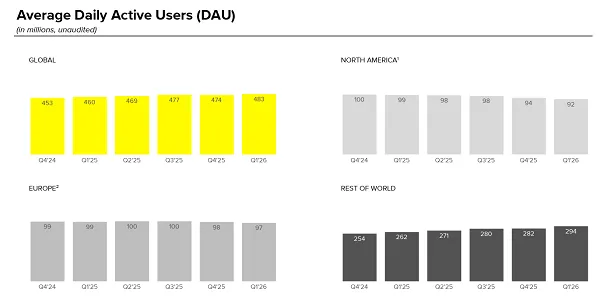
- Advertising revenue growth slows to 3% YoY; North America DAU declines; geopolitical headwinds cost $20-25M in March alone; 1,000 employee layoffs signal operational challenges















Overview
Snap Inc. faces a critical inflection point that directly impacts cross-border e-commerce sellers relying on the platform for customer acquisition. The company reported Q1 2026 earnings on May 7, 2026, with advertising revenue growth decelerating to just 3% year-over-year ($1.24B), missing growth expectations and triggering significant stock decline. The termination of Snap's flagship $400 million AI partnership with Perplexity—announced in November 2024 to integrate conversational search into Snapchat's Chat interface—represents a major strategic setback. Combined with 16% workforce reductions (approximately 1,000 employees) and activist investor pressure from Irenic Capital Management, Snap's operational challenges signal potential platform instability that sellers must monitor closely.
The immediate concern for e-commerce sellers centers on advertising platform reliability and feature development roadmap execution. Snap's North America market—its largest revenue source—showed alarming trends: DAU declined in the region while revenue growth slowed to just 2%, with ARPU decreasing sequentially to $3.17 (missing analyst estimates of $3.21). The company quantified geopolitical uncertainty's impact at $20-25 million during March alone, with expectations that headwinds will persist through subsequent quarters. This creates a challenging environment for sellers who depend on Snap's AI-powered advertising solutions—currently utilized in nearly 70% of advertising spend on the platform. The failed Perplexity integration specifically undermines Snap's competitive positioning against Meta, Pinterest, and Reddit, which all reported upbeat Q1 results, leaving Snap vulnerable to advertiser budget consolidation toward dominant platforms like Meta and Google.
For cross-border sellers, the strategic implications are substantial and require immediate portfolio rebalancing. Snap's adjusted EBITDA of $233.3 million exceeded estimates ($205.9M), demonstrating operational efficiency, but this masks deeper structural challenges. The company's pivot away from third-party AI integrations toward internal capability development signals uncertainty about product roadmap execution timelines. Activist investor pressure suggests potential governance changes and strategic reassessment, creating unpredictability around advertising product features, pricing, and inventory availability. Sellers in fashion, beauty, consumer electronics, and lifestyle categories—who rely heavily on Snap's visual content capabilities and Gen Z/millennial targeting—face increased risk of platform feature delays, potential price increases to offset revenue shortfalls, and reduced investment in competitive advertising tools. The combination of weak financial results, failed AI partnership, and recent layoffs creates a challenging narrative that could accelerate advertiser budget migration to more stable platforms.
Questions 8
What does Snap's 16% workforce reduction mean for platform feature development and seller support?
Snap's approximately 1,000 employee layoffs (16% of workforce) announced in April 2026 signal operational challenges and cost-cutting measures that typically precede reduced investment in product development and seller support infrastructure. Historical precedent from similar tech platform layoffs shows 6-12 month delays in feature releases, reduced customer support responsiveness, and slower bug fixes. For cross-border sellers, this translates to potential delays in new advertising formats, analytics dashboard improvements, and international market expansion tools. Sellers should document current platform performance metrics and establish backup advertising channels (Meta, TikTok, Pinterest) before support quality deteriorates. Expect reduced responsiveness from Snap's seller support team during Q2-Q3 2026.
How does Snap's failed Perplexity deal impact advertising capabilities for e-commerce sellers?
Snap's $400 million partnership termination with Perplexity removes planned conversational AI search integration into Snapchat's Chat interface, which was designed to enhance user engagement and discovery. This directly affects sellers' ability to leverage next-generation AI-powered advertising targeting and content recommendation features that competitors like Meta are rapidly deploying. The failed integration signals Snap's struggle to execute complex AI partnerships, creating uncertainty about future product roadmap execution. Sellers should expect delayed or reduced AI-powered advertising automation features compared to Meta and Google, potentially impacting campaign efficiency and ROI. Monitor Snap's upcoming product announcements at the AWE conference (June 16th) to assess internal AI capability development timelines.