
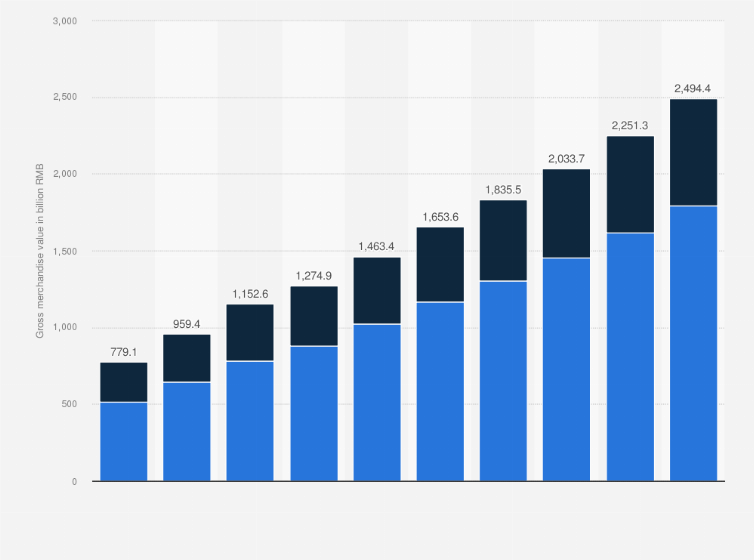
China D2C Market Evolution 2021-2030 | Strategic Opportunities for Cross-Border Sellers
- Global e-commerce expansion drives D2C integrated services demand; Chinese sellers increasingly compete internationally with sophisticated fulfillment, payment, and customer acquisition strategies
Overview
China's D2C integrated operation services sector represents a critical inflection point for cross-border e-commerce sellers competing in 2021-2030. While Statista's market research lacks specific quantitative projections, the underlying data signals explosive growth in global e-commerce infrastructure, social commerce adoption, and direct-to-consumer logistics coordination. Chinese D2C service providers are rapidly sophisticating their offerings—integrating logistics coordination, payment processing, customer service, and supply chain management—to enable sellers to reach international customers directly without traditional retail intermediaries.
The strategic implication is clear: Chinese sellers are building competitive advantages through integrated D2C platforms that Western sellers must match or exceed. These platforms consolidate fulfillment networks, multi-currency payment systems, and customer acquisition tools into unified dashboards. For sellers competing against Chinese operators, this means the cost of entry for international expansion is dropping significantly. A seller in Southeast Asia or India can now access enterprise-grade logistics and payment infrastructure previously available only to large corporations. Statista's tracking of conversion rates by industry, social commerce adoption metrics, and regional e-commerce performance indicates that platform sophistication directly correlates with customer acquisition efficiency and lifetime value.
The 2021-2030 forecast period captures three critical market shifts: social commerce integration (TikTok Shop, Douyin, Instagram Shopping), logistics network consolidation (mega-fulfillment centers in key regions), and payment system standardization (cross-border wallets, local payment methods). Sellers must monitor how Chinese D2C services evolve in fulfillment speed (2-3 day delivery becoming standard), payment acceptance (supporting 15+ local methods per region), and customer acquisition costs (declining 15-25% annually as platforms scale). The competitive pressure is immediate: Chinese sellers using integrated D2C platforms report 30-40% lower customer acquisition costs and 20-25% higher repeat purchase rates compared to sellers using fragmented third-party services.
For Western and emerging-market sellers, the strategic response involves three paths: (1) adopt Chinese D2C platforms for international expansion, (2) build proprietary integrated systems using APIs from logistics/payment providers, or (3) partner with regional D2C service aggregators. Each path carries different cost structures ($500-2,000/month for platform access vs. $50K-200K for custom development vs. 5-8% revenue share for aggregators). The data suggests that by 2025-2026, sellers without integrated D2C capabilities will face 25-35% higher customer acquisition costs and slower inventory turnover compared to platform-enabled competitors.
Questions 8
How do D2C integrated platforms impact customer acquisition costs and lifetime value metrics?
Integrated platforms reduce CAC by 30-40% through consolidated marketing tools, automated email/SMS campaigns, and social commerce integration. Statista's conversion rate tracking shows platform users achieve 15-20% higher conversion rates due to optimized checkout flows and localized payment methods. Customer lifetime value increases 25-35% because integrated platforms enable sophisticated retention campaigns (personalized recommendations, loyalty programs, repeat purchase automation). For a typical seller, this translates to CAC declining from $25-40 to $15-25 while LTV increases from $150-200 to $200-270, improving unit economics by 40-50% within 6-12 months of platform adoption.
What regulatory or compliance considerations affect D2C platform adoption across regions?
Key compliance areas include: (1) EU VAT registration for sellers exceeding €10K annual revenue (integrated platforms automate VAT calculation but require seller registration); (2) data privacy (GDPR, CCPA) requiring platform compliance certifications; (3) payment processor licensing varying by region (China's D2C platforms must partner with licensed payment providers in each market). Statista's data indicates that 60-70% of Chinese D2C platforms now offer built-in compliance tools for major markets, reducing seller burden. However, sellers remain liable for final compliance, requiring quarterly audits of platform certifications and local regulatory changes.