




Trump Tariffs Collapse Canada-US Cross-Border Commerce | 42% Travel Decline Signals Market Disruption
- University of Toronto research reveals 42% year-over-year decline in Canadian visits to US metros (April 2024-March 2026); business travel to tech/finance hubs drops sharply; automotive sector faces compounding tariff pressures; recovery timeline estimated at 3+ years














Overview
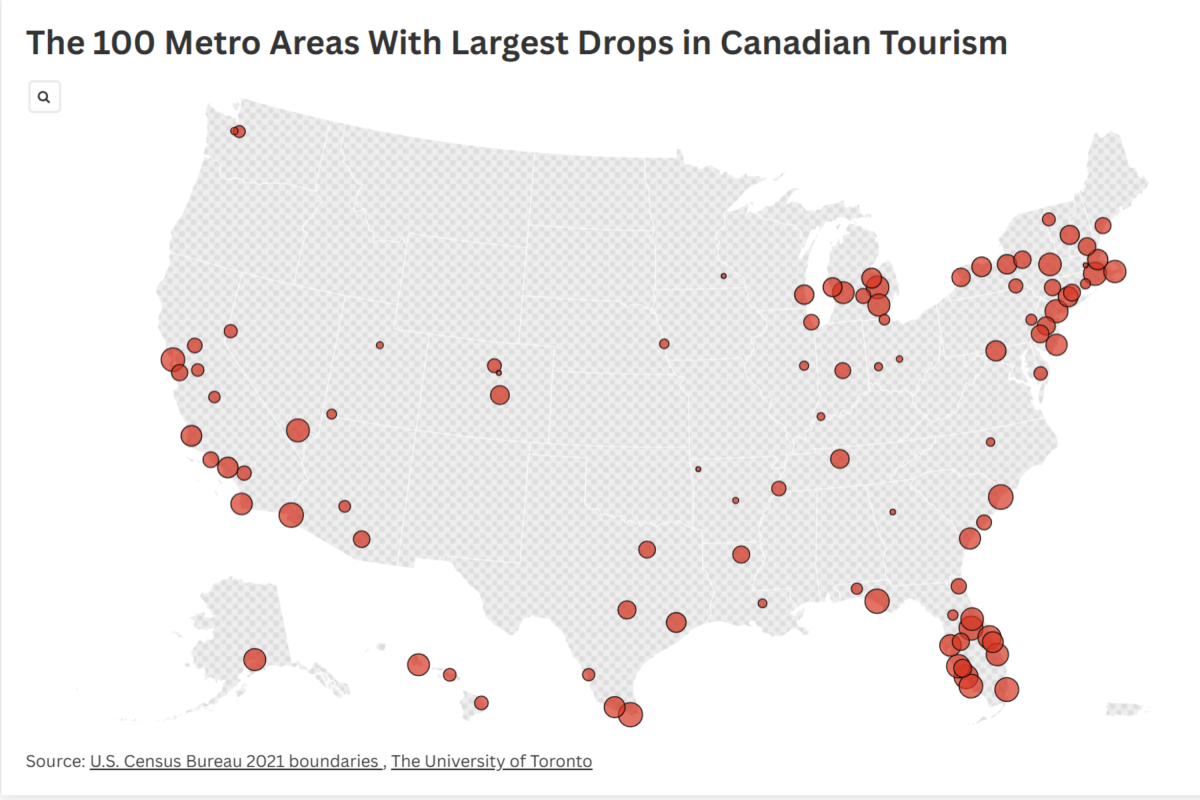
Trump's escalating tariff policies have triggered a 42% year-over-year decline in Canadian visits to major US metropolitan areas between April 2024 and March 2026, according to University of Toronto research analyzing cell phone location data across 267 US cities. This figure substantially exceeds the 25-34% decline captured by traditional border crossing statistics, revealing that tariff-driven economic uncertainty is reshaping cross-border commerce patterns far more dramatically than official metrics suggest. The research, part of the "Mapping Tariffs" project, demonstrates that policy-induced disruption extends well beyond leisure tourism into critical business travel corridors affecting supply chain coordination, B2B negotiations, and commercial relationships between Canadian and US companies.
The tariff impact disproportionately affects high-value business centers and tariff-dependent industries. Major commercial hubs including New York, Los Angeles, San Francisco, Dallas, and Houston experienced significant declines in business travel by tech and finance professionals, while Grand Rapids, Michigan—a critical automotive industry hub with deep Ontario supply chain ties—recorded the second-largest visitation drop directly linked to tariff policy uncertainty. The research reveals that when Canadians do travel to the US, they visit fewer locations and stay shorter periods, indicating behavioral shifts driven by exchange rate fluctuations (CAD weakness), elevated airfares, and jet fuel surcharges. April 2026 data from Statistics Canada showed the first year-over-year increase since December 2024 (1.4% rise in return trips), driven primarily by 5.8% growth in automobile crossings, yet air travel declined 8.1%—suggesting modal shifts away from business travel toward freight-focused logistics.
For cross-border e-commerce sellers, this data signals cascading operational challenges across multiple dimensions. The 42% decline in business travel directly correlates with reduced face-to-face supply chain coordination, commercial negotiations, and relationship-building between Canadian suppliers and US importers. Sellers relying on Canadian customer bases face reduced consumer traffic to US markets, while those dependent on Canadian sourcing encounter supply chain friction from diminished B2B communication. The automotive sector's particular vulnerability—with tariff-dependent supply chains experiencing compounding pressures beyond direct trade costs—indicates that sellers in automotive parts (HS codes 8704-8708), industrial equipment, and machinery categories face both tariff exposure and operational disruption from reduced business travel. Recovery timelines remain uncertain; historical precedent suggests approximately three years for Canadian visits to recover from major disruptions (COVID-19 recovery pattern), meaning sellers should anticipate sustained market volatility through 2028-2029. The strain on Canada-US economic relationships cascades through interconnected business ecosystems, affecting logistics networks, supplier relationships, and cross-border commerce operations that extend far beyond traditional tourism metrics.
Questions 8
Which US business centers are most affected by reduced Canadian business travel?
Major commercial and financial hubs including New York, Los Angeles, San Francisco, Dallas, and Houston experienced significant declines in business travel by tech and finance professionals. Grand Rapids, Michigan—a critical automotive industry hub with deep Ontario supply chain ties—recorded the second-largest visitation drop directly linked to tariff policy uncertainty. The research specifically notes that 'high-tech and financial centres like San Francisco and Houston appear to be experiencing reductions not only in tourists but also in business-related travel.' For cross-border sellers, this signals reduced face-to-face meetings, supply chain coordination, and commercial negotiations between Canadian and US companies, particularly affecting automotive parts suppliers and industrial equipment manufacturers.
What does the shift from air travel to automobile crossings indicate for cross-border sellers?
April 2026 Statistics Canada data shows the first year-over-year increase since December 2024 (1.4% rise in return trips), driven primarily by 5.8% growth in automobile crossings, while air travel declined 8.1%. This modal shift suggests Canadian businesses are prioritizing freight-focused logistics and supply chain operations over business travel. For sellers, this indicates that while consumer/business travel remains depressed, automotive and goods movement continues—suggesting opportunities in freight forwarding, logistics optimization, and automotive parts categories. However, the persistent 30% decline when comparing April 2026 to April 2024 (pre-escalation baseline) indicates sustained market volatility and reduced overall cross-border commerce activity.