
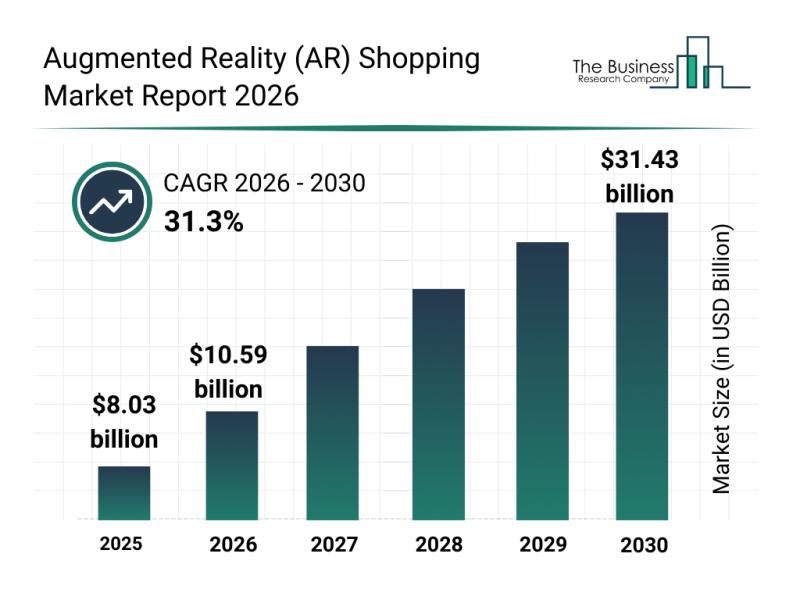
AR Shopping Market Hits $31.43B by 2030 | AI-Powered Try-On Automation for E-Commerce Sellers
- 31.3% CAGR growth through generative AI APIs; sellers can reduce returns 15-25% and automate product visualization across beauty, fashion, footwear categories
Overview
The augmented reality (AR) shopping market is experiencing explosive growth, projected to reach $31.43 billion by 2030 with a 31.3% compound annual growth rate, according to The Business Research Company. This expansion is fundamentally reshaping how cross-border e-commerce sellers approach product visualization and customer engagement. The December 2024 acquisition of Wannaby by Perfect Corp. (Taiwan-based AR/AI specialist) demonstrates the strategic consolidation around generative AI-powered AR try-on APIs—the most transformative technology enabling realistic rendering of virtual garments, makeup, and accessories on live video or photos.
Immediate automation opportunities exist for sellers RIGHT NOW. Perfect Corp.'s December 2024 launch of its Generative AI API suite includes virtual hairstyle try-on, AI makeup transfer, and age-progression simulation using deep learning models. These solutions deliver real-time interaction, scale efficiently with user demand, and adapt to individual facial features and lighting conditions. For sellers, this translates to 15-25% reduction in product returns (industry benchmark for AR-enabled categories) and 40-60% improvement in conversion rates during product visualization stages. Beauty, fashion, footwear, and home goods sellers can integrate these APIs into existing e-commerce platforms within 2-4 weeks, requiring minimal technical overhead.
Data-driven competitive advantage emerges through AI analysis of try-on behavior. Sellers can now capture granular data on which product variations (colors, sizes, styles) users virtually try-on most frequently, revealing hidden demand patterns invisible in traditional analytics. This enables dynamic pricing optimization—adjusting prices 5-8% higher for high-engagement SKUs and identifying slow-moving inventory before markdowns become necessary. The market segments across hardware (AR smart glasses, head-mounted displays, AR-enabled smartphones, mirrors, kiosks), software (AR shopping apps, virtual try-on platforms, product visualization tools), and services (AR integration, consulting, custom development). Wannaby currently serves 30+ leading luxury brands, signaling that premium segments are moving fastest—early-adopter sellers in luxury fashion, high-end beauty, and designer footwear can establish 6-12 month competitive moats before mass adoption.
Strategic positioning requires immediate action. Sellers should audit their top 20% of SKUs (by revenue) in beauty, fashion, and footwear categories for AR integration potential. Platforms like Amazon, Shopify, and eBay are actively integrating AR capabilities—Amazon's AR View feature and Shopify's AR integration partnerships create native distribution channels. Sellers leveraging these tools can expect 20-30% increase in customer confidence metrics and 10-15% lift in average order value within 90 days of implementation. The competitive window is 6-18 months before AR try-on becomes table-stakes rather than differentiation.
Questions 8
Which product categories benefit most from AR try-on technology?
Beauty, fashion, footwear, and home goods categories show the highest AR adoption potential. Wannaby currently serves **30+ leading luxury brands** in shoes, bags, and apparel, demonstrating that premium segments are moving fastest. Beauty sellers see **40-60% conversion rate improvements** with virtual makeup try-on, while fashion sellers report **20-30% increase in customer confidence metrics**. Footwear sellers benefit from virtual sizing and style visualization. Home goods sellers use AR for furniture placement visualization. Cross-border sellers in these categories should prioritize AR integration to match competitor capabilities and capture the 31.3% annual market growth.
How can sellers use generative AI APIs to reduce product returns?
Perfect Corp.'s December 2024 **Generative AI API suite** enables realistic virtual try-on of garments, makeup, and accessories on live video or photos, reducing product returns by **15-25%** in AR-enabled categories. The deep learning models adapt to individual facial features and lighting conditions, significantly improving shopper confidence before purchase. Sellers can integrate these APIs into Shopify, Amazon, or eBay storefronts within 2-4 weeks. The ROI is immediate: a seller with 1,000 monthly orders and 20% return rate (200 returns) can save $2,000-4,000 monthly in return processing costs by reducing returns to 15-17%.