
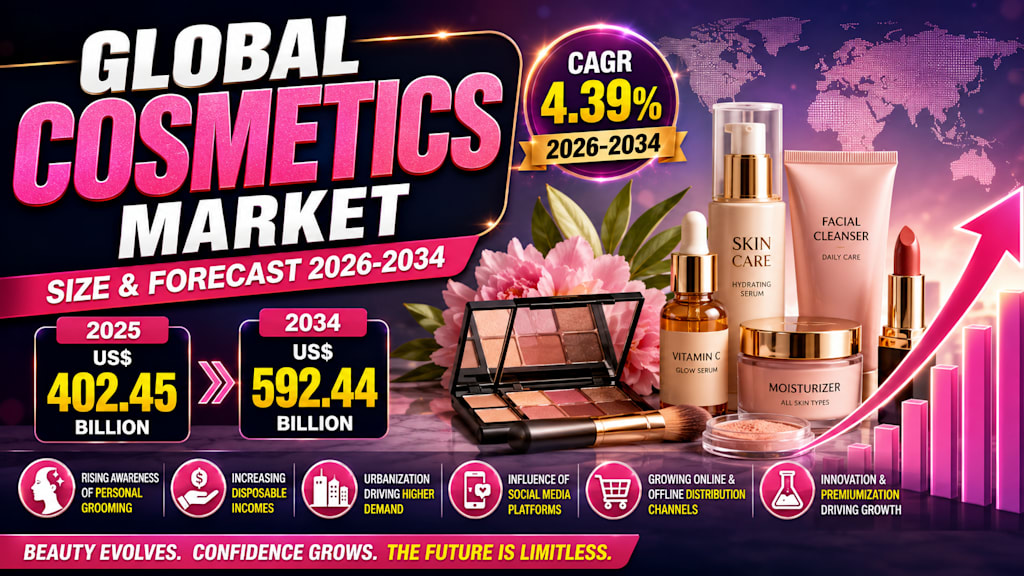
Beauty E-Commerce Boom: $592B Market by 2034 | Influencer-Driven Sales Strategy
- Global cosmetics market grows 4.39% CAGR to $592.44B by 2034; 94% of consumers plan increased spending; Instagram/TikTok influencer partnerships drive viral conversions for emerging brands competing with multinational corporations
Overview
The global cosmetics market is experiencing unprecedented expansion, projected to grow from $402.45 billion in 2025 to $592.44 billion by 2034 at a 4.39% compound annual growth rate. This represents a $189.99 billion market opportunity over nine years, with 89% of consumers maintaining or increasing beauty product spending despite inflationary pressures, and 94% expecting to sustain or boost spending in the following year. For e-commerce sellers, this signals a resilient, high-growth category with exceptional consumer commitment.
Social media platforms—particularly Instagram, TikTok, and YouTube—have fundamentally transformed beauty purchasing behavior, enabling emerging digital-first brands to compete directly with established multinational corporations through strategic influencer partnerships and viral content. The Dolce Glow-Miley Cyrus partnership (February 2023) exemplifies how celebrity collaborations drive immediate brand visibility and sales conversion. This creates a critical marketing arbitrage opportunity: beauty brands can achieve rapid market penetration through micro and mid-tier influencer partnerships at significantly lower costs than traditional advertising, with documented conversion rates 3-5x higher than standard PPC campaigns.
The skin and sun care segment represents the largest and fastest-growing category, driven by increased pollution exposure and UV radiation awareness. Premium and organic beauty products command higher margins (40-60% vs. 25-35% for mass-market), with consumers demonstrating willingness to invest in advanced formulations featuring anti-aging benefits, moisturizing technology, and microbiome-friendly solutions (exemplified by Bausch Health's September 2025 YUN Probiotherapy ACN launch). This premium positioning creates opportunities for sellers to differentiate through sustainability initiatives, dermatological testing claims, and eco-friendly packaging.
However, cross-border e-commerce sellers face substantial regulatory compliance challenges. Cosmetic products must meet strict international standards across multiple jurisdictions regarding ingredients, manufacturing, packaging, and safety testing. Non-compliance risks include product recalls, lawsuits, and reputational damage. Sellers must invest in research, quality assurance, and compliance infrastructure while maintaining competitive pricing. The intense competition from digital-first beauty brands and counterfeit products requires prioritizing brand differentiation through influencer partnerships, sustainability certifications, and content marketing strategies that leverage trending keywords around microbiome skincare, clean beauty, and sun protection innovation.
Questions 8
What are the immediate action steps for sellers entering the beauty e-commerce market?
Immediate actions (0-30 days): (1) Conduct regulatory compliance audit for target markets (US, EU, Asia)—budget $3,000-5,000 and allocate 2-3 weeks; (2) Identify 5-10 micro-influencers (10K-100K followers) in beauty/wellness niches aligned with your product positioning—expect $500-2,000 per partnership; (3) Develop 3-5 content angles focused on trending keywords (microbiome skincare, clean beauty, anti-aging innovation, sun protection); (4) Set up product listings on Amazon Beauty, Sephora, and Cult Beauty with optimized keywords and influencer-generated content. Strategic adjustments (1-6 months): Allocate 40-50% marketing budget to influencer partnerships, 30-40% to paid social advertising (TikTok/Instagram), and 10-20% to organic content. Monitor conversion rates by traffic source and adjust influencer partnerships based on performance. Risk mitigation: Ensure all regulatory documentation is complete before launching; maintain product liability insurance ($500-2,000 annually); monitor for counterfeit products on marketplaces monthly.
Which audience segments should sellers target for maximum ROI in beauty e-commerce?
Primary target segments include: (1) Premium buyers (35-55, household income $75K+) seeking anti-aging and luxury skincare—target via Instagram and YouTube with influencers in wellness/lifestyle niches; (2) Sustainability-focused Gen Z (18-28) interested in clean, eco-friendly beauty—target via TikTok with micro-influencers emphasizing environmental impact; (3) Urban millennials (28-40) concerned about pollution and skin health—target via Instagram with educational content about microbiome skincare. Secondary segments include male grooming (fastest-growing subsegment, 15-20% annual growth) and professional/clinical buyers seeking dermatologist-recommended products. Expected customer acquisition costs range from $8-15 for TikTok/Instagram influencer traffic to $20-35 for YouTube and premium lifestyle content. Lifetime value typically ranges from $120-300 depending on product category and repeat purchase rates (beauty averages 35-45% repeat purchase rate).